
Many people come to the ocean with a simple hope: to encounter a particular marine animal. A whale shark, a manta ray, a large school of fish, or perhaps that rare moment when the sea feels truly alive. When it happens, we call it luck. When it does not, we often attribute the failure to the wrong season.
In reality, the ocean has never operated according to the human calendar.
The ocean moves to a rhythm. This rhythm is shaped by currents, temperature, sunlight, and microscopic life that we never see from the surface. Marine species do not arrive and disappear to satisfy travellers. They move because the ocean changes, and those changes are what sustain their lives.
Understanding this rhythm transforms the way we experience the sea. Encounters with marine life no longer feel accidental, but instead emerge as the outcome of complex and beautiful ecological processes. When we begin to see the ocean this way, every journey becomes more meaningful. It is no longer just about what appears, but about why it happens.
The Ocean Has Seasons Too
On land, seasons are easy to recognise. Rain and dry periods, autumn and spring, cold and heat. In the ocean, seasons operate far more subtly, yet their impact is profound.
A single factor does not drive ocean seasons. They emerge from several interconnected systems working together:
- monsoon systems,
- global ocean currents,
- changes in water temperature and water column structure,
- upwelling and downwelling processes.
Each of these systems shapes the ocean’s rhythm in its own way.
Monsoon systems alter wind direction and strength on a large scale. These shifts drive changes in surface currents, influence water mass movement, and determine which areas become more productive at certain times.
Global ocean currents function as pathways for energy distribution. They move warm and cold water between regions, transporting nutrients, plankton, and small organisms that form the foundation of marine food webs.
Changes in water temperature create layers within the water column, including thermoclines. For many marine species, these layers define physiological comfort zones where they can move, feed, and conserve energy.
Upwelling and downwelling regulate the vertical movement of nutrients. When nutrients are lifted towards the surface, productivity increases and marine life becomes more active. When these processes weaken, ecosystem energy often settles into a quieter state.
Unlike terrestrial seasons, which can be defined by dates, ocean seasons resemble waves of energy. There are periods when the sea is highly productive, rich in food and biological activity, and times when its rhythm slows. Marine species follow these dynamics not by choice, but because it is the only way to survive in an ever-moving environment.
Read Also: Indonesia Diving Season and Best Time to Dive in Komodo
How Do You Encounter Seasonal Marine Animals?
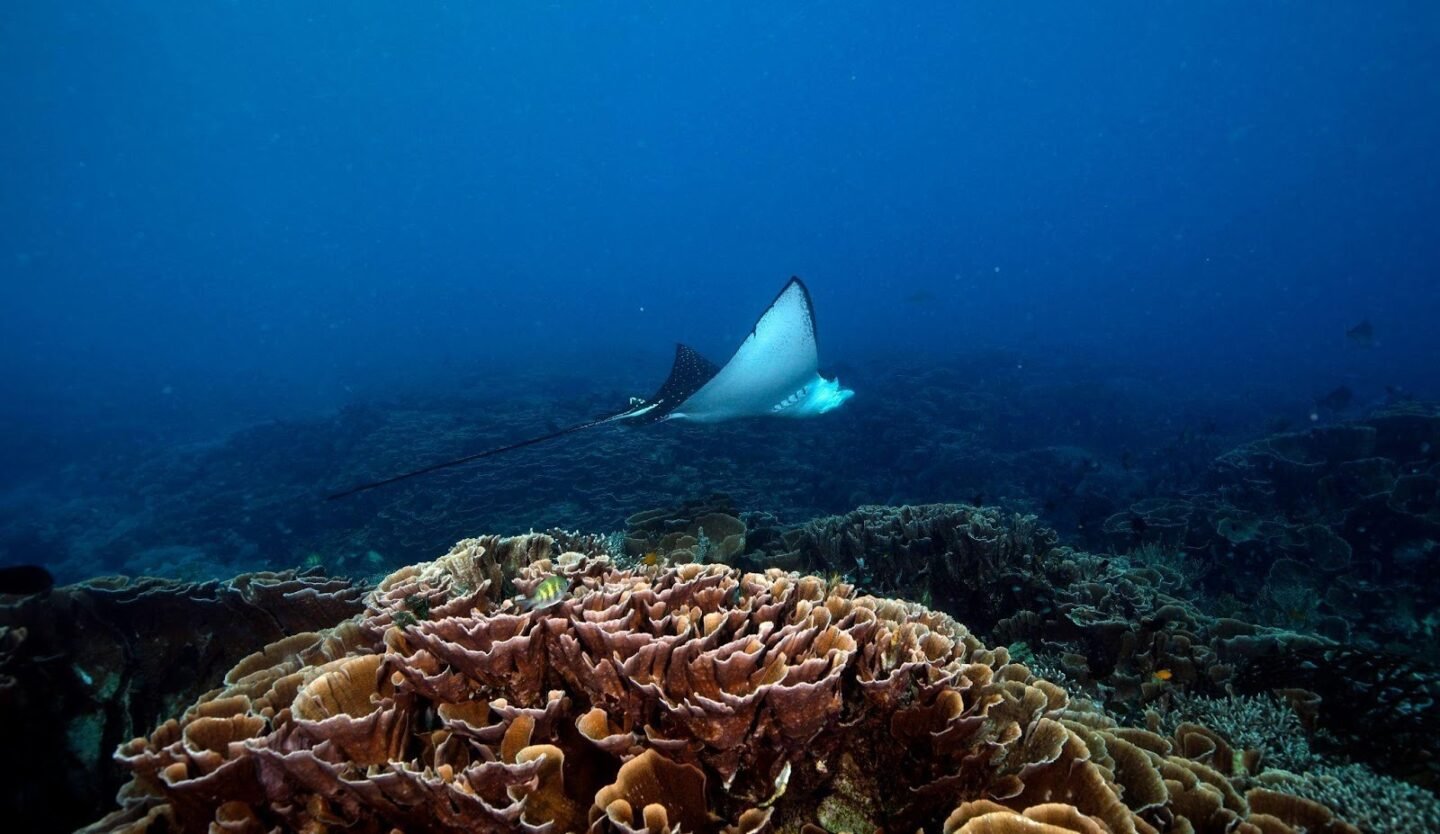
Encountering seasonal marine animals is not about being in the right place during the right month. It is about being present when ecosystem conditions permit it. Four main factors explain why marine animals appear seasonally in certain regions.
Food Comes First: Following Plankton Blooms
At the base of every marine food chain lies a group of organisms that often goes unnoticed: plankton. When ocean conditions such as light, nutrients, and temperature align, plankton multiply rapidly in what is known as a plankton bloom.
These blooms attract zooplankton, then small fish, and eventually large predators. This is why whale sharks, manta rays, and pelagic fish schools appear during specific periods. They do not follow calendars. They follow food.
When blooms end, and plankton disperses or declines, the food web shifts with it. Large animals do not disappear. They simply continue their journey to other areas where the ocean is active.
Breeding, Birthing, and Nursery Grounds
Many marine species visit certain locations not to feed, but to reproduce. Some areas function as mating grounds, birthing sites, or nursery habitats.
These processes are highly sensitive. Water temperature, stable currents, and low disturbance levels are critical factors. As a result, seasonal presence often corresponds to essential life stages that are not always visible to observers.
Temperature and Water Quality Matter
Every species has a comfort range. Small changes in temperature, oxygen levels, or water clarity can make an area temporarily suitable or unsuitable.
Features such as thermoclines create layers of different temperatures. For divers, this may feel like a sudden drop in warmth. For marine animals, it represents a physiological boundary that determines where they can swim efficiently and safely.
Safety from Predators and Extreme Conditions
Certain seasons bring very strong currents or intense biological activity. Under these conditions, some species move away to conserve energy or reduce risk. An ocean that is too energetic for one species may become unfavourable for another.
Seasonal Visitors and Year-Round Residents
Not all marine life moves seasonally. Many species remain year-round, particularly within stable coral reef ecosystems. Seasonal visitors, by contrast, appear when specific conditions are met. They arrive, take advantage of the moment, and then move on.
| Category | Example Marine Species | Presence Pattern | Distinctive Features and Appeal |
| Year-Round Residents | Small reef fish (clownfish, damselfish) | Present year-round | Strong contrasting colours and sharp patterns that stand out among corals; fast, expressive movements that keep reefs constantly vibrant |
| Invertebrates (shrimp, crabs, starfish) | Present year-round | Intricate and symmetrical body details; unique textures ranging from transparent and feathery to finely spined, a form of beauty often revealed only through close observation | |
| Certain nudibranch species | Present year-round (locally) | Extreme shapes and colours resembling abstract art: neon tones, layered lines, and petal-like cerata that move slowly through the water | |
| Seasonal Visitors | Manta rays | Appear when plankton conditions are optimal | Broad, wing-like bodies with unique belly patterns; graceful movements that give the impression of flying underwater |
| Whale sharks | Arrive during plankton blooms. | Massive size combined with calm movement; distinctive white spot patterns unique to each individual | |
| Pelagic fish (trevally, tuna) | Seasonal, following baitfish | Metallic sheen reflecting light; tight, dynamic schooling formations full of energy. | |
| Certain shark species | Appear when energy and food conditions are favourable | Streamlined silhouettes and efficient movement; a calm yet powerful presence often sensed before it is clearly seen |
Where Seasonal Marine Encounters Happen
Certain regions around the world are known for seasonal marine life encounters. This is not by chance but rather due to their ecological characteristics.
These areas are typically located along:
- natural migration routes,
- nutrient-rich upwelling zones,
- major current convergence points,
- regions with consistent seasonal plankton productivity.
Such conditions create stages where different species appear at specific times, then fade as ocean dynamics shift.
Seasonal Marine Visitors in Komodo National Park
Komodo is not a calm marine destination. It is an ecosystem driven by currents and pelagic movement, where water masses from the Indian and Pacific Oceans meet, exchange, and generate constantly shifting energy. Strong currents are not merely a defining feature of Komodo. They are the primary engine that determines which species arrive and when.
Under certain conditions, whale sharks may pass through while following food concentrations that form along current pathways. Manta rays frequently appear when currents deliver large amounts of plankton into specific areas, creating intense but temporary feeding events. At the same time, pelagic fish such as trevally and tuna exploit concentrated baitfish, whereas occasional sharks appear when energy flow and the food chain peak.
Seasonal Marine Visitors in Raja Ampat
Raja Ampat is often described as being alive year-round, and this is accurate. The richness of Raja Ampat’s marine environment is driven by something very specific: biodiversity fuelled by plankton. The region lies at the heart of the Coral Triangle, with micro- and macro-current systems that consistently transport nutrients into both shallow and deeper waters.
Under certain conditions, when Raja Ampat’s plankton system reaches its peak, manta rays gather for feeding and cleaning. This high productivity also triggers large schools of fish to move in synchrony, creating underwater scenes that appear denser and more active. Meanwhile, spawning events take place out of sight. They are rarely observed directly, yet they are crucial for ecosystem regeneration and the long-term persistence of marine life in the region.
Raja Ampat is always rich. At certain times, however, that richness reaches a different level of biological intensity. It becomes more concentrated, more vibrant, and more dynamic when plankton, currents, and light align in perfect balance.
Read Also: Diving with Mantas: Komodo vs. Raja Ampat
Seasonal Marine Visitors in the Maldives
In the Maldives, marine life movement is strongly influenced by monsoon systems. Wind direction and currents determine which side of an atoll becomes the centre of activity.
During certain phases, whale sharks arrive to feed, while manta rays gather at cleaning stations or feeding aggregations. When the season shifts, activity moves to a different side of the atoll.
The animals do not disappear.
The stage moves.
Verdict: When You Follow the Rhythm, the Ocean Gives More
Every month, the ocean is alive. What changes is not its existence, but how that life reveals itself. Sometimes it appears through dramatic large-animal encounters. At other times, it is found in quiet details. Both are equally valuable.
This is why two people can visit the same location at nearly the same time and return with entirely different stories. Understanding ocean seasons is not about lowering expectations. It is about expanding how we experience the sea. When we begin to follow natural rhythms, each journey becomes a process of observation. Watching how currents move, how life gathers, and how the ocean regulates itself without human intervention.
For travellers and divers who wish to experience the ocean this way, La Galigo Liveaboard is designed for long-range voyages with a calm pace, routes that follow ocean dynamics, and an approach that respects natural processes rather than forcing outcomes.
When a journey allows space to adapt to conditions, any encounter that occurs feels more complete. It is often there that the most meaningful ocean experiences are found.
FAQ
What are seasonal marine species?
Seasonal marine species are animals that do not remain in one location throughout the year. They appear when ocean conditions, such as food availability, currents, and temperature, support their biological needs, and they move on when those conditions change.
Does “seasonal” mean they can only be observed in specific months?
Not necessarily. Seasonal refers to ocean conditions rather than dates. In some years, ideal conditions may arrive earlier, later, or last for shorter periods than the general pattern.
Why did I not see large animals while diving? Was the ocean empty?
No. The ocean is almost never empty. When large animals are not visible, life is often active on a smaller scale, within reefs, sandy areas, or different water layers beyond the dive zone.
Do liveaboards increase the chances of seeing seasonal marine life?
Liveaboards allow journeys to follow ocean conditions across wider areas. This flexibility enables routes to adapt to marine dynamics rather than fixed land-based schedules.
Are seasonal encounters safe for marine animals?
They can be, when approached responsibly. Respecting distance, avoiding disturbance of natural behaviour, and choosing operators who understand ocean rhythms are essential for maintaining ecological balance.
Does stronger current always mean more marine life?
Not always, but often. Strong currents can deliver nutrients and plankton that energise the food web. However, extremely intense currents may temporarily displace certain species or push activity into deeper or sheltered areas. What matters is not just current strength, but how it interacts with topography, water temperature, and food availability.
Can seasonal marine life patterns change from year to year?
Yes. While general seasonal patterns exist, ocean systems are dynamic. Variations in monsoon strength, current intensity, water temperature, and plankton productivity can shift timing and intensity from one year to another. This is why long-term averages are useful for understanding trends, but real-time ocean conditions ultimately determine marine activity.
References
Talley, L. D., Pickard, G. L., Emery, W. J., & Swift, J. H. (2011). Descriptive physical oceanography: An introduction (6th ed.). Academic Press.
Behrenfeld, M. J., & Falkowski, P. G. (1997). Photosynthetic rates derived from satellite-based chlorophyll concentration. Limnology and Oceanography, 42(1), 1–20.
Sims, D. W., Witt, M. J., Richardson, A. J., Southall, E. J., & Metcalfe, J. D. (2006). Encounter the success of free-ranging marine predators. Marine Ecology Progress Series, 311, 283–293.
Couturier, L. I. E., Marshall, A. D., Jaine, F. R. A., et al. (2012). Biology, ecology and conservation of the Mobulidae. Journal of Fish Biology, 80(5), 1075–1119.
Sale, P. F. (2002). Coral reef fishes: Dynamics and diversity in a complex ecosystem. Academic Press.