
Sample Itinerary
Dive more, Experience More
9 Days / 8 Nights
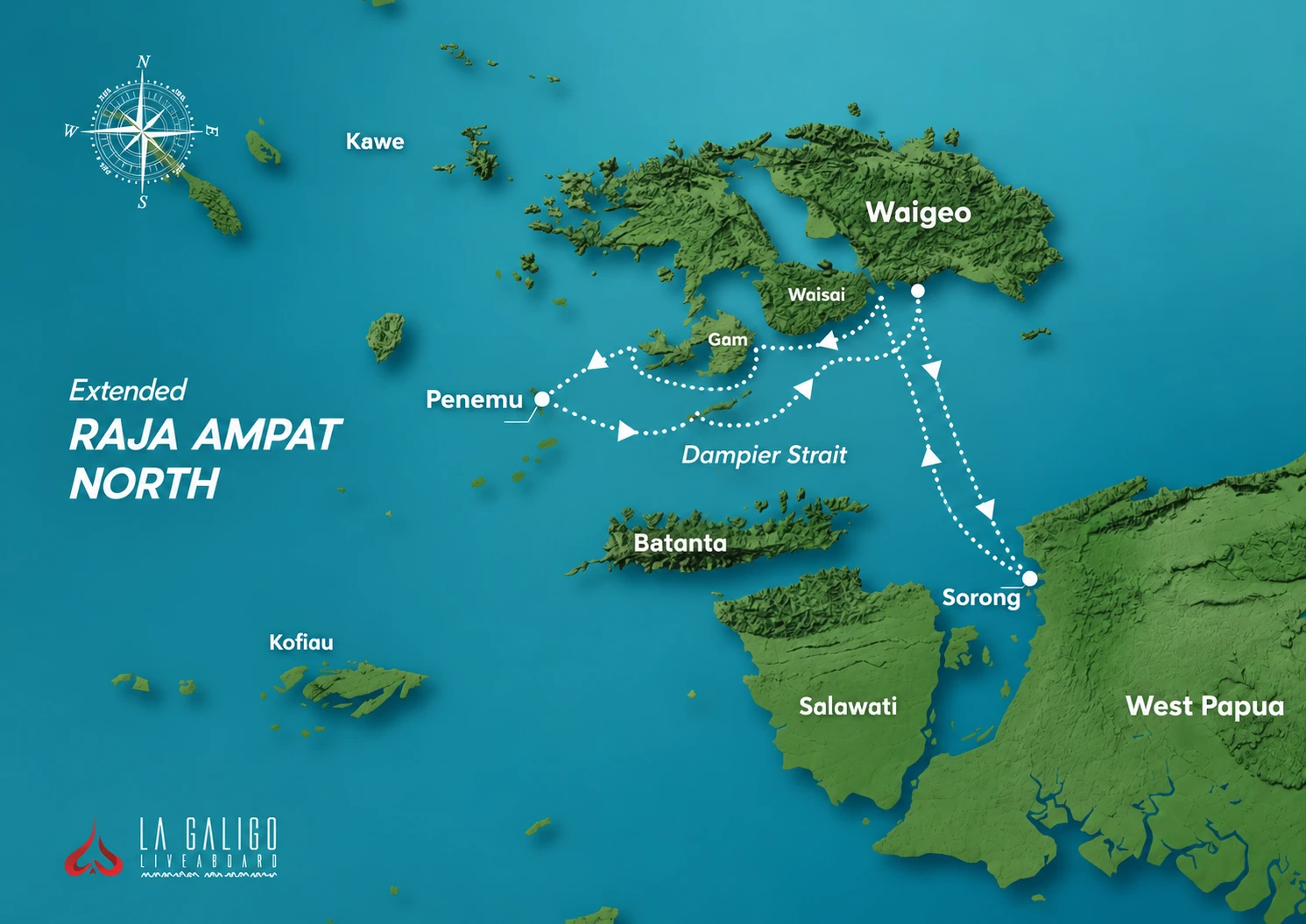
Please Note: La Galigo does not guarantee this outlined itinerary, and it is to be considered as a rough guideline. Information compiled here is based on past trips we have conducted, and includes common dive sites and routes we often visit. Weather and sea conditions in the area can be unpredictable, and La Galigo retains the right to alter an itinerary from advice of the shipʼs captain, cruise director, or owner for the safety of the vessel, its passenger and crew.
The above rates are per person per trip and subject to change. Please note these fees are in line with third party supplier costs.
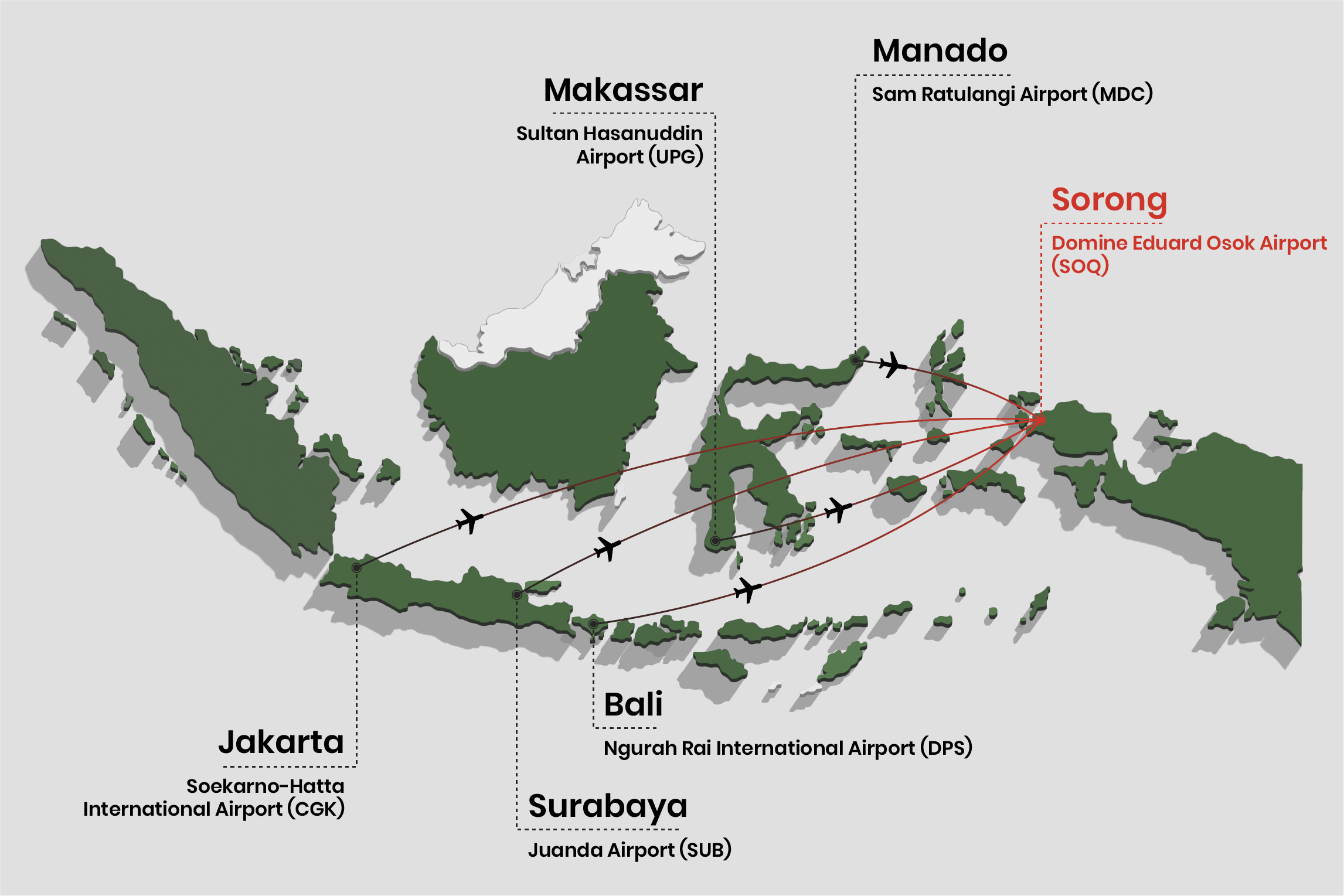
The remote paradise of Raja Ampat lies in the far reaches of eastern Indonesia. So, how do you get there? Your journey begins with an international flight into Indonesia, followed by a domestic flight to Domine Eduard Osok Airport in Sorong (SOQ).
As the largest city and capital of Southwest Papua, Sorong serves as the main gateway for liveaboard dive boats exploring Raja Ampat. Though getting to this secluded paradise requires a bit of extra time and preparation, the rewards are well worth the effort.
Raja Ampat stands as Indonesia’s crown jewel, known for its remarkable biodiversity, awe-inspiring landscapes, and some of the finest dive sites on the planet.
Indonesia offers multiple international airports throughout its archipelago. Most international visitors typically arrive via Jakarta or Bali, as both airports provide direct domestic flights to Sorong.
Welcome aboard La Galigo in Sorong, where your Raja Ampat adventure begins. Settle into your cabin, meet the crew and get acquainted with your home for the next eight nights. Our welcome and dive briefings introduce life aboard, with time to discuss your equipment, experience and underwater interests with the team.
Saonek Kecil provides our first opportunity to get into the water. This opening dive allows you to check your weighting, fine-tune your buoyancy and get comfortable with your equipment before the fuller diving days ahead. Take your time, settle into the surroundings and enjoy those first discoveries alongside your guide and dive buddies.
Back aboard, the island scenery provides a fitting introduction to the journey. With your equipment ready and the first dive logged, relax on deck, exchange stories with your fellow guests and look forward to exploring the reefs, mangrove-fringed islands and marine life that make Raja Ampat so compelling.
Mioskon opens our first full diving day with coral-covered bommies, schooling snapper and the possibility of a beautifully camouflaged wobbegong. Look carefully beneath the reefs ledges without disturbing resting animals; their intricate markings can make them surprisingly difficult to distinguish from their surroundings. Chicken Reef follows, shifting our attention between the reef and the fish moving above it.
At Sawandarek, turtles, sweetlips and gathering schools are among the attractions. Allow time to appreciate their behaviour as well as the scenery: a turtle feeding or fish pausing at a cleaning station can be just as memorable as a larger passing visitor.
After dark, we return to Sawandarek for a different perspective. Torchlight draws our attention to the smaller details as daytime residents shelter and nocturnal animals become active. Exploring the same area by day and night reveals how much changes beneath the surfaceand gives photographers an entirely new set of subjects to search for.
Mayhem starts the day with the fish-filled activity that makes Raja Ampats current-swept reefs so rewarding. Watch the schools change shape as larger fish move through, while our guides plan the dive around the conditions. There is plenty to absorb, both along the reef and in the surrounding water.
Mangrove Ridge introduces a striking meeting of marine and coastal habitats, where reef life extends towards the forest-lined shoreline. Citrus Ridge then changes the palette with its characteristic orange and yellow soft corals. Their colour and texture create a beautiful backdrop for passing fish, offering plenty of inspiration for wide-angle photographers.
As evening settles over Gam Bay, we prepare for a night dive. The focus becomes smaller and more deliberate, searching for movement among the reefs shadows and crevices. From schooling fish to mangrove scenery and the discoveries made by torchlight, today captures several very different sides of Raja Ampat
Yefnabi and Yeben Reef begin a day of varied reef exploration. Follow the changing underwater contours, watching the surrounding fish while allowing time for the smaller residents. Our guides assess the conditions, helping you balance the wider scene with details that are easily missed when something larger catches your attention.
Batu Rufus adds distinctive scenery, with a sheltered lagoon and contrasting coral-lined slopes and walls. Galaxy Jetty completes the diving, offering another opportunity for patient observation and photography.
Above water, a trek to Piaynemos viewpoint delivers one of Raja Ampats most recognisable panoramas. Follow the steps through the islands greenery before emerging above a maze of forested limestone islets and turquoise lagoons. Take your time on the climbthe view is worth pausing for, and not only through a camera lens. After exploring the reefs below, seeing this island landscape from above brings a rewarding new perspective to the journey.
My Reef opens the day with abundant fish life and the possibility of passing reef sharks. Keep your attention moving between the reef and the blue, where gathering schools can suddenly shift as a predator approaches. It is an engaging introduction to a day that combines fish activity with some exceptional underwater scenery.
Melissas Garden follows with one of Raja Ampats signature sights: an expansive hard-coral garden alive with small reef fish. Branching colonies create intricate shelter beneath you, while clouds of fish rise and retreat above them. Careful buoyancy allows you to appreciate the detail without touching the delicate coral.
Keruo Channel brings a change of perspective, with wall and slope scenery explored according to the movement of the water. Keruo Bay completes the days diving, offering further time to discover the reefs smaller residents. Above water, the surrounding islands provide an equally inviting backdrop as we relax aboard and reflect on the days highlights.
Arborek Jetty begins the day with a photogenic combination of schooling fish and marine growth around its supporting pillars. Watch how the fish gather beneath the structure, with shifting light adding another dimension to the scene. It is a rewarding setting for both wider compositions and closer observation.
Manta Sandy offers the possibility of one of Raja Ampats most sought-after encounters. At this recognised cleaning station, visiting mantas hover and circle while cleaner fish attend to them. We follow the sites viewing rules and give the rays room to approach naturally. Sightings are never guaranteed, but observing their behaviour can become a defining memory of the trip.
Mikes Point then introduces contrasting reef contours, overhangs and coral gardens, with our route shaped by the conditions. Batu Lima rounds out the day, completing a varied sequence that moves from jetty life and potential manta encounters to the intricate scenery of the Dampier Straits reefs.
Cape Kri opens a day featuring some of the Dampier Straits best-known diving. Its extraordinary fish diversity rewards looking in every direction, from gathering schools along the reef edge to smaller residents among the coral. Rather than chasing individual sightings, pause and appreciate how much life shares the same stretch of reef.
Blue Magics submerged pinnacle shifts our attention towards schooling fish and hunting pelagics, with the possibility of an oceanic manta making an appearance. Keep an eye beyond the immediate reef: some of the most memorable encounters begin as a distant shape approaching through the blue.
Sardines Reef continues the fish-filled spectacle before Sapokren completes our diving day. This final stop offers another opportunity to slow down and look closely after the wider action of the earlier dives. Back aboard, compare photographs and favourite encounters on a day with so many celebrated sites, choosing a single highlight may prove difficult.
We return to Mikes Point for another opportunity to explore its varied underwater landscape. Changing conditions and fish activity can make a familiar site feel entirely different, while a second visit gives you time to notice details missed the first time around. Our guides shape the dive around the conditions as we begin our final morning underwater.
Mioskon provides a fitting last dive, returning us to its coral gardens, schooling snapper and the search for camouflaged wobbegongs. Savour the reef, capture those final underwater photographs and enjoy one more dive alongside the team who have shared the journey with you.
Then we trade coral reefs for rainforest with a visit to Kali Biru, Raja Ampats beautiful Blue River. Its clear turquoise water and lush surroundings offer a refreshing change of scenery. Enjoy the peaceful setting before La Galigo heads back towards Sorong for our final night aboard, with plenty of stories to share along the way.
After breakfast, it’s time to say goodbye. Transfers are arranged for the airport or local hotels. Disembarkation is available from 07:00, and guests with later onward plans are welcome to stay onboard until 11:00. Guests leave with photos, stories, and memories of incredible reefs, manta encounters, and limestone landscapes. For many, its not a farewell, but a promise to return to Raja Ampat and La Galigo once again.
La Galigo does not guarantee this outlined itinerary, and it is to be considered as a rough guideline. Information compiled here is based on past trips we have conducted, and includes common dive sites and routes we often visit. Weather and sea conditions in the area can be unpredictable, and La Galigo retains the right to alter an itinerary from advice of the shipʼs captain, cruise director, or owner for the safety of the vessel, its passenger and crew.