
For many divers and ocean travellers, encounters with abundant marine life often feel like luck. One day, the sea appears vibrant, full of fish, turtles, manta rays, and even sharks. On another day, in the very same location, the ocean feels quiet and empty.
Yet behind these contrasts, very little is truly accidental.
The factor that most often determines whether a location becomes a marine life hotspot is ocean currents. These are not simply moving water masses, but natural systems that regulate the distribution of food, energy, and life in the sea.
This article explores why moving water so often becomes the centre of marine life, how currents shape the behaviour of marine animals, and why destinations such as Raja Ampat are a global diver’s dream, not by chance, but because of their currents.
Why the World’s Best Marine Encounters Happen Where Water Moves
If we examine maps of the world’s best dive sites, from tropical coral reefs to subtropical waters, one pattern consistently emerges. These locations are characterised by active water movement.
Moving water means:
- nutrients are continuously replenished,
- oxygen is well distributed,
- food does not stagnate in one place.
By contrast, waters that are too calm tend to lose energy quickly. Without fresh input, plankton declines, food webs weaken, and biodiversity decreases.
For marine life, currents are not a disturbance. Currents are a source of life.
How Ocean Currents Turn Ordinary Seas into Marine Life Hotspots
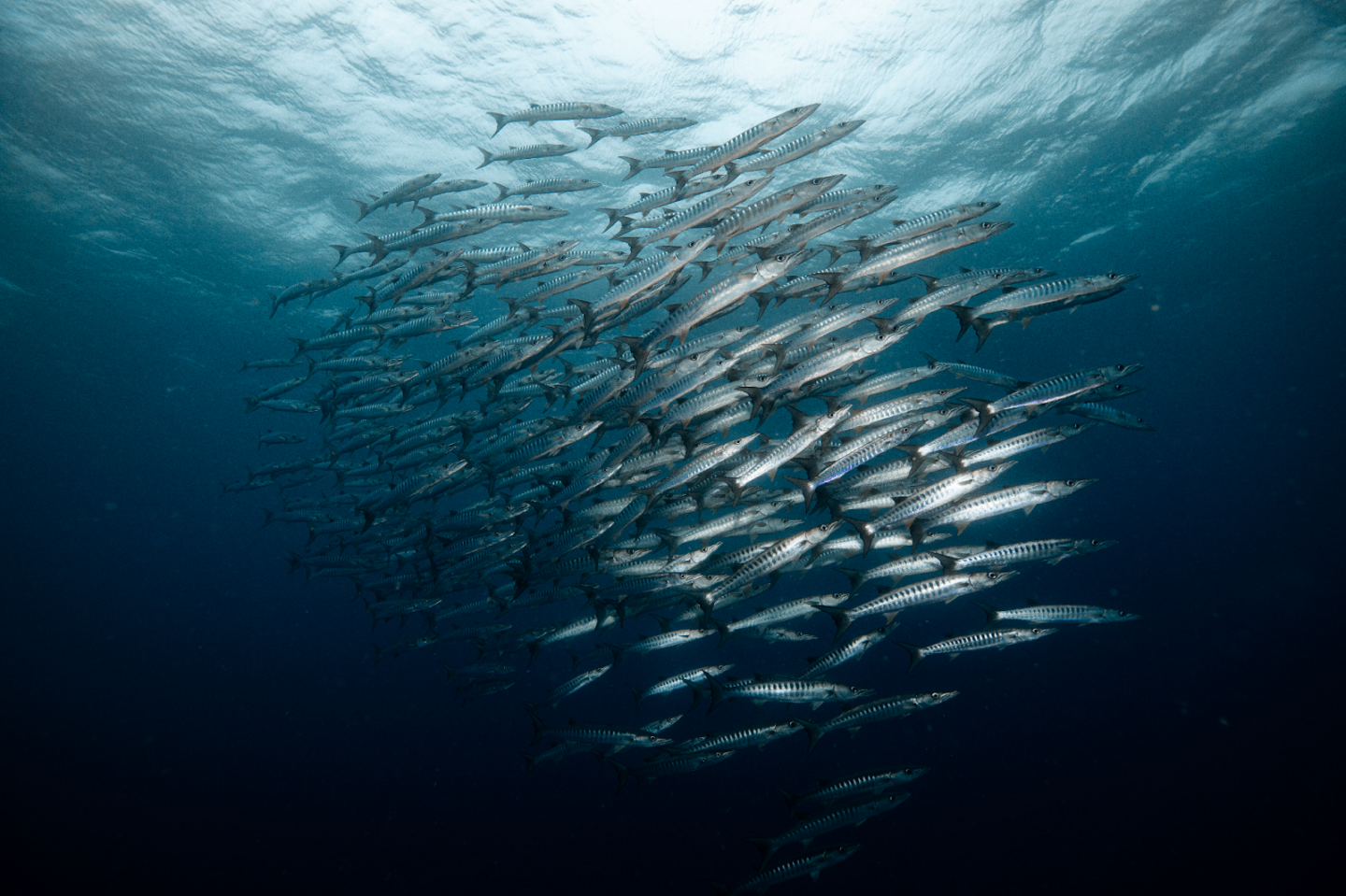
Ocean currents function like a natural logistics system. They transport nutrients from deeper waters, spread them into shallower zones, and maintain ecosystem productivity.
An ordinary area can become a hotspot when:
- currents carry nutrients upward from the seabed,
- converging currents concentrate plankton,
- reef structures break currents and create feeding zones.
It is at these points that marine life gathers. Not because the place is visually attractive, but because energy is consistently available.
From Nutrients to Predators: How Currents Power the Marine Food Chain
Ocean currents drive the food chain from the smallest organisms to the largest predators. This process is continuous and interconnected.
Nutrient Delivery and Plankton Blooms
Currents transport nutrients such as nitrogen and phosphate from deeper waters into the upper layers of the ocean. These nutrients trigger plankton growth, forming the foundation of nearly all marine life.
Plankton blooms are a sign of healthy waters. In areas with active currents, these blooms occur repeatedly rather than as brief seasonal events.
Why Small Life Attracts Big Life
Plankton attracts zooplankton, which then attracts small fish, followed by larger fish. In a short time, a single area can become a centre of biological activity.
Large animals such as manta rays, whale sharks, and tuna are not searching for beautiful scenery. They seek energy efficiency, which is found where food is abundant.
Read Also: What Animals Eat Manta Rays?
Energy Efficiency: Why Animals Choose Moving Water
Swimming against currents requires effort, but the reward is worth it. In current-rich areas, marine animals do not need to travel far to feed. The energy expended is lower than the energy gained.
For this reason, many species choose to remain within specific current pathways, following the rhythm of the ocean rather than moving randomly.
Why Marine Animals Follow Currents
Marine animals do not recognise maps, coordinates, or administrative boundaries. What they respond to are water patterns.
Migration routes, feeding grounds, and breeding areas often follow:
- changes in current direction,
- the intensity of water movement,
- seasonal food availability.
This explains why the same location can feel extraordinary at one time and unremarkable at another. Marine life follows currents, not human schedules.
What Diving in Current-Rich Areas Feels Like and Why It Is Worth It
Diving in areas with strong currents is often considered challenging. For many experienced divers, however, these conditions offer the most rewarding experiences.
Common characteristics of current-rich dives include:
- large numbers of fish swimming into the flow,
- reefs that appear healthier and more colourful,
- more frequent encounters with large species.
With proper technique and careful planning, currents are not an obstacle. They are the main stage on which marine life thrives.
Read Also: Indonesia Diving Season and Best Time to Dive in Komodo
Why Powerful Currents Make Raja Ampat One of the World’s Ultimate Marine Destinations
Few places in the world combine ocean currents, reef structure, and biodiversity as harmoniously as Raja Ampat. Its uniqueness lies not only in the number of species present, but in its highly strategic geographic position within regional ocean circulation, at the heart of the Coral Triangle. This region encompasses the waters of Indonesia, the Philippines, Malaysia, Papua New Guinea, the Solomon Islands, and Timor-Leste. It is here that major currents from different oceans converge, mix, and deliver life-sustaining energy into marine ecosystems.
Situated at the centre of this system, Raja Ampat becomes a meeting point for currents flowing from multiple directions. These currents do not simply pass through. They interact intensely with hundreds of islands and complex reef structures. Raja Ampat is surrounded by deep seas, narrow straits, headlands, and natural channels that act like funnels, accelerating and concentrating water flow. When currents meet reef walls, steep slopes, and uneven seabeds, water energy is disrupted and lifted upward, carrying nutrients from the deep into shallow waters.
The currents in this region:
- continuously supply fresh nutrients to coral reefs,
- maintain productivity throughout the year rather than seasonally,
- create natural feeding hotspots for many species.
The combination of consistent currents and marine structures that effectively trap nutrients makes Raja Ampat an ideal environment for plankton growth. From this foundation, the marine food chain operates efficiently. Plankton attracts small fish, small fish draw in predators, and large species adopt the area as a regular feeding route.
This explains why marine life in Raja Ampat feels dense, diverse, and stable within a relatively compact area. For divers and ocean travellers, this translates into repeated, reliable encounters with marine life rather than rare, chance encounters.
Raja Ampat is not only visually stunning. It functions with remarkable ecological efficiency. At the core of this system, ocean currents act as the engine that keeps it alive.
Why Marine Life Hotspots Shift with Seasons and Currents
Marine hotspots do not remain fixed throughout the year. Seasonal changes influence current direction and strength, which, in turn, shift the centres of marine activity.
Understanding this dynamic helps travellers to:
- choose the most suitable time to visit,
- manage diving expectations,
- appreciate the natural rhythm of the ocean.
Rather than viewing these changes as uncertainty, many divers regard them as part of the appeal of a living, dynamic sea.
Follow the Current, and You Will Find Life
In the ocean, life always follows energy, and that energy moves with the currents.
For anyone who loves the sea, whether divers, snorkellers, or travellers, understanding currents means understanding why certain places feel so alive. Not by chance, but because the ocean operates according to its own rhythm.
With La Galigo Liveaboard, you are invited not simply to visit Raja Ampat, but to experience the ocean as it should be experienced. By following currents, reading seasons, and exploring in harmony with nature. Each journey is designed to bring guests to locations where marine life truly gathers, using an approach that is safe, responsible, and deeply respectful of the ecosystem.
Follow the current.
Let the sea show you where to go.
And discover life, in its most honest and extraordinary form, with La Galigo Liveaboard.
FAQ
Why do locations with strong currents have more marine life?
Because currents transport food. Active currents lift nutrients from deep waters into shallow zones, triggering plankton growth. Plankton attracts small fish, which in turn attract predators, thereby forming marine life hotspots.
Are ocean currents dangerous for divers?
Not necessarily. Currents can be challenging, but with proper planning, thorough briefings, and experienced guidance, diving in current-rich areas is often safer and far more rewarding. Many of the world’s best dive sites are located in areas with strong currents.
Why are the currents in Raja Ampat so productive?
Because of its unique geographic position. Raja Ampat lies at the heart of the Coral Triangle, where currents from different oceans converge. Hundreds of islands, narrow straits, and reef structures concentrate these currents, allowing nutrients to accumulate in relatively small areas.
Is marine life in Raja Ampat only abundant during certain seasons?
No. Although there are seasonal variations, currents in Raja Ampat remain relatively consistent throughout the year, meaning marine productivity does not depend on a short seasonal window. This is why marine encounters in Raja Ampat tend to be more stable than in many other destinations.
References
Allen, G. R., & Erdmann, M. V. (2012). Reef fishes of the East Indies. Tropical Reef Research.
Asaad, I., Lundquist, C. J., Erdmann, M. V., & Costello, M. J. (2018). An assessment of the distribution and conservation status of reef fishes in the Coral Triangle. Marine Policy, 94, 23–33.
Carpenter, K. E., Barber, P. H., Crandall, E. D., Ablan-Lagman, M. C. A., Ambariyanto, et al. (2011). Comparative phylogeography of the Coral Triangle and implications for marine management. Journal of Marine Biology, 2011, 1–14.
Hughes, T. P., Bellwood, D. R., Folke, C., Steneck, R. S., & Wilson, J. (2005). New paradigms for supporting the resilience of marine ecosystems. Trends in Ecology & Evolution, 20(7), 380–386.
Kleypas, J. A., McManus, J. W., & Meñez, L. A. B. (1999). Environmental limits to coral reef development: Where do we draw the line? American Zoologist, 39(1), 146–159.
Rudnick, D. L., & Gordon, A. L. (1996). The Indonesian Throughflow: Transport and mixing. Journal of Geophysical Research: Oceans, 101(C5), 12283–12300.
Spalding, M. D., Fox, H. E., Allen, G. R., Davidson, N., Ferdaña, Z. A., et al. (2007). Marine ecoregions of the world: A bioregionalisation of coastal and shelf areas. BioScience, 57(7), 573–583.
Veron, J. E. N., DeVantier, L. M., Turak, E., Green, A. L., Kininmonth, S., et al. (2009). Delineating the Coral Triangle. Galaxea, Journal of Coral Reef Studies, 11(2), 91–100.