
Amid the global coral reef crisis, from ocean warming and mass bleaching to escalating human pressure, the name Raja Ampat almost always emerges as an exception. Numerous scientific reports, research expeditions, and field observations place it among the healthiest coral reef systems in the world today.
But how “healthy” are Raja Ampat’s reefs when compared with other regions? Is this reputation merely about visual beauty and species richness, or does it genuinely reflect an ecologically intact and functioning ecosystem?
This article examines the health of Raja Ampat’s coral reefs in comparison with major coral reef regions worldwide, using measurable, contextual, and science-based indicators to assess their position within the global reef landscape.
Read Also: What Are Coral Reefs? The Importance of Marine Ecosystems
What Defines a Healthy Coral Reef?
Before comparing regions, it is important to agree on one fundamental point: what defines a healthy coral reef? In marine ecology, reef health is not measured by a single indicator, but by a combination of structure, function, and long-term resilience.
Live Coral Cover and Reef Structure
Live coral cover is the most commonly used indicator. It measures the percentage of reef area covered by living coral rather than sand, dead coral rubble, or algae.
However, the percentage alone is not sufficient. Physical reef structure is equally critical. Healthy reefs display three-dimensional complexity: branching corals, bommies, slopes, and crevices that provide habitat for a wide range of organisms. This structure determines the reef’s capacity to support life and protect coastlines.
A reef with high coral cover but fragile or homogeneous structure remains vulnerable to disturbance.
Biodiversity and Species Balance
Biodiversity is a defining feature of healthy coral reefs. This includes:
- The number of hard and soft coral species
- The diversity of reef fish across functional groups
- The presence of invertebrates, plankton, and supporting microorganisms
More important than species counts alone is balance. A healthy reef is not dominated by a single group of organisms, but shows a relatively stable distribution across species and ecological functions.
Ecological Function and Resilience
Ecosystem functions are often overlooked because they are not always visually obvious. Healthy reefs can:
- Control algal growth through herbivorous fish
- Maintain population balance through natural predators.
- Support continuous coral recruitment.
Resilience, the ability to recover after disturbances such as bleaching events or storms, is a key indicator of reef health in the age of climate change.
Reef Health Overview in Raja Ampat
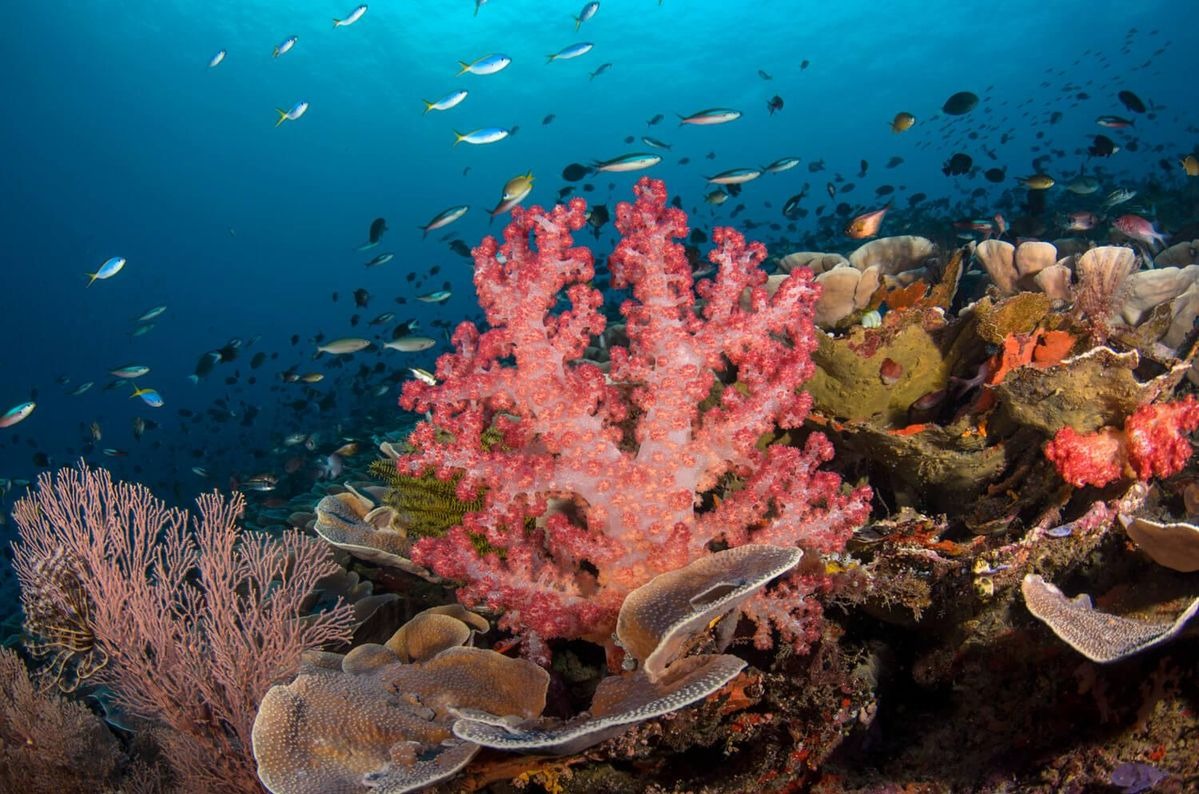
Raja Ampat lies at the heart of the Coral Triangle, the region with the highest marine biodiversity on the planet. Its strength, however, lies not only in species numbers but in the relative integrity of its ecosystem.
Coral Cover and Biodiversity Levels
Multiple field surveys show that many sites in Raja Ampat maintain high and stable live coral cover. More importantly, coral species diversity is exceptionally broad, encompassing nearly all major tropical coral groups.
This diversity creates ecological redundancy. If one species is affected, others can fulfil similar roles. This redundancy is one of the foundations of Raja Ampat’s reef resilience.
Fish Biomass and Trophic Structure
Fish biomass in Raja Ampat is high relative to that in many other tropical regions. What stands out is not only the abundance of small fish, but also the presence of:
- Large populations of herbivorous fish
- Mid-level predators and apex predators
- A complete and functioning food web
The presence of apex predators indicates that the ecosystem still functions naturally and has not been significantly distorted by overfishing.
Physical Condition and Human Impact
Physical damage, such as coral breakage from blast fishing or anchors, is relatively rare across much of Raja Ampat. Human pressure exists, but at a lower level than in densely populated coastal regions.
This allows reef structures to remain complex and to function as long-term habitats.
How Raja Ampat Compares to Other Coral Regions
To understand Raja Ampat’s global position, comparisons must be made with other major coral regions, each with distinct ecological contexts and environmental pressures.
Raja Ampat vs the Great Barrier Reef
The Great Barrier Reef is the largest reef system in the world, but it has also been among the most affected by coral bleaching over the past two decades. Many sections have experienced declines in coral cover and shifts in community structure.
Compared with the Great Barrier Reef, Raja Ampat has experienced bleaching events, but typically with lower spatial extent and faster post-disturbance recovery compared with heavily impacted regions such as the central Great Barrier Reef.
This does not mean that Raja Ampat is immune, but it does indicate higher resilience.
Raja Ampat vs the Caribbean
Caribbean reefs have long faced chronic pressures, including coral disease, algal dominance, and the loss of herbivorous fish. Many reefs in the region have lost key ecological functions, even when they still appear visually colourful.
By contrast, Raja Ampat continues to maintain:
- Dominance of live coral over algae
- A complete food web
- Active natural coral recruitment
This comparison reinforces that reef health is not purely an aesthetic measure.
Raja Ampat vs Other Southeast Asian Reefs
Southeast Asia hosts extensive coral reefs, but also experiences some of the highest human pressures globally. Overfishing, coastal development, and pollution have caused widespread degradation in many areas.
Raja Ampat stands out because of:
- Relatively lower human pressure
- Limited physical damage
- More consistent protection
This makes it a positive anomaly in a high-risk region.
Raja Ampat vs the Maldives
The Maldives is one of the world’s most iconic reef destinations, with beautiful atoll systems and a highly developed marine tourism industry. Although many Maldivian reefs have shown encouraging recovery in recent years, repeated thermal stress events have altered community structures in several atolls.
Raja Ampat stands apart due to:
- Far higher coral and fish species diversity
- Bleaching impacts that are generally lighter and unevenly distributed
- Lower and more controlled tourism pressure
- Intact ecosystem functions, including complete marine food chains
This comparison shows that while destinations like the Maldives offer iconic atoll diving experiences, Raja Ampat distinguishes itself through exceptional biodiversity and ecosystem completeness.
Raja Ampat vs the Red Sea
The Red Sea is often considered a special case in global coral reef studies because of its ability to tolerate consistently higher sea temperatures than many tropical regions. This thermal tolerance positions it as a potential future climate refuge.
Raja Ampat stands out because of:
- Much higher coral and fish species diversity
- More complete and balanced ecosystem function
- Resilience based on biodiversity rather than extreme adaptation
The Red Sea, on the other hand, is notable for:
- Coral tolerance to extreme heat
- Survival under thermal conditions close to global bleaching thresholds
- Unique physiological adaptations
This comparison shows that “healthy reefs” can take different forms. Raja Ampat exemplifies resilience through ecosystem complexity, whereas the Red Sea exemplifies resilience through biological adaptation. Both are important to global conservation, but each faces distinct challenges as environmental pressures intensify.
Reef Resilience in a Changing Climate
Climate change is the greatest test facing coral reefs worldwide. No region is entirely safe, including Raja Ampat.
Bleaching Response and Recovery Rates
When bleaching events occur, the critical difference between regions lies in what happens afterwards. In Raja Ampat:
- Bleaching tends to be lighter and uneven
- Mass mortality is less common.
- Recovery occurs relatively quickly.
This indicates that stress levels have generally not exceeded ecological tolerance thresholds.
Long-Term Stability and Adaptive Capacity
Long-term stability depends on a reef’s ability to adapt. The genetic and species diversity found in Raja Ampat provides greater adaptive potential in the face of future environmental change.
How Humans, Local Communities, and Travellers Shape Reef Health in Raja Ampat
Global comparison highlights an important truth: reef health is not accidental. It results from a combination of environmental conditions, controlled human pressure, and effective management.
Raja Ampat is not perfect and is not immune to climate change. However, its current condition demonstrates that reefs can remain healthy, resilient, and functional when given the opportunity.
The Role of Local Communities in Reef Stewardship
Local communities are the most important actors in protecting Raja Ampat’s reefs. For many years, community-based marine management has underpinned conservation in the region. The sea is not treated as open-access space, but as a shared resource managed for long-term sustainability.
A key element is customary management rights. When communities have legitimate authority over their marine areas, compliance arises from responsibility rather than enforcement. Local rules on fishing zones, seasons, and methods are socially upheld, not merely legally imposed.
Changes in fishing practices have also played a major role. Reductions in destructive methods and greater awareness of long-term impacts have significantly lowered pressure on reefs. In this context, conservation is not a prohibition but an adaptation of livelihoods.
Government Policy and Marine Protected Areas
Government involvement reinforces systems built by local communities. Raja Ampat has an extensive network of marine protected areas with clear zoning, including no-take, limited-use, and tourism zones.
What distinguishes Raja Ampat is relatively consistent enforcement. Zoning exists not only on maps, but is understood by communities, tourism operators, and fishers. Violations are not treated as normal behaviour.
Collaboration between the government, NGOs, and local communities is also crucial. Scientific research, ecosystem monitoring, and field education operate in concert, creating an adaptive management system that can respond to changing conditions.
The Responsibility of Travellers and Divers
Travellers and divers often underestimate the impact of their presence. Underwater behaviour, such as touching coral, poor buoyancy control, or standing on shallow reefs, can damage structures that take decades to grow.
Operator choice also matters. Operators that apply sustainable practices, limit diver numbers, and provide strict environmental briefings help keep pressure low. Uncontrolled tourism, by contrast, can accelerate degradation.
In Raja Ampat, travellers are not merely consumers of natural beauty, but part of a social-ecological system. Every decision, from operator selection to behaviour underwater, contributes to the future of the reefs.
Verdict
Raja Ampat stands out in global comparison not because it is free from threats, but because its reef ecosystem still functions as a whole. Compared with many regions now struggling under heavy pressure, Raja Ampat continues to exhibit a rare combination of high biodiversity, relatively low human impact, and the capacity to recover from disturbance.
This comparison reinforces that healthy reefs are not defined by visual beauty alone, but by ecosystem function, resilience, and long-term sustainability. This is what makes Raja Ampat not only beautiful to visit, but meaningful for anyone who wishes to dive on reefs that are truly alive.
If your goal is to experience Raja Ampat while supporting a reef system that remains healthy, exploring it with La Galigo Liveaboard aligns with those values, offering access to Raja Ampat’s best sites while respecting the natural balance that makes the region exceptional.
FAQ
1. Does Raja Ampat truly have the healthiest coral reefs in the world?
Raja Ampat is often considered among the healthiest reef systems, but it is not the only one. Its strength lies in the combination of high coral cover, extreme species diversity, and intact ecosystem function. Many regions excel in specific aspects, but few match Raja Ampat’s overall completeness.
2. What is the difference between a beautiful reef and a healthy reef?
A beautiful reef focuses on visual appeal, such as bright colours and abundant fish. Ecological functions, including food-web balance, low algal dominance, recovery capacity after disturbance, and long-term sustainability characterise a healthy reef.
3. Why is Raja Ampat more resilient than many other regions?
Raja Ampat’s resilience is driven by:
- Extremely high species diversity
- Relatively low human pressure
- Dynamic ocean current systems
- Consistent protection measures
These factors provide reefs with space to recover from environmental stress.
4. Are Raja Ampat’s reefs immune to climate change?
No. Raja Ampat is still affected by ocean warming and bleaching. However, impacts to date have tended to be more limited, and recovery has been faster than in many other regions. Resilience does not mean immunity, but greater capacity to withstand and adapt.
5. Why are the Maldives and the Red Sea still important in global comparison?
Because they represent different models of resilience:
- The Maldives highlight challenges faced by tourism-dependent reef systems
- The Red Sea demonstrates corals with extreme heat tolerance.
Comparing these regions with Raja Ampat shows that reef health does not have a single definition.
6. Is tourism always harmful to coral reefs?
Not necessarily. Impact depends on scale and management. Tourism with visitor limits, sustainable operators, and environmental education can coexist with conservation. Problems arise when pressure exceeds the ecosystem’s carrying capacity.
7. What role do travellers and divers play in protecting Raja Ampat’s reefs?
Travellers influence reef health through:
- Responsible diving and snorkelling behaviour
- Choosing operators that follow sustainable practices
- Respecting local rules and conservation zones
In ecosystems like Raja Ampat, individual decisions can have direct effects on reef condition.
8. Why is comparing coral reef regions important?
Comparisons help us:
- Understand why some reefs persist while others collapse
- Avoid assuming all reefs face identical challenges.
- Design more targeted and effective conservation strategies.