
Whales, the majestic giants of the ocean, can hold their breath for impressively long periods. Yet, their extraordinary diving capabilities remain a mystery to many. Understanding how long these marine mammals can stay submerged not only fascinates but also underscores the delicate balance they maintain underwater. This article delves into the science behind whale breath-holding, revealing the incredible adaptations that enable these creatures to thrive in the depths of the ocean.
You might already know that whales are not fish, they are mammals.
This means they breathe with their lungs, as they do not have gills to process oxygenated water like other marine animals.
This is the reason why when they dive, they only stay down for a while before coming back up to the surface again for another breath of air, just like you when you freedive.
The Average Diving Time of a Whale
Some whale species can remain submerged for up to 60 minutes or more, although most whales surface every 5–15 minutes before needing to return to the surface for air. This impressive adaptation allows them to navigate the depths with extraordinary efficiency.
That duration is simply mind-boggling when you compare it to humans. Forget about the average joe, the world record for the longest static dive (without any equipment) is 24 minutes and 37 seconds.
Note that whales are diving while moving their bodies a lot, which requires much more oxygen consumption.
How Whales Can Hold Their Breath For So Long
Whales also breathe using their lungs and take in oxygen from the air for use in their muscles and blood. However, they have very high concentrations of Haemoglobin and Myoglobin in their tissues and blood.
These proteins are used to store oxygen in the muscles and blood.
To put it into perspective, sperm whales myoglobins that are roughly 9 times more than those found in humans. This amazing biological adaptation aids whales in storing large amounts of oxygen within their tissues and bloodstream enhancing their ability to survive well underwater.
Additionally, it is worth mentioning that whales are able to amazingly slow their heart rates while diving deep into the sea. And even more impressively, they can significantly reduce blood flow to non-essential tissues while maintaining oxygen supply to vital organs. This strange arrangement has helped whales succeed in aquatic habitats.
ALSO READ: What is a Manta Cleaning Station? Can I Dive at Manta Cleaning Station?
The Depths They Can Dive to
In diving for long durations in comparison to other whale species, the Cuvier beaked whale is unrivalled. This is because they spend most of their time far from the shore, and they dive up to depths that are beyond human reach making it difficult to study their behaviour and biology.
Using satellite technology, a team of researchers tagged a bunch of Cuvier Beaked whales and tracked them. This research achieved a singular and extraordinary event by recording a Cuvier beaked whale that dived at an incredible depth of 2992 meters or approximately 9816 feet.
This represents the deepest recorded dive for any whale species.
The Record of Longest Time They Dive
The same study found that the Cuvier’s whales had spent 140 minutes or approximately 2.2 hours, at their targeted dive depth before returning to the surface to breathe. before:at the bottom before coming up for air.
The same study recorded a dive lasting approximately 137–140 minutes, making it the longest well-documented dive for any whale species.
Other Whale Species
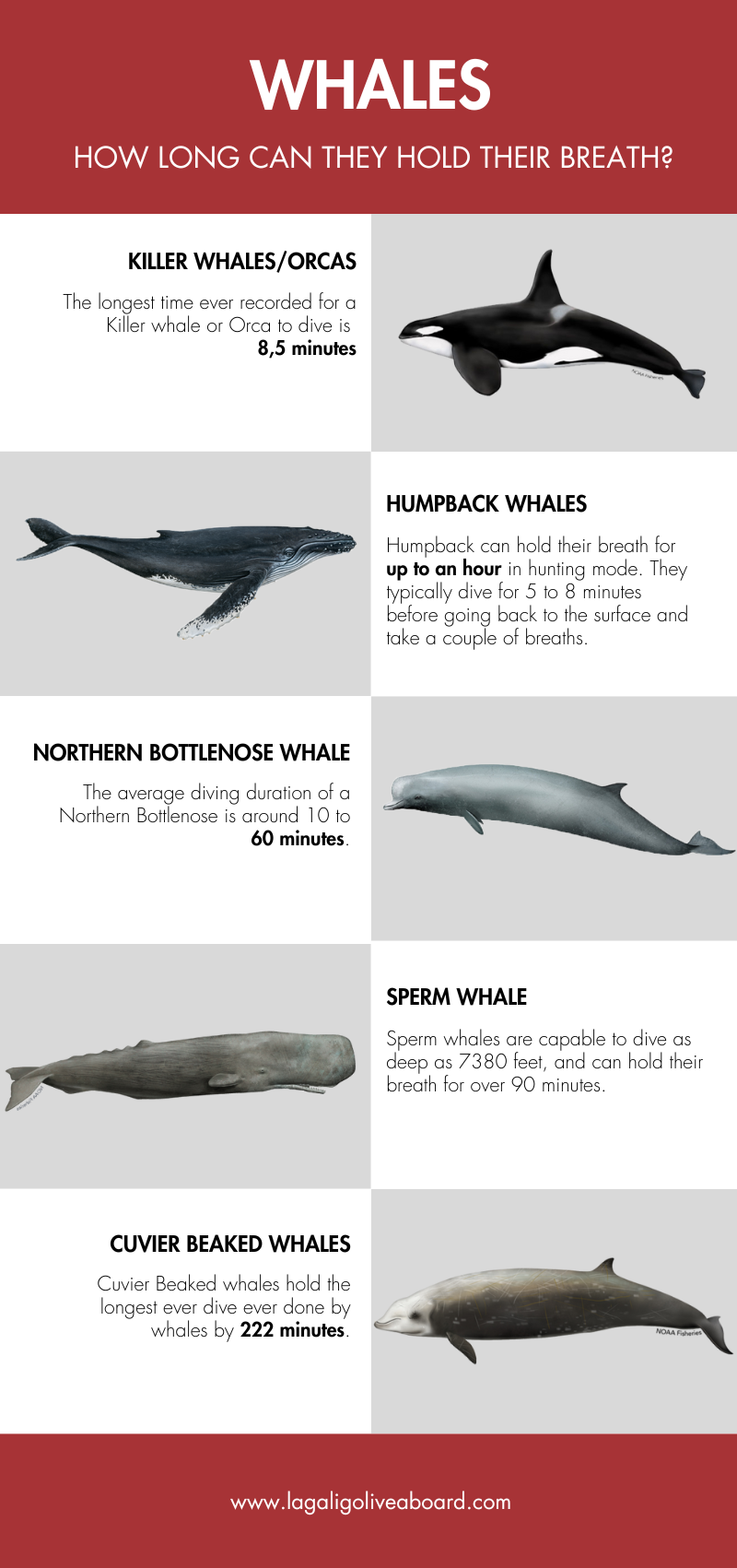
Comparison of Dive Duration and Depth Across Different Whale Species
| Species | Average Dive Time | Maximum Recorded Dive | Typical Depth |
| Sperm Whale | 30–45 minutes | ~90 minutes | 1,000–2,000 m (can exceed) |
| Northern Bottlenose Whale | 20–60 minutes | ~120 minutes | 800–1,500 m |
| Humpback Whale | 5–15 minutes | ~60 minutes (rare) | 100–300 m |
| Killer Whale (Orca) | 3–8 minutes | ~8.5 minutes | 100–300 m |
Killer Whales/ Orcas (Orcinus orca)
The “Killer whale” or the Orca is known as a top ocean predator; this, you probably know.
However, compared to Cuvier’s beaked whales, killer whales have much shorter dive durations, typically lasting under 10 minutes, as the record. While orcas are powerful predators, they are not among the deepest-diving whales.
Humpback Whales (Megaptera novaeangliae)
Better than the Orcas, a Humpback can hold their breath for up to an hour.
However, their average diving duration is much lower when they hunt for food.
They typically dive for 5 to 8 minutes before going back to the surface and take a couple of breaths.
Sperm Whales (Physeter macrocephalus)
Sperm whales are believed to be capable of diving as deep as 7380 feet and can hold their breath for over 90 minutes.
They usually dive that deep to find their favourite prey, squid.
Northern Bottlenose Whale (Hyperoodon ampullatus)
The average diving duration of a Northern Bottlenose is around 10 to 60 minutes.
Northern bottlenose whales are capable deep divers, typically diving longer and deeper than humpback whales. However, they do not surpass sperm whales, which remain the champions among toothed whales for both dive depth and duration.
While exceptional dives approaching two hours have been documented, typical dive durations are considerably shorter.
ALSO READ: Surprising and Rare Marine Animals Found in Indonesia
Can Human Dive as Deep as the Whales?
Sadly, no.
Our body is simply not built to survive such great pressure that amounts, as we dive deep into the ocean.
The deepest dive a human ever made was 332.35 meters or 1089 feet, a world record achieved by Ahmed Gabr in the Red Sea.
But for standard recreational diving, depth limits are typically 40 meters, while technical diving allows deeper dives with specialised training. While scuba equipment allows humans to remain underwater for extended periods, this is fundamentally different from whales’ natural breath-holding ability.
The air tank a Scuba Diver carries with them could last somewhere around 40 to 50 minutes.
Seasoned divers, however, could make that last an hour or even more, especially at shallower depths.
This could be done by taking a Sidemount scuba course.
Though we cannot dive as deep as whales do, the deep ocean presents very different conditions compared to shallow coral reefs. While life in the deep is often less dense per unit area, it includes unique ecosystems such as hydrothermal vents. In contrast, shallow reefs are supported by sunlight and are immediately rich in visible biodiversity.
The deeper you go, the darker it becomes, the lesser stuff you can see, although it does become a lot weirder the rarer it gets, which is the appeal for some people.Good thing is, unlike the whales who must dive that deep in search of food, we dive to have fun and for recreation.
For some people, it is even more than that, it’s a lifestyle.
But we will always wonder about the mysteries of the deep ocean and the amazing creatures that visit these depths.