
When most people hear the word shark, they immediately picture a large predator swimming swiftly through the open ocean. But did you know that there is a group of small sharks that actually “walk” along the seabed?
They are known as walking sharks, one of the world’s most unique marine species. Instead of relying on their tails to swim like most sharks, walking sharks use their pectoral and pelvic fins to move slowly across coral reefs, sandy bottoms, and seagrass meadows.
Most walking shark species are found only in Indonesia and Papua New Guinea. Indonesia’s rich marine biodiversity makes it a global hotspot for endemic species, inspiring pride and curiosity.
For us at La Galigo, walking sharks exemplify Indonesia’s rich marine biodiversity. Promoting responsible diving practices helps protect these extraordinary creatures for future generations and enhances your experience as a conscious traveller.
Let’s take a closer look at this remarkable shark.
Quick Facts About Walking Sharks
| Fact | Description |
| Scientific name | Hemiscyllium genus |
| Distribution | Indonesia and Papua New Guinea |
| Centre of diversity | Indonesia is home to most known walking shark species |
| Habitat | Coral reefs, reef flats, seagrass meadows, and shallow coastal habitats |
| Size | Generally less than 1 metre |
| Diet | Crabs, shrimp, marine worms, molluscs, and small fish |
| Unique feature | Uses its fins to “walk” along the seabed |
| Danger to humans | Harmless and generally avoids divers |
| Best places to see them | Raja Ampat and various regions across Eastern Indonesia |
What Are Walking Sharks?
Walking sharks are a group of small sharks belonging to the Hemiscyllium genus that live on the seafloor. Unlike pelagic sharks, which spend most of their lives swimming in open water, walking sharks typically explore the seabed in search of food.
Although they are called “walking sharks”, they do not walk on land. They live entirely underwater. Their distinctive “walking” movement comes from using their pectoral and pelvic fins to support their bodies as they move slowly across the seafloor.
This unique form of movement makes walking sharks look very different from other shark species. Their slow, salamander-like motion can inspire awe and curiosity about their extraordinary adaptations.
Walking sharks are also relatively small. Most species grow to less than one metre in length, making them very different from the large sharks often portrayed in films and documentaries.
Walking sharks are nocturnal animals. This means they are most active at night, when they search for food, while during the day they usually rest beneath coral formations or within reef crevices. This is one reason why spotting a walking shark while diving is considered such a special experience.
How Do Walking Sharks Walk Along the Seabed?
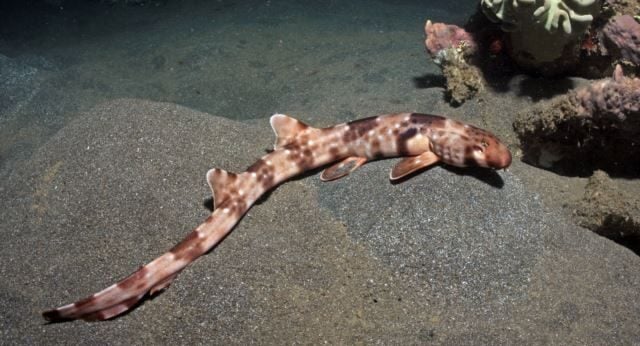
The question people ask most often is, how can a shark possibly walk?
The answer lies in their remarkable physical adaptations.
Walking sharks have stronger pectoral and pelvic fins than many other shark species. These fins do more than provide stability while swimming. They also support the shark’s body as it moves across the seabed.
Rather than continuously propelling themselves with their tails, walking sharks move their fins alternately to push themselves forward. Their movement is slow, steady, and highly efficient for navigating uneven coral surfaces.
This adaptation offers several advantages.
Makes Finding Food Easier
Coral reefs are full of narrow crevices that provide shelter for small animals such as crabs, shrimp, marine worms, molluscs, and small fish.
By “walking”, walking sharks can carefully explore every corner of the reef without having to swim quickly. They can reach places inaccessible to many other predators and hunt prey hidden among the coral.
Adapted to Shallow Waters
Walking sharks are also commonly found on reef flats and in shallow waters influenced by the tides.
When the tide goes out, some shallow pools become isolated from the open sea and have lower oxygen levels. Remarkably, walking sharks can tolerate these conditions better than many other shark species.
This ability allows them to exploit habitats that are rarely used by larger predators while reducing competition for food.
This remarkable adaptation makes walking sharks one of the most fascinating examples of evolution in the marine world.
Where Can You Find Walking Sharks?
Although divers worldwide now recognise walking sharks, their natural distribution is actually very limited.
They are found naturally only in Eastern Indonesia and Papua New Guinea. Indonesia alone is home to most known walking shark species.
This makes Indonesia the global centre of walking shark diversity.
Why Does Indonesia Have So Many Walking Shark Species?
This is one of the most fascinating facts about walking sharks.
Unlike large sharks that can migrate thousands of kilometres, walking sharks have relatively small home ranges. They can’t cross deep ocean waters to move between islands.
As a result, walking shark populations living on different islands have remained isolated for thousands or even millions of years.
Over these immense timescales, each population evolved independently, eventually giving rise to distinct species.
This is why Indonesia is home to so many endemic walking sharks. The country’s unique geography, consisting of thousands of islands, has naturally driven this evolutionary process.
In other words, Indonesia is not only home to walking sharks, but also the birthplace of much of their remarkable diversity.
Some of the regions known as walking shark habitats include:
- Raja Ampat
- Cenderawasih Bay
- Triton Bay
- Halmahera
- Remote coral reefs throughout West Papua
These regions are also renowned for their exceptionally healthy marine ecosystems and are home to thousands of reef fish species, sea turtles, manta rays, and many other shark species.
For us at La Galigo Liveaboard, this is what makes every journey so special. You are not only diving in one of the world’s richest marine environments, but also exploring the natural habitat of species that cannot be found across most other parts of the planet.
Of course, seeing a walking shark can never be guaranteed on every dive. They are naturally shy, exceptionally well camouflaged, and most active at night. That is precisely why every encounter with a walking shark is such a memorable moment and one that divers always look forward to.
Read Also: Shark Teeth, all the facts and fiction
What Makes Walking Sharks So Special?
Their ability to walk may be what makes walking sharks famous, but the more you learn about them, the more you realise that their uniqueness extends far beyond the way they move.
Able to Survive in Low-Oxygen Waters
Most sharks require relatively stable water conditions to survive. Walking sharks are different.
They are often found on reef flats and in shallow tidal pools that form when the tide recedes. Under these conditions, oxygen levels in the water can be much lower than in deeper areas.
Walking sharks possess physiological adaptations that allow them to tolerate these conditions better than many other shark species. This enables them to exploit habitats rarely used by larger predators, giving them greater opportunities to find food.
Their ability to thrive in such challenging environments is one reason walking sharks are considered an extraordinary example of evolution.
Each Species Has a Very Limited Home Range
One of the most remarkable facts about walking sharks is their extremely restricted distribution.
Unlike whale sharks or hammerhead sharks, which can migrate across entire oceans, walking sharks generally remain close to the areas where they were born. They are even unable to cross the deep waters that separate one island from another.
As a result, isolated populations have evolved independently over thousands or even millions of years, eventually becoming distinct species.
This is why Indonesia has such a remarkable number of endemic walking sharks.
However, this also comes with consequences. Because each species occupies such a limited range, habitat degradation in a single location can significantly affect the survival of species found only there.
Harmless to Divers
Although they belong to the shark family, walking sharks are not animals to be feared.
They are small, naturally shy, and almost always choose to avoid humans. When they encounter divers, walking sharks usually continue moving slowly along the seabed or seek shelter beneath coral formations.
That is why encountering a walking shark is far more likely to be an awe-inspiring moment than a frightening one.
Why Are Walking Sharks Important to Marine Ecosystems?
Every species plays a role in maintaining the balance of marine ecosystems, and walking sharks are no exception.
As small predators that live on the seabed, walking sharks help regulate populations of small animals such as crabs, shrimp, marine worms, and small fish. This role helps maintain the balance of the food web within coral reef habitats.
Their presence also highlights the importance of the connections between different coastal ecosystems.
Walking sharks are found not only on coral reefs but also in seagrass meadows and mangrove habitats, which form part of their natural environment.
This means that protecting walking sharks involves more than conserving coral reefs alone. These interconnected coastal ecosystems must also remain healthy to support the species throughout its entire life cycle.
This is why marine conservation is never just about a single species. By protecting coral reefs, seagrass meadows, and mangrove forests, we also safeguard the many marine animals that depend on these habitats.
Are Walking Sharks Threatened?
Although walking sharks are not a primary target of fisheries in many parts of Indonesia, this does not mean they are free from threats.
In fact, their greatest challenges come from environmental change.
Some of the main threats facing walking sharks include:
- Coral reef degradation caused by human activities.
- Climate change leading to rising sea temperatures.
- Coastal development that alters natural habitats.
- Declining environmental quality in coastal ecosystems.
Because many walking shark species occur within extremely limited ranges, habitat loss in a single location can affect a large proportion of their entire population.
For example, Hemiscyllium halmahera is currently classified as Near Threatened. This status reminds us that species with restricted distributions require special attention to keep their populations secure.
The good news is that marine protected areas throughout Indonesia have helped safeguard important habitats for walking sharks. Coral reef conservation, effective protected-area management, and responsible marine tourism all play important roles in securing the future of these remarkable sharks.
Can Divers See Walking Sharks in Indonesia?
Absolutely. Indonesia is one of the best places in the world to see walking sharks in their natural habitat.
However, because they are naturally shy and exceptionally well camouflaged, spotting a walking shark requires a little luck.
Tips for Increasing Your Chances of Seeing Walking Sharks
The following suggestions can help improve your chances:
- Choose destinations that are well known as walking shark habitats, such as Raja Ampat.
- Dive at several different dive sites during your trip, as each location offers unique habitat characteristics.
- Maintain good buoyancy to avoid damaging coral reefs.
- Avoid chasing or touching marine wildlife.
- Follow the guidance of dive guides who understand the behaviour and habitats of walking sharks.
Remember that the true purpose of diving is not simply to capture the perfect photograph, but to enjoy marine life without disturbing its natural behaviour.
The more responsibly we dive, the greater the chance that future generations will be able to enjoy the same experience.
Explore Walking Shark Habitats with La Galigo Liveaboard
One of the things that makes Indonesia so special is the abundance of pristine dive sites located far from the crowds.
When you travel with us aboard La Galigo Liveaboard, you can explore some of the world’s richest marine biodiversity hotspots, including Raja Ampat and many other extraordinary destinations across Eastern Indonesia.
Every dive offers the opportunity to discover something new. It might be a group of manta rays gliding past, a coral reef bursting with colourful fish, or even a walking shark slowly making its way across the seabed.
FAQ
Can walking sharks really walk?
Yes. Walking sharks use their pectoral and pelvic fins to move across the seabed. They remain completely underwater and do not walk on land.
Where can walking sharks be found?
Walking sharks are naturally found only in Indonesia and Papua New Guinea. Indonesia is home to most of the walking shark species currently known to science.
Are walking sharks dangerous to humans?
No. Walking sharks are small, shy sharks that generally avoid people.
Why are walking sharks found only in certain regions?
Walking sharks have limited dispersal abilities and cannot easily cross deep ocean waters. Millions of years of geographical isolation have allowed separate populations to evolve into distinct species.
What do walking sharks eat?
They feed on a variety of small seabed-dwelling animals, including crabs, shrimp, marine worms, molluscs, and small fish.
Can I see walking sharks while diving in Raja Ampat?
Yes. Raja Ampat is one of the best places to see walking sharks. However, because they are primarily nocturnal and exceptionally well camouflaged, sightings always depend on diving conditions and a little good fortune.
References
Allen, G. R., Erdmann, M. V., Dudgeon, C. L., & Fahmi. (2016). Review of the bamboo shark genus Hemiscyllium (Orectolobiformes: Hemiscylliidae). Journal of the Ocean Science Foundation.
Hasan, V., et al. (2021). Distribution and population structure of the walking shark (Hemiscyllium freycineti) in Misool, Raja Ampat. Jurnal Ilmiah Platax / JASM, Sam Ratulangi University.
Nababan, M., et al. (2023). Population structure of the Halmahera walking shark (Hemiscyllium halmahera) in North Maluku waters. Journal of Omni-Akuatika.