
Your scuba tank pressure gauge is one of the most important tools you use underwater, not because it is complicated, but because it keeps you aware. It tells you how much breathing gas remains in your scuba tank, helps you compare the dive with the plan, and gives you the information you need to ascend with a comfortable reserve. Learning to read your scuba tank pressure gauge regularly also helps you recognise changes in gas consumption before they affect your dive plan.
When you already have experience underwater, checking your gauge is not a beginner habit. It is part of how you manage current, depth, workload, camera focus, and multi-dive days without letting the dive feel rushed. This matters even more in places like Raja Ampat and Komodo, where reef slopes, channels, pinnacles, and drift-style dives can change how quickly your scuba tank pressure drops.
A scuba tank pressure gauge, also called an SPG or submersible pressure gauge, shows your remaining tank pressure in bar or psi. For experienced divers, that number helps you read workload, current exposure, and whether the dive is still matching the plan. PADI explains that an SPG helps you monitor your air supply throughout the dive and should be easy to read and securely attached so it does not drag, damage the reef, or become hard to find.
What Is a Scuba Tank Pressure Gauge?
A scuba tank pressure gauge shows your remaining scuba tank pressure, but for experienced divers, its real value is not just the number. It helps you read how the dive is progressing, how your workload is changing, and whether the original plan still makes sense underwater.
Your gauge may be connected to your regulator first stage by a high-pressure hose, or your pressure reading may come through an air-integrated dive computer. Either way, the goal is the same: you need reliable, easy-to-read pressure information throughout the dive.
Depending on your setup, you may be using:
- An analogue SPG attached by a hose
- A console that includes pressure, depth, and compass
- An air integrated dive computer
- A wireless transmitter paired with a dive computer
No matter which system you use, the purpose is the same: you need to know how much gas is left in your scuba tank so you can manage the dive properly. PADI notes that an SPG may be mechanical or built into a dive computer, and it reads tank pressure in either bar or psi.
Why Scuba Tank Pressure Matters
Your scuba tank pressure tells you how much breathing gas remains, but the number also gives you feedback. Regularly checking your scuba tank pressure gauge shows whether your breathing rate, depth, current exposure, and pace still match the dive plan.
If your pressure drops faster than expected, it usually means something about the dive has changed: depth, current, workload, temperature, excitement, trim, or pace. Noticing that early helps you adjust calmly before the dive feels rushed.
DAN lists not monitoring your pressure gauge as one of the ways divers can run out of air, and recommends checking your pressure gauge regularly and communicating your remaining air with your buddy.
This is why pressure awareness matters even more on a La Galigo liveaboard. You are diving across several days, often moving between reef slopes, channels, pinnacles, and current influenced sites. Your ability to stay relaxed, control your buoyancy, and monitor your gas consistently helps you enjoy the full itinerary instead of treating each dive like a race against your tank.
READ ALSO: Buoyancy Control: The Importance, Techniques and Tips
How to Read a Scuba Tank Pressure Gauge
A scuba tank pressure gauge usually displays pressure in either bar or psi.
In many international dive destinations, including Indonesia, you will usually hear pressure discussed in bar. In some places, especially where imperial units are common, you may see psi instead.
Many recreational scuba cylinders are filled to around:
- 200 bar
- 3000 psi
These numbers can vary depending on cylinder type, fill pressure, temperature, and local operating standards. The important part is not memorising one “correct” starting number. The important part is checking your actual starting pressure before the dive and understanding the pressure plan from your briefing.
Before the dive, confirm:
- Your starting scuba tank pressure
- The pressure point when you should signal your guide
- The pressure point when the group may begin heading shallower
- The minimum pressure expected before the safety stop
- The reserve pressure expected when you surface
- Whether the dive plan changes because of current, depth, or site conditions
Your guide may adjust the plan based on current, depth, site profile, and group conditions. Follow the briefing instead of assuming every dive uses the same gas plan.
When Should You Check Your Scuba Tank Pressure?
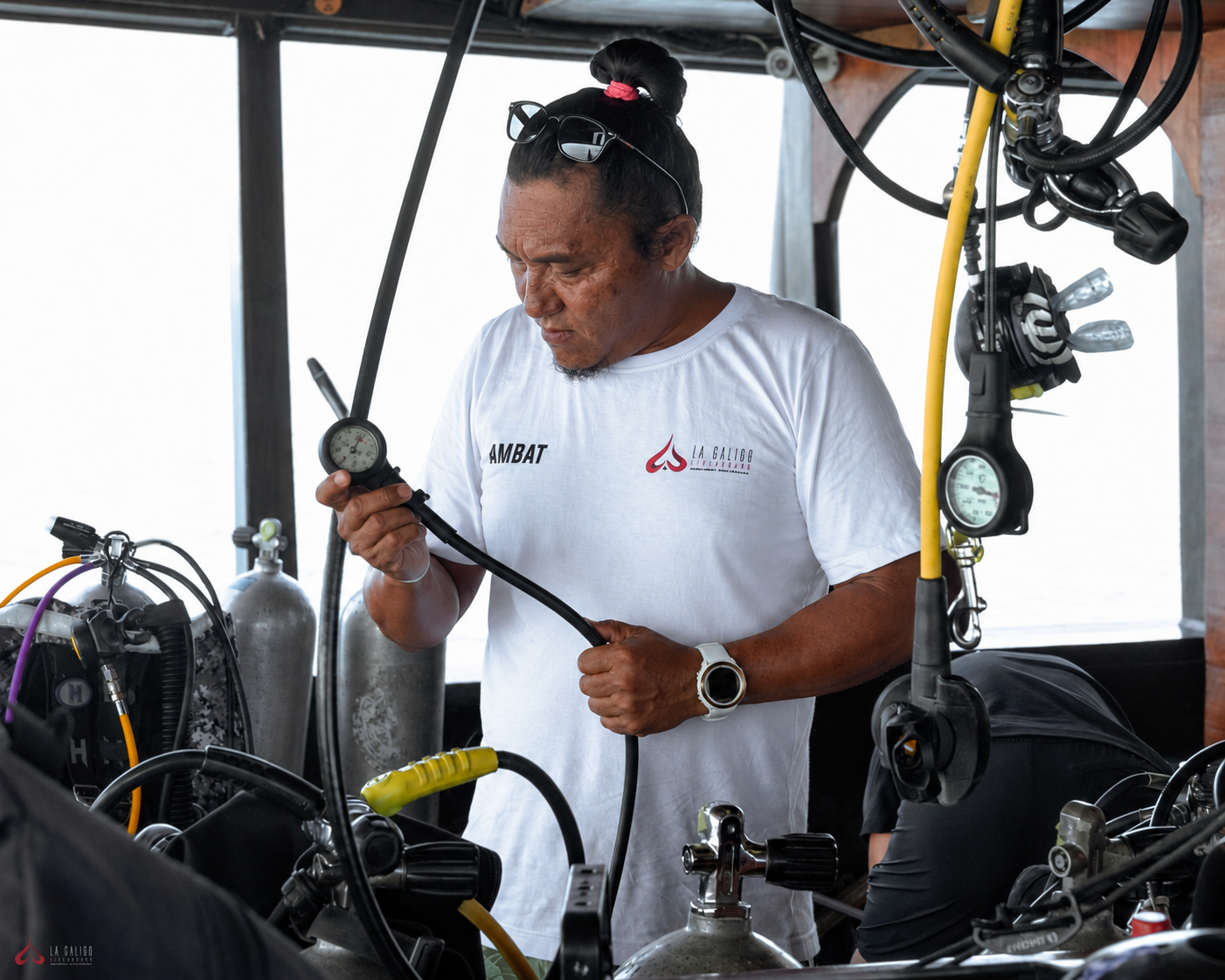
You should check your scuba tank pressure before the dive, during the descent, at the planned depth, after any section with stronger current, before you move to a new part of the reef, before ascending, and after surfacing.
The point is not to stare at your scuba tank pressure gauge constantly. Instead, build pressure checks into the rhythm of your dive, so you always know whether your gas, depth, and route still match the plan.
A good habit is to check more often when:
- You are diving deeper
- There is current
- You are using a camera
- Visibility is reduced
- You are swimming more than expected
- You feel your breathing rate increasing
- You are diving a new site
- Your buddy or guide asks for an air check
When you are experienced, you do not wait until the tank feels low. You check early, compare your pressure with the plan, and make small adjustments before the dive becomes rushed.
On a La Galigo liveaboard, this matters because many dives are shaped by site conditions. Raja Ampat and Komodo can include current, reef slopes, channels, pinnacles, and drift style dives. Your gauge helps you stay aware while your guide manages the route, pace, and timing.
Common Scuba Tank Pressure Mistakes
Even when you have plenty of dives behind you, simple pressure management mistakes can still happen, especially when the scenery is distracting, the current changes, or your camera takes too much of your attention. Most mistakes happen not because you do not know what to do, but because you stop checking early enough.
1. Checking Too Late
The biggest mistake is waiting too long between gauge checks. If you only check your pressure when your guide asks, you are reacting instead of actively managing the dive.
A better habit is to check after descent, once you settle at depth, after harder swimming, after a photo sequence, and before the group changes direction or begins ascending.
2. Ignoring Workload
Current, depth, surge, camera use, poor trim, and stress can all increase your breathing rate. If you are working harder, your scuba tank pressure will drop faster. A quick check of your scuba tank pressure gauge after a demanding section of the dive can help you recognise this change early.
This does not mean the dive is unsafe. It means the dive is asking you to adjust. Slow your movement, improve your trim, stay close to your guide’s line, and avoid fighting the current. Small corrections early often make the rest of the dive feel smoother.
3. Letting the Gauge Dangle
Your pressure gauge should be easy to find and secured close to your body. A dangling SPG can drag across coral, create unnecessary drag, hit the reef, or become damaged. PADI specifically notes that an SPG should be securely attached so it is easy to find and does not damage sensitive aquatic life.
On a La Galigo liveaboard, this matters even more because you are diving in some of Indonesia’s richest reef environments. Good equipment positioning protects your dive, your equipment, and the reef you came to experience.
4. Depending Only on Someone Else
Your guide is there to lead the dive, read conditions, and support the group, but your scuba tank pressure is still information you need to own. When you know your pressure and communicate early, your guide has more room to pace the dive well. A good dive is not about stretching your tank as long as possible. It is about staying controlled, aware, and relaxed.
5. Trusting Technology Without Redundancy
Air integrated computers are useful, but they should support your awareness, not replace it. You still need to understand your pressure, your gas plan, and what backup system your setup requires. DAN notes that when using air-integrated computers, carrying an analogue SPG can be important for knowing your gas reserves if a computer fails.
Your exact setup may depend on your certification, equipment, and the operator’s requirements. The important point is simple: your gas information should be reliable, accessible, and understood.
How Your Scuba Tank Pressure Changes During a Dive
Your scuba tank pressure decreases as you breathe, but your gas does not last the same amount of time on every dive. On a multi-day liveaboard trip, your breathing pattern can change from one dive to another depending on depth, current, temperature, fatigue, excitement, camera use, and how relaxed you feel in the water.
You may use gas faster when you are:
- Diving deeper than planned
- Swimming into current
- Diving in colder water
- Overexcited by a busy reef or big encounter
- Overweighted
- Moving with poor trim
- Taking photos or videos
- Diving after a long break
- Carrying unfamiliar equipment
- Feeling tired during a multi-dive day
You may use gas more efficiently when you are:
- Properly weighted
- Calm and relaxed
- Neutrally buoyant
- Streamlined
- Moving slowly
- Following the planned route
- Staying close to your guide and buddy
This is why experienced divers care about more than the size of the scuba tank. A bigger tank does not fix poor awareness. Your gauge gives you the information, but your diving habits determine how well you use it.
READ ALSO: How Do You Breathe While Scuba Diving?
Scuba Tank Pressure Gauge vs Air Integrated Dive Computer
A traditional scuba tank pressure gauge is simple, direct, and easy to understand. An air-integrated computer can show your pressure digitally and may also calculate gas time remaining based on your breathing rate and depth.
Both can be useful, and the important thing is that your scuba tank pressure gauge or air-integrated system gives you pressure information that is clear, accessible, and easy to interpret underwater.
An analogue SPG is valued because it is straightforward and does not depend on wireless connection or computer battery. An air-integrated computer is useful because it keeps your depth, time, no-decompression limit, and gas information in one place.
The best setup is the one you can read quickly, trust under pressure, and use without losing awareness of your buddy, guide, depth, and route. If you use air integration, make sure you know how to check connection status and what backup system you are expected to carry.
The equipment should support your awareness, not replace it.
READ ALSO: 9 Essential Types of Scuba Diving Gear Every Diver Should Have
How to Communicate Scuba Tank Pressure Underwater
Knowing your pressure is only half the job. You also need to communicate it early and clearly, especially on guided dives where your pressure update helps your guide manage the route and pace for the group.
Before the dive, confirm how your guide wants pressure updates. Some teams use hand signals for bar or psi, while others ask you to show your gauge directly. On guided dives, you may be asked to signal at specific pressure points.
A good rule is to communicate early, especially if:
- You are using gas faster than expected
- You are near the planned turn pressure
- You are uncomfortable
- Your buddy has significantly less gas
- You are unsure about the route or current
- You have reached the pressure discussed in the briefing
Do not wait until your tank is low. Early communication gives your guide more options.
How to Use Your Pressure Gauge During a Guided Liveaboard Dive
On a guided liveaboard dive, your pressure gauge is not something you check only when your guide asks. Use it to stay ahead of the dive.
Before you descend, know your starting pressure and the pressure points from the briefing. During the dive, compare your scuba tank pressure with the route, depth, current, and your own workload. If you are breathing faster than expected, signal early instead of trying to stretch the dive.
This is especially useful in Raja Ampat and Komodo, where a dive can shift between relaxed reef sections, current, reef slopes, and deeper moments. The more aware you are of your pressure, the easier it is to stay calm, follow your guide’s pace, and enjoy the dive without rushing the ascent.
If you are carrying a camera, build pressure checks into your shooting rhythm. Check before you settle into a subject, after you finish a sequence, and before you move to the next part of the reef. A good photo is not worth losing awareness of your gas, your buddy, or your guide’s route.
Why Air Awareness Matters on a La Galigo Liveaboard
On a La Galigo liveaboard, your scuba tank pressure gauge becomes part of a bigger diving rhythm. You are not rushing one isolated dive. You are managing your energy, gas, buoyancy, and focus across several days of guided diving in places where conditions can change from site to site.
Good gas awareness helps you stay relaxed and consistent across the full itinerary. It also helps you get more from sites where current, depth, reef structure, and marine life can shift throughout the dive.
This matters in destinations like Raja Ampat and Komodo because many of the best dives are not static reef tours. They can involve drift, channels, slopes, pinnacles, and changing current. When you understand your scuba tank pressure, you are better prepared to enjoy those dives without feeling rushed or distracted.
La Galigo’s guided approach helps you turn pressure awareness into a smoother dive. You get a clear briefing, a planned route, and guide pacing that matches the site conditions, so you can focus on staying relaxed, monitoring your gas, and enjoying the reef instead of guessing what comes next.
Simple Pre Dive Scuba Tank Pressure Checklist
Before you enter the water, check:
- Your tank valve is open according to the crew’s pre-dive check
- Gas flows properly when you breathe from both second stages
- Your starting scuba tank pressure matches the expected fill, and the gauge responds normally when you breathe from the regulator.
- Your SPG or transmitter is secured and easy to access
- You understand the pressure plan from the briefing
- You know when to signal your guide
- You and your buddy know how to communicate air underwater
This takes very little time, but it prevents confusion underwater.
Final Thoughts
Your scuba tank pressure gauge is not just a number display. It is one of the main tools that helps you dive with control, confidence, and awareness.
When you understand your scuba tank pressure, you can make better decisions underwater. You know when your pace is working, when your workload is changing, when to communicate, and when to begin the ascent with enough reserve.
For experienced divers, this is part of what makes a dive feel smooth. You are not guessing. You are reading the dive as it unfolds.
On a La Galigo liveaboard, that awareness helps you get more from every dive. You can enjoy the reef, follow the guide’s route, manage changing conditions, and focus on what you came for: properly paced diving in some of Indonesia’s best underwater destinations.
Refrences
Buzzacott, P., Pollock, N. W., & Rosenberg, M. (2014). Exercise intensity inferred from air consumption during recreational scuba diving. Diving and Hyperbaric Medicine, 44(2), 74–78.
Moon, R. E., Cherry, A. D., Stolp, B. W., & Camporesi, E. M. (2009). Pulmonary gas exchange in diving. Journal of Applied Physiology, 106(2), 668–677. American Physiological Society.
Schellart, N. A. M., van Rees Vellinga, T. P., van Dijk, F. J., & Sterk, W. (2015). Correction for adiabatic effects in the calculated instantaneous gas consumption of scuba dives. Diving and Hyperbaric Medicine, 45(4), 224–230.