
The ocean always has a way of surprising those who explore it. From giant whale sharks to colourful nudibranchs, every species has its own remarkable survival story. Yet one tiny marine creature often goes unnoticed because of its size: the bobtail squid.
At first glance, it looks like an ordinary small squid. However, behind its body, which measures only a few centimetres in length, the bobtail squid possesses one of the most ingenious survival strategies in the marine world. Rather than relying on speed or strength, it works together with millions of glowing bacteria to hide itself from predators.
What Is a Bobtail Squid?
Bobtail squid are a group of small cephalopods belonging to the order Sepiolida. Although their name includes the word “squid”, they have a rounder and more compact body than the squid most people are familiar with.
One of the best-studied species is the Hawaiian bobtail squid (Euprymna scolopes). This species has become an important model organism in scientific research because of its unique relationship with bioluminescent bacteria. For decades, this partnership has helped scientists understand how animals and microorganisms can develop mutually beneficial relationships.
Is a Bobtail Squid Actually a Squid?
Not really. Despite the name, bobtail squid are not true squid at all, they sit in their own order, Sepiolida, separate from both the true squids and the cuttlefish. All three belong to the wider group of ten-armed cephalopods, but the bobtail squid has been going its own evolutionary way for a very long time. Its rounded body and the broad ear-like fins along its sides give it more of a cuttlefish look than a squid one, and the common name is really just an accident of appearance.
These differences make the bobtail squid one of the most fascinating cephalopods to study, both from an evolutionary and a behavioural perspective.
Quick Facts About Bobtail Squids
| Fact | Description |
| Common name | Bobtail squid |
| Example species | Euprymna scolopes |
| Group | Cephalopods |
| Habitat | Sandy seabeds in shallow coastal waters |
| Activity | Nocturnal, active at night |
| Diet | Small crustaceans and other small prey |
| Unique feature | Uses bioluminescent bacteria for camouflage |
Why Is the Bobtail Squid So Unique?
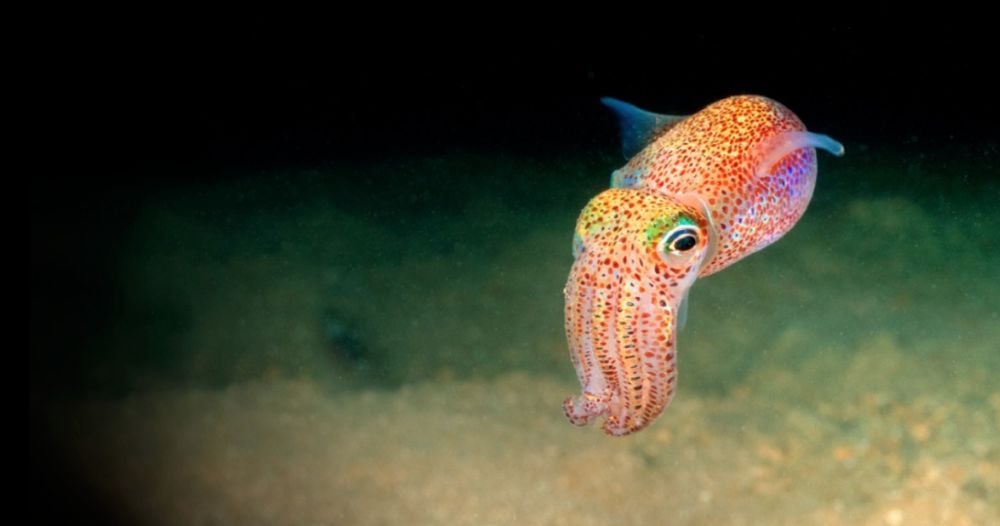
Many marine animals can produce light. However, the bobtail squid is different because it does not generate that light on its own.
Instead, it forms a symbiotic relationship with a bioluminescent bacterium called Vibrio fischeri (also known as Aliivibrio fischeri ).
The bacteria produce the light, while the bobtail squid provides them with shelter and nutrients.
Because It Hides Using Living Light
At night, moonlight passes through the ocean’s surface and creates the silhouette of swimming animals when viewed from below. These silhouettes make prey much easier for predators to detect.
The bobtail squid has an extraordinary solution.
It uses light produced by the bacteria housed within a specialised light organ on the underside of its body to conceal its silhouette. The brightness of this light is adjusted to match the surrounding ambient light, making the squid appear to disappear when viewed from below.
This strategy is known as counterillumination, a form of camouflage that uses light to reduce the animal’s shadow.
Rather than hiding in darkness, the bobtail squid uses light to become more difficult to see.
Because It Forms an Extraordinary Partnership with Glowing Bacteria
The relationship between the bobtail squid and Vibrio fischeri does not happen by chance.
When young bobtail squid hatch, they do not yet have bacteria inside their light organs. Instead, they must acquire them from seawater. Remarkably, the squid’s light organ can select the appropriate bacteria until Vibrio fischeri becomes the dominant species.
Once the bacteria become established, both organisms benefit.
The bobtail squid gains protection through bioluminescent camouflage, while the bacteria receive a safe, nutrient-rich environment in which to live.
Because It Helps Scientists Understand Animal-Microbe Symbiosis
This relationship is far more complex than simply an animal hosting bacteria.
Researchers have discovered that the two organisms communicate through a variety of biological signals. The bacteria influence the development of the squid’s light organ, while the squid regulates the internal environment to keep the bacteria healthy and in balance.
The partnership runs on a daily cycle. At dawn, the squid expels most of its bacteria, some ninety percent of them, back into the seawater, then buries itself in the sand and lets the survivors multiply through the day, so the light organ is fully stocked again by nightfall. It does this every day of its life, and in the process it seeds the water with the very bacteria the next generation of hatchlings will need to find.
Because these interactions are so highly organised, the bobtail squid has become an important model organism for understanding how relationships between animals and microorganisms develop from the earliest stages of life.
Read Also: Frogfish: Secretive Hunters of the Deep
Where Do Bobtail Squids Live?
Bobtail squids are commonly found on sandy seabeds in shallow coastal waters. The Hawaiian bobtail squid (Euprymna scolopes) is endemic to Hawaii, while related bobtail squid species occur in other parts of the Indo-Pacific, including Indonesia.
During the day, they often bury most of their bodies beneath the sand, leaving only their eyes visible. This behaviour helps them avoid predators while conserving energy.
As night falls, they emerge from their hiding places to hunt.
How Do Bobtail Squids Hunt and Survive?
Bobtail squids are active nocturnal hunters.
Using their excellent eyesight and quick movements, they search for small prey along the seabed. When daylight returns, their survival strategy changes completely.
They bury themselves back into the sand to avoid predators.
In addition to their glowing camouflage, this burying behaviour provides another highly effective layer of protection.
What Do Bobtail Squids Eat?
As small predators, bobtail squids feed on a variety of tiny marine organisms that live on or near the seabed.
Their role in the food web helps maintain the balance of benthic communities. At the same time, bobtail squids also serve as prey for larger predators.
This highlights that even small species play an important role in maintaining the balance of marine ecosystems.
How Does the Bobtail Squid’s Life Cycle Work?
One of the most fascinating stages in a bobtail squid’s life begins immediately after it hatches.
Contrary to what many people might expect, baby bobtail squids are born without their glowing bacteria.
Their light organ is initially empty.
Shortly after hatching, they begin interacting with microorganisms in the surrounding seawater. The light organ then selectively recruits the appropriate bacteria until it becomes colonised by Vibrio fischeri.
This marks the beginning of a symbiotic relationship that continues throughout the squid’s life.
The bobtail squid’s ability to recognise, accept, and regulate these bacterial populations is one reason this species has become such an important model organism in modern biological research.
Why Are Bobtail Squids Important to Marine Science?
To scientists, bobtail squids are much more than tiny marine animals.
They are among the best model organisms for studying how animals establish long-term relationships with beneficial microorganisms.
Through research on Euprymna scolopes and Vibrio fischeri, scientists have gained valuable insights into cell communication, organ development, innate immunity, and host-microbe interactions.
Modern approaches such as genomics, transcriptomics, and other omics technologies have also helped reveal how these two organisms influence one another at the molecular level.
This knowledge has also contributed to our broader understanding of how microbiota affect the health of a wide range of organisms.
The Remarkable World of Bobtail Squids
The ocean’s most fascinating stories are not always found in its largest animals. The bobtail squid shows how even a tiny marine creature can have an extraordinary relationship with the world around it.
Its partnership with glowing bacteria, remarkable camouflage, and daily biological rhythms reveal just how sophisticated life beneath the sea can be. For divers and ocean lovers, understanding these hidden relationships can make every encounter with marine life even more meaningful.
At La Galigo, we believe that exploring the ocean is not only about seeing remarkable species, but also about understanding the science and natural connections that make the underwater world so extraordinary.
Frequently Asked Questions
Why do bobtail squids glow?
Bobtail squids appear to glow because they live in symbiosis with Vibrio fischeri, a bioluminescent bacterium that produces light as part of this mutually beneficial relationship.
Do bobtail squids produce their own light?
No. The light is produced by bacteria that live within a specialised light organ in the bobtail squid’s body.
Are bobtail squids dangerous?
No. They are small marine animals and not aggressive toward humans.
Where do bobtail squids live?
They typically live on sandy seabeds in shallow coastal waters and are active mainly at night.
Why do scientists study bobtail squids?
Their relationship with Vibrio fischeri is one of the best-studied models for understanding interactions between animals and microorganisms.
References
Nyholm, S. V., & McFall-Ngai, M. J. (2021). A lasting symbiosis: How the Hawaiian bobtail squid finds and keeps its bioluminescent bacterial partner. Nature Reviews Microbiology, 19(10), 666–679.
Rader, B. A., & Nyholm, S. V. (2012). Host/microbe interactions revealed through “omics” in the symbiosis between the Hawaiian bobtail squid Euprymna scolopes and the bioluminescent bacterium Vibrio fischeri. The Biological Bulletin, 223(1), 103–111.