
Coral reefs are often portrayed as symbols of strength beneath the ocean. Their structures are hard, complex, and vividly coloured, giving the impression that they have endured unchanged for thousands of years. For many travellers, divers, and snorkellers, this view creates a sense that coral reefs are stable and resilient ecosystems.
Yet behind this beauty lies a far more fragile reality. Coral reefs are not strong because they are immune to change, but because they exist within an extremely precise balance. When that balance is even slightly disrupted, the consequences can be significant and long-lasting.
This article invites us to see coral reefs differently, not merely as beautiful scenery, but as living systems that are sensitive, complex, and easily disturbed.
The Illusion of Strength Beneath the Surface
Why Coral Reefs Look Strong
Visually, coral reefs resemble underwater rock formations. Their branches are hard, massive, and appear permanent. They do not move quickly, show panic, or change dramatically from day to day. This leads many people, often unconsciously, to assume that corals are robust.
In reality, corals move slowly not because they are strong, but because their survival depends on long-term stability. Their resilience is built on relatively stable environmental conditions, including water temperature, clarity, ocean chemistry, and the balance of surrounding ecosystems.
When Beauty Masks Vulnerability
Visual beauty can be misleading. Bright colours and intact structures can make reefs appear healthy, even when biological damage has already begun. In many cases, stress develops long before any visible signs appear.
In other words, a reef can look healthy while actually being under serious pressure.
Coral Reefs Are Living Systems, Not Underwater Rocks
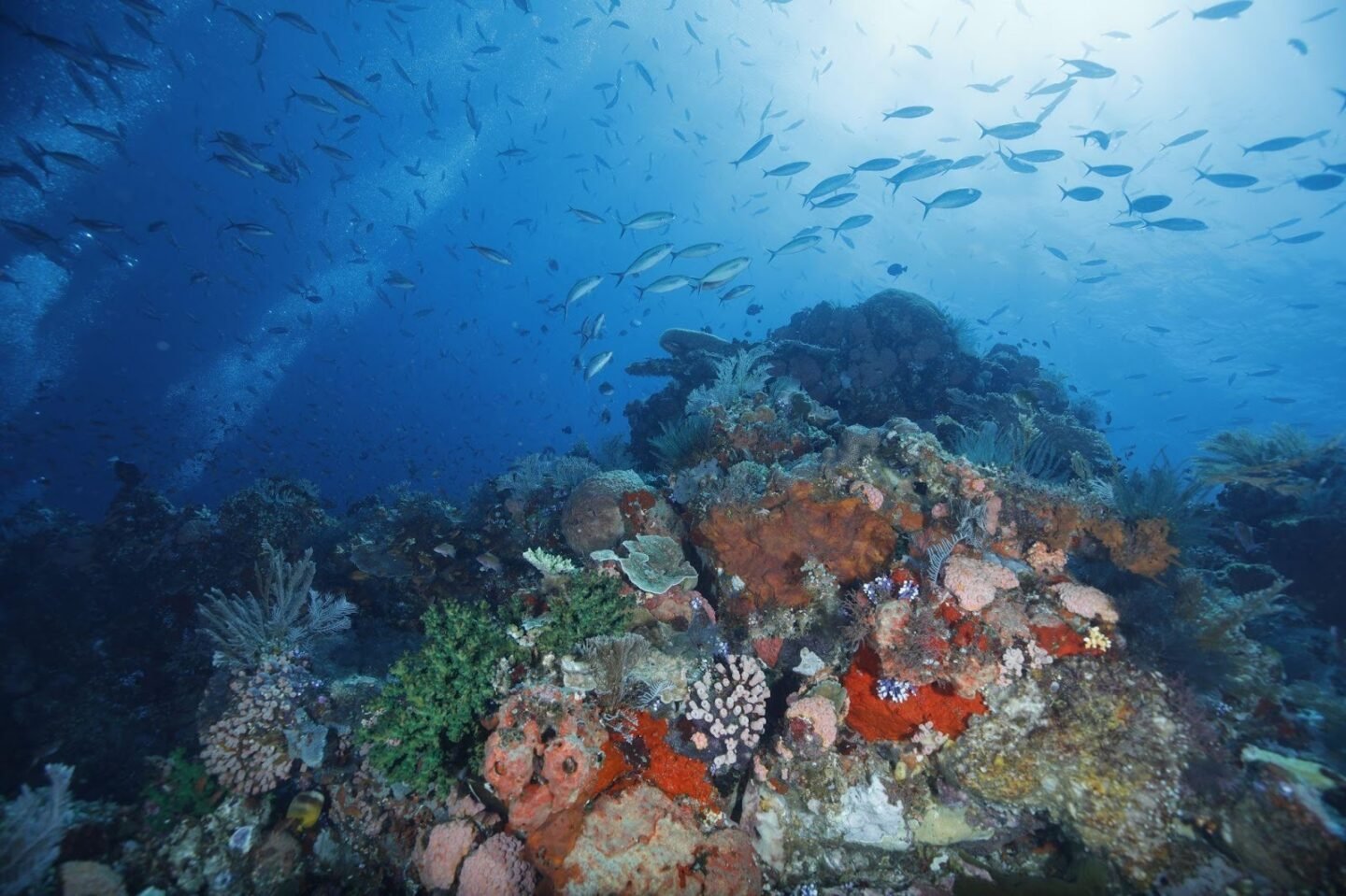
What Coral Really Is
Corals are living animals. They are colonies of tiny polyps that live in symbiosis with microscopic algae called zooxanthellae. These algae give corals their colour and provide energy through photosynthesis.
This relationship is highly efficient, but also extremely sensitive. Even small environmental changes can disrupt the symbiosis.
Read Also: Symbiotic Relationships: 8 Incredible Underwater Symbiotic Relationships
A Narrow Environmental Comfort Zone
Corals can survive only within a very narrow range of temperature, pH, and water quality. An increase in sea temperature of around one degree Celsius above normal seasonal peaks, especially when sustained over time, can:
- disrupt coral metabolism,
- trigger chronic stress,
- weaken growth and survival capacity.
This is the core of coral fragility. Not weakness, but extreme precision.
When Damage Starts Quietly
Stress Before Visible Damage
One of the most common misunderstandings is that coral damage is always obvious. In reality, stress often develops slowly and quietly.
Corals may remain upright, colourful, and seemingly normal while:
- gradually losing zooxanthellae,
- experiencing reduced energy levels,
- beginning to fail reproductively.
Why Bleaching Isn’t Always Obvious
Bleaching does not always result in starkly white corals. In its early stages, changes can be subtle, such as slightly faded colours, slower growth, or impacts that only become visible over time.
For divers, this means one important thing: A beautiful reef today is not necessarily an ecologically healthy one.
Read Also: How Ocean Pollution Affects Humans and What We Can Do About It?
Repeated Stress Breaks Reef Resilience
Reefs Need Time to Recover
The greatest challenge facing modern coral reefs is not a single bleaching event, but stress that occurs too frequently.
Historically, reefs often had decades to recover after major disturbances. Today, marine heatwaves can occur every few years or even more often.
When Stress Comes Too Often
As a result:
- corals die before recovery is possible,
- community structures shift permanently,
- long-term resilience is lost.
The key message is clear.
Corals are not failing to adapt. They are running out of time.
When a Reef Still Looks Beautiful but No Longer Functions
Losing Balance Without Losing Beauty
Not all damage leads to immediate collapse. Research by Hoegh-Guldberg and Bellwood shows that reefs can retain their skeletal structure while:
- growth slows,
- the ecosystem balance is disrupted.
How Ecosystem Functions Decline Without Obvious Visual Clues
When herbivorous fish decline, algae begin to dominate. The reef may still look intact, but its ecological functions diminish. Productivity drops, coastal protection weakens, and biodiversity declines.
This leads to one of the most important insights:
Visual beauty does not equal ecological function.
Why This Matters for Ocean Travellers
What Divers and Snorkellers Often Miss
For those who spend time in the ocean, diving, snorkelling, or simply enjoying reef views, this understanding changes how reefs are perceived. The goal is not to induce guilt, but to build awareness.
Why “Looks Healthy” Can Be Misleading
A calm, colourful reef may be close to a critical threshold. Recognising this helps travellers be more cautious, maintain an appropriate distance, and understand why responsible tourism practices.
Fragile Doesn’t Mean Hopeless
Reefs Can Recover Under the Right Conditions
Corals can recover when pressure is reduced and balance is restored. Many reefs show signs of recovery when:
- temperatures stabilise,
- water quality improves,
- human pressure is minimised.
Read Also: What is Ocean Sound and Underwater Noise Pollution?
Why Thoughtful Travel Still Matters
Small choices matter. Selecting responsible operators means choosing those that actively limit environmental pressure rather than simply moving divers through popular sites. This includes controlling group size, planning dives around site sensitivity and conditions, enforcing strict buoyancy and no-contact policies, and prioritising reef health over rigid schedules.
Operators that work this way reduce cumulative stress on corals. Fewer divers at one time means less sediment disturbance, fewer accidental contacts, and more stable conditions for fragile reef organisms to recover between visits.
Some marine operators are built around these principles. La Galigo Liveaboard, for example, operates with a calm and considered approach: unhurried diving, reduced pressure on sensitive sites, and consistent encouragement for guests to observe rather than simply pass through.
Seeing Coral Reefs Differently
Seeing coral reefs is no longer just about appreciating beauty. It is about understanding the fragility hidden beneath that beauty. Corals are not fragile because they are weak, but because they depend on an exceptionally delicate balance.
With this perspective, we do not merely enjoy the ocean. We learn to respect it.
FAQ
Why are coral reefs considered fragile?
Because corals live within a very narrow environmental balance, even small changes can cause stress, despite their solid appearance.
How fragile is coral?
An increase in sea temperature of around one degree Celsius is enough to weaken corals, often without obvious visual signs.
What has made coral reef fragility worse?
Stress that occurs too frequently, including ocean warming, changes in water chemistry, and human pressure, leaves corals with insufficient time to recover.
Can we survive without coral reefs?
Possibly, but at great risk. Coral reefs protect coastlines, support fisheries, and help maintain ocean balance.
How old are the oldest coral reefs?
Some coral reefs have developed over thousands of years, yet they can be damaged in a far shorter time.
References
IPCC. (2018). Global warming of 1.5°C: An IPCC special report on the impacts of global warming of 1.5°C above pre-industrial levels.
Bellwood, D. R., Hughes, T. P., Folke, C., & Nyström, M. (2004). Confronting the coral reef crisis. Nature, 429(6994), 827–833.
Hoegh-Guldberg, O., Mumby, P. J., Hooten, A. J., Steneck, R. S., Greenfield, P., Gomez, E.,Hatziolos, M. E. (2007). Coral reefs under rapid climate change and ocean acidification. Science, 318(5857), 1737–1742.
Hughes, T. P., Kerry, J. T., Álvarez-Noriega, M., Álvarez-Romero, J. G., Anderson, K. D., Baird, A. H., … Wilson, S. K. (2017). Global warming and recurrent mass bleaching of corals. Nature, 543(7645), 373–377.
Lesser, M. P. (2011). Coral bleaching: Causes and mechanisms. Coral Reefs, 30(1), 1–17. https://doi.org/10.1007/s00338-010-0692-5
NOAA. (n.d.). What is coral bleaching? National Ocean Service.
NOAA. (n.d.). Coral reef conservation. National Marine Fisheries Service.