
For many divers, the term dive briefing may sound simple. A short explanation before entering the water. On a liveaboard, especially one operating in remote regions, a dive briefing is far more than an introduction to a dive. It is the foundation of the entire safety system, operational planning, and the smooth flow of the diving experience.
This article explains how dive briefings work on liveaboards, why their role is far more critical than on day trips, and what guests need to understand, particularly those joining a liveaboard for the first time.
The Importance of Dive Briefings on a Liveaboard
Because liveaboards operate in remote marine environments, onboard systems and crew coordination become the primary safety framework.
In this context, a dive briefing is a structured pre-dive session designed to align crew and guests around a shared understanding of the planned dive. It is not only about which site will be dived, but about how the entire dive will be conducted safely and in a coordinated manner, from entry to exit and return to the vessel.
For this reason, dive briefings on a liveaboard function as:
- A tool for alignment between crew and guests
- A channel for communicating risks and mitigation measures
- A preventive mechanism, rather than a reactive response
A well-delivered briefing ensures that everyone understands what will be done, where, when, and what to do if the plan changes. Without clear and consistent briefings, dives can become uncoordinated, confusing, and potentially risky, particularly in remote locations where there is little margin for error.
How Dive Briefings Work on a Liveaboard
On a liveaboard, dive briefings are not one-off events. They are part of an ongoing process that follows the rhythm of the vessel.
A typical day usually includes:
- A morning briefing with an overview of conditions and plans
- A pre-dive briefing before each dive
- Occasionally, a short debrief after the dive.
The information shared is always dynamic and adjusted to real-time sea and environmental conditions.
Briefings as an Onboard System
What distinguishes liveaboard dive briefings from standard briefings is their role as part of the onboard operational system.
Briefings are directly linked to:
- The vessel’s schedule
- Tender movements
- Crew positioning at entry and exit points
- Time management between dives
- Emergency procedures
In other words, a dive briefing is not only communication with divers, but a coordination mechanism for the entire vessel operation.
What Is Covered in a Liveaboard Dive Briefing
A liveaboard dive briefing typically includes:
- Dive Site Description
Underwater topography such as slopes, walls, channels, or seamounts. This helps divers visualise the dive route before entering the water. - Environmental Conditions
Current direction and strength, visibility, water temperature, and possible changes during the dive. - Entry and Exit Procedures
Whether entry is via back roll, giant stride, or tender, exit points and signalling methods are also explained. - Dive Plan
Dive direction, maximum depth, bottom time, and options for divers who need to end the dive early. - Safety Procedures
Lost buddy protocols, strong current scenarios, delayed SMB use, and actions to take if separated from the group. - Environmental Awareness
Sensitive areas, reef protection, and expected behaviour during the dive.
To better understand the role of dive briefings on a liveaboard, it helps to compare them with the format used in land-based dive centres.
Dive Briefings on Day Trips
At dive centres or day-trip operations, dive briefings are usually designed for shorter, more focused dive activities within a single area. Because operations are land-based, many logistical and safety aspects are supported by nearby infrastructure.
Briefings are commonly conducted:
- At the dive shop
- On a speedboat
- Or shortly before entering the water
They tend to be concise and to the point, based on the assumption that:
- Dive sites are relatively easy to access
- Conditions are well known to guides.
- External assistance can be reached quickly if needed.
The main focus of day-trip briefings typically includes:
- A short dive site description
- Maximum depth and dive time
- Dive direction and meeting points
- Common hazards at the site
Because only one or two dives are planned, these briefings serve as basic orientation. They provide sufficient information to ensure safe diving without overwhelming guests.
In addition, the margin for error is relatively larger. If issues arise:
- Dives can be cancelled or shortened
- Guests can return to land.
- Equipment can be replaced.
- Medical assistance is more accessible.
These factors make day-trip dive briefings practical, efficient, and situational. This is not because they are less important, but because the operational environment is simpler than on a liveaboard.
Dive Briefings in Liveaboard vs Dive Centre: Key Differences
| Aspect | Dive Centre / Day Trips | Liveaboard in Remote Locations |
| Briefing duration | Relatively short | Longer, layered, and more detailed |
| Dive focus | One site, one or two dives | Multiple dives integrated with the vessel schedule |
| Operational context | Land-based | Fully vessel-based |
| Land support | Always available | Managed through onboard systems and crew coordination |
| Decision-making | More static, rarely changes | Dynamic, based on real-time sea conditions |
| Crew role | Guides and instructors | Primary safety and logistics system |
| Margin for error | Greater due to operational flexibility | Greater emphasis on precision and teamwork |
| Main briefing purpose | Basic pre-dive orientation | Safety, coordination, and operational flow |
The Crew’s Role in Liveaboard Dive Briefings
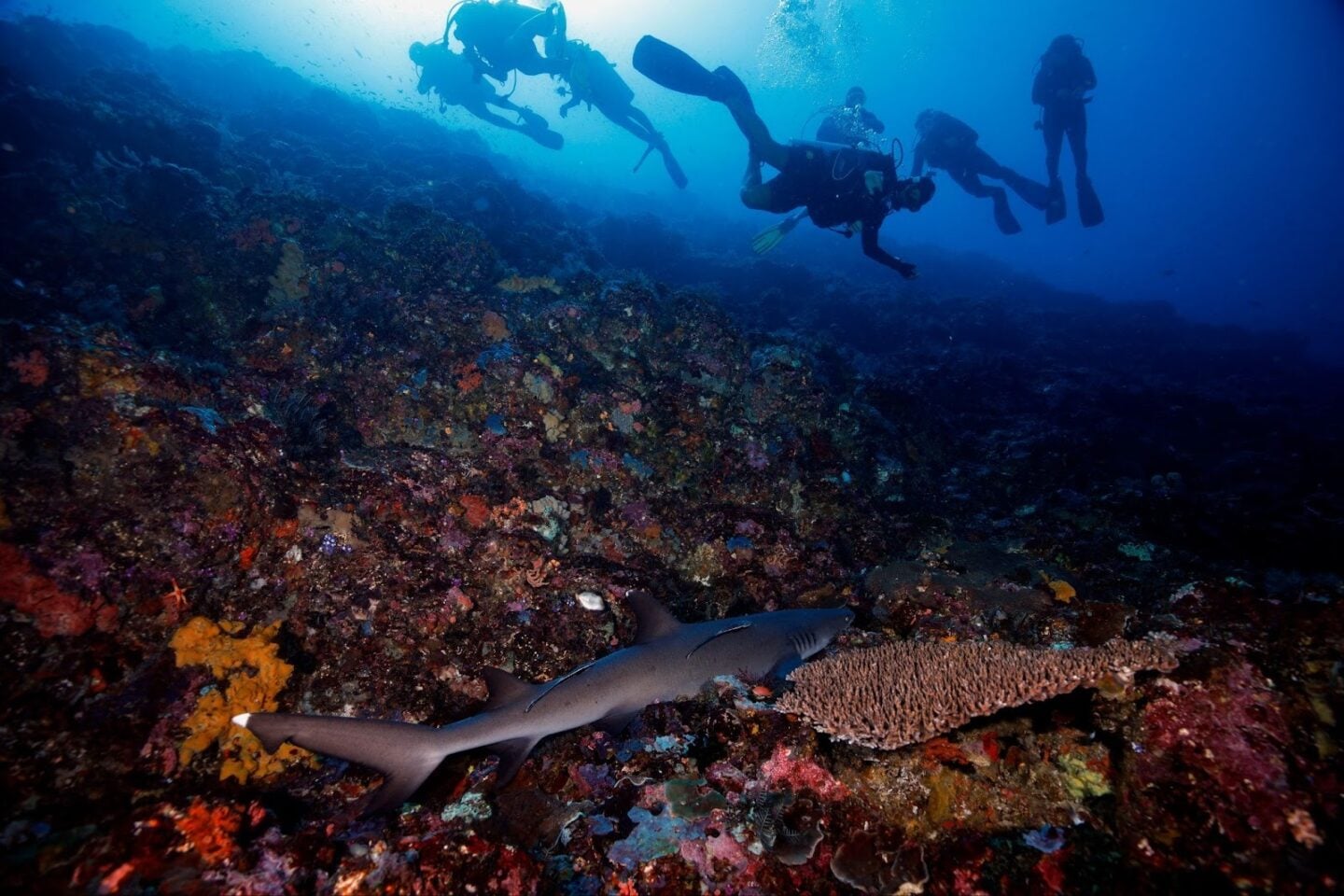
Effective dive briefings rely heavily on the crew. On a liveaboard, briefings are usually led by the Cruise Director, Dive Master, or a combination of both. In reality, however, briefings are the result of coordinated teamwork.
Behind the scenes:
- The captain provides up-to-date information on sea and weather conditions
- Deck crew ensure entry and exit procedures are safe and efficient.
- Tender drivers understand routes, currents, and pick-up timing.
- Dive guides adjust groupings based on guests ability and pace.
Beyond delivering information, an experienced crew reads guest dynamics. They observe who is comfortable in the water, who needs more time to adapt, and how to structure groups so that each dive remains safe without sacrificing comfort.
This is the approach applied by the crew of La Galigo Liveaboard. Briefings are delivered calmly and clearly, without rushing, allowing guests time to understand the dive context and ask questions. The crew also observes guest responses from the first day, including during the check dive, so that subsequent briefings can be adjusted to real conditions on board.
In this way, dive briefings become more than a routine. They are part of a service system that ensures guests feel supported, understood, and confident before every dive.
Check Dives on a Liveaboard
One aspect that often raises questions for guests is the check dive. A check dive is an initial dive conducted at the beginning of a liveaboard trip to help both crew and guests adapt before the main dive programme begins.
Although it takes place in the ocean, a check dive is usually conducted in a sheltered and relatively calm environment, such as a lagoon or house reef. It is not a test and not a formal assessment, but a preventive step to ensure that all subsequent dives are safer, more comfortable, and better coordinated.
What is the Purpose of a liveaboard check dive?
A liveaboard check dive is not an exam and not a skills test. There are no scores, no pass or fail criteria, and no pressure to prove ability. Instead, it is a shared adaptation process between guests, crew, and the local environment.
The main purposes of a check dive include:
- Adapting to Local Sea Conditions
Every body of water has its own character. Currents, visibility, temperature, and seabed type may differ significantly from the last location a guest dived. A check dive allows gradual adaptation before more demanding dives. - Buoyancy and Weighting Adjustment
Changes in salinity, wetsuit type, or gear configuration often affect weighting. A check dive provides time to make adjustments calmly, without time pressure, resulting in more stable buoyancy on later dives. - Observing Diver Comfort and Control
For the crew, the check dive is an opportunity to observe how guests:- Control buoyancy
- Manage breathing
- Move near the reef
- Respond to underwater instructions.
- These observations help the crew understand individual needs, including who may require closer guidance.
- Appropriate Diver Grouping
Based on the check dive, the crew can form more balanced dive groups by matching divers with similar pace and experience. This supports safety, efficiency, and comfort for everyone.
A Controlled Check Dive Environment
Check dives are typically conducted in carefully selected areas such as:
- Lagoons
- Sheltered bays
- House reefs
- Areas with minimal current
These locations allow for low-risk dives while still reflecting real local conditions. Although conducted in open water, the environment is chosen to be safe for adaptation, yet realistic enough for observation.
With this approach, the check dive becomes a key foundation for the entire liveaboard diving programme. It builds confidence for guests and provides operational clarity for the crew before more challenging dives begin.
Check Dives at Dive Centres
Read Also: Dive Centre vs Liveaboard
At dive centres, a check dive is often referred to as a refreshment or refresher dive. It is usually intended for guests who:
- Have not dived for a long time
- Have recently completed certification
- Want to rebuild comfort before regular dives.
Refresher dives at dive centres are often conducted in swimming pools or very shallow, calm water. These environments allow divers to practise without environmental pressure, such as currents, waves, or variable visibility.
The main focus of a refresher dive is basic skill revision, including:
- Buoyancy control
- Mask clearing
- Regulator recovery
- Basic trim and finning
In this context, instructors or guides take an active role as supervisors and correctors, ensuring that guests recall core procedures correctly. Refresher dives are often accompanied by additional explanations on land before or after the session.
Because they are conducted in controlled environments close to land facilities, refresher dives at dive centres are:
- Educational
- Relatively relaxed
- Easy to stop or repeat if needed
This approach is highly effective for rebuilding confidence before more complex dives. However, because the environment differs from open water, refresher dives do not always reflect real conditions encountered later. This is where the fundamental difference with liveaboard check dives becomes clear.
Check Dive Differences: Liveaboard vs Dive Centre
| Aspect | Dive Centre | Liveaboard |
| Common term | Refreshment or refresher dive | Check dive |
| Location | Pool or very shallow water | Open water in a controlled environment |
| Dive nature | Skills practice | Supervised a fun dive |
| Primary focus | Basic skills | Real-world adaptation and crew observation |
| Environmental context | Artificial or very calm | Natural, selected for minimal risk |
| Operational purpose | Restore diver comfort | Prepare divers for the main dive sequence |
| Crew role | Instructor or guide | Observer and dive group coordinator |
| Impact on subsequent dives | Limited | Determines grouping and dive planning |
How Good Briefings Create Seamless Diving
Well-executed dive briefings create a diving experience that flows without friction.
Their impact includes:
- Smoother transitions between dives
- Less confusion and stress
- Fewer miscommunications
- More time enjoying the underwater world
Guests do not need to constantly ask questions or guess what to do next. Everyone moves with the same understanding.
Verdict
On a liveaboard, dive briefings are the heart of the diving experience. They bring together safety, planning, and comfort into a single, interconnected system.
When briefings are done well, dives feel calmer, more structured, and more meaningful. Not only because everyone knows what to do, but because trust is established between crew, guests, and the sea itself.
For anyone seeking a complete liveaboard experience, understanding the role of dive briefings is an essential first step.
Frequently Asked Questions
What is a liveaboard dive briefing?
A liveaboard dive briefing is a structured pre-dive session that integrates the dive plan, sea conditions, safety procedures, and vessel operations. Its purpose is not only to inform, but to ensure shared understanding between crew and guests before entering the water.
Is a liveaboard dive briefing different from one at a dive centre?
Yes. On a liveaboard, briefings are usually more detailed and layered because operations take place in open water, often in remote locations. With no immediate land support, briefings become a critical part of safety and coordination.
Why do liveaboard dive briefings feel longer?
Because they cover more than just the dive site, in addition to topography and depth, they address currents, vessel or tender entry and exit, emergency procedures, and real-time plan adjustments.
Do I need to attend every dive briefing?
Yes. Attending briefings is part of the guest’s responsibility. Information is often specific to each dive and may change daily. Missing a briefing means risking the loss of important details.
What should guests do to benefit most from briefings?
Listen carefully, ask questions when needed, and share relevant personal conditions, such as long intervals since your last dive. Dive briefings are designed to support guests, not to limit their experience.