
Have you ever seen a marine animal that seems to disappear right before your eyes? One moment its body is brown, the next it becomes white with speckles, and moments later it blends perfectly with the surrounding coral or sandy seabed. If you are not paying close attention, you could easily swim straight past it without ever noticing it was there.
This is one reason we at La Galigo are always fascinated whenever we encounter a cuttlefish while exploring Indonesia’s waters. This remarkable animal is not only a fantastic subject for underwater photography, but also one of the most extraordinary examples of adaptation in the marine world.
Let’s take a closer look at Nature’s Master of Disguise.
What Is a Cuttlefish?
Although its English name includes the word fish, a cuttlefish is not a fish. It belongs to the cephalopods, a group of molluscs that also includes octopuses, squids, and nautiluses.
Like its fellow cephalopods, a cuttlefish has a well-developed head, large eyes, eight arms, and two long tentacles used to capture prey.
Cuttlefish also have a relatively flattened body with fins running along each side of the mantle. These fins allow them to move slowly and gracefully as they explore coral reefs and sandy seabeds. When threatened, they can accelerate using jet propulsion, expelling water through a siphon to propel themselves rapidly away from danger.
What Makes Cuttlefish So Unique?
Among the thousands of species that inhabit the ocean, what makes cuttlefish so special?
The answer is not just one thing. From their extraordinary camouflage abilities to their highly strategic hunting techniques, cuttlefish possess a range of adaptations that set them apart from most marine animals. Let’s explore some of the remarkable features that make them one of the ocean’s most fascinating creatures.
A Master of Camouflage
Camouflage is the feature for which cuttlefish are best known. They can change the colour, pattern, and even the texture of their skin within seconds to match their surroundings. Cuttlefish select their camouflage pattern based on the visual information they receive, including the size of nearby objects, contrast, and the structure of the seabed. This extraordinary ability has earned them the title Nature’s Master of Disguise.
A Patient and Precise Hunter
Rather than chasing prey at high speed, cuttlefish rely on patience. They move slowly while blending into their surroundings, then launch their two specialised tentacles with remarkable speed when prey comes within range. This strategy lets them hunt efficiently without expending unnecessary energy.
Exceptional Vision
Behind their impressive camouflage lies an exceptionally advanced visual system. Here is the strangest part. As far as researchers can tell, cuttlefish are colourblind. They have only one type of visual pigment, so they almost certainly see the reef in something close to black and white. Yet they produce colour-matched camouflage against complex, multicoloured backgrounds, and they get it right. Exactly how remains an open question. What is clear is that they are extraordinarily good at reading brightness, contrast, edges, and the size of objects around them, and that this is the information their camouflage is built from.
The Secret Behind Their Graceful Movement
Another remarkable feature that often goes unnoticed is the cuttlebone, a lightweight internal structure that regulates buoyancy. Thanks to the cuttlebone, cuttlefish can hover effortlessly in the water without constantly swimming. This adaptation helps them conserve energy while hunting and exploring their habitat.
Together, these adaptations make cuttlefish not only highly efficient predators but also one of the most extraordinary marine animals you may encounter while diving. In the next section, we will take a closer look at how cuttlefish can transform the colour and texture of their skin within seconds.
How Do Cuttlefish Change Their Colour and Skin Texture?
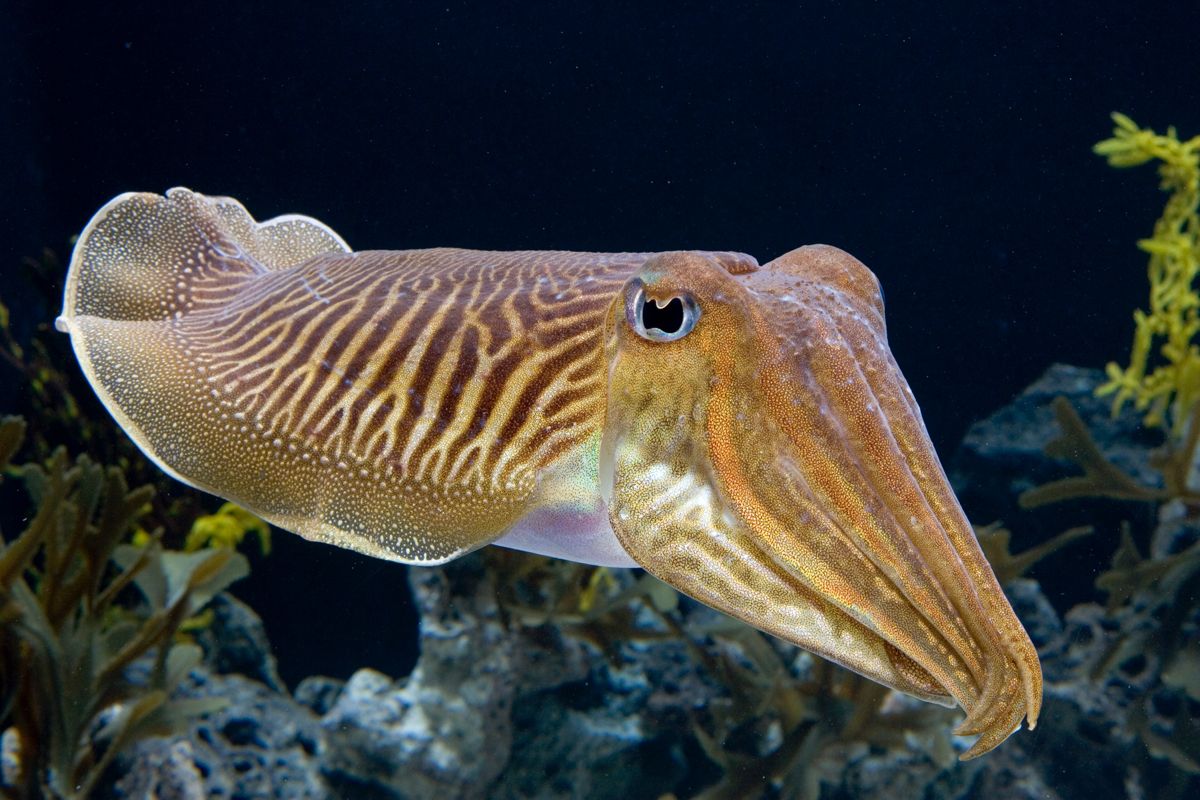
Specialised Skin Cells Enable Instant Camouflage
The secret behind a cuttlefish’s camouflage lies within its skin. Beneath the surface are thousands of pigment cells called chromatophores, which can expand or contract extremely quickly under the control of the nervous system. Cuttlefish also possess iridophores and leucophores, layers of cells that reflect and scatter light to produce different visual effects. In addition, skin structures known as papillae allow the surface of their bodies to become smooth or resemble the texture of rocks and coral.
Their Eyes Guide Every Colour Change
Cuttlefish do not change colour at random. They first analyse the size of nearby objects, contrast, edge definition, and surrounding patterns before selecting the camouflage that best matches their environment.
Different Patterns Match Different Habitats
Scientists generally classify cuttlefish camouflage into three main pattern types: uniform for relatively even environments, mottle for moderately textured habitats, and disruptive, which uses bold contrasts to break up the body’s outline and make it harder to detect.
Where Do Cuttlefish Live?
Cuttlefish are commonly found in shallow coastal waters rich in natural structures. Coral reefs, seagrass meadows, sandy seabeds, and rocky areas all provide ideal habitats, offering both shelter and productive hunting grounds.
Most cuttlefish species are found throughout the Indo-Pacific, the Mediterranean Sea, and the coastal waters of Africa and Australia. The Indo-Pacific is recognised as one of the world’s richest marine biodiversity hotspots, so it is no surprise that many cuttlefish species inhabit this region.
There is one striking gap in that distribution: cuttlefish are entirely absent from the Americas. Neither the Atlantic nor the Pacific coast has a single native species, which is why they remain unfamiliar to a great many divers until they come to this side of the world.
Healthy habitats are also essential for their survival. Well-preserved coral reefs provide refuge, while biologically rich seabeds supply food for a wide variety of cuttlefish species.
Read Also: Surprising and Rare Marine Animals Found in Indonesia
When Are You Most Likely to Encounter Cuttlefish?
There is no single answer that applies to every cuttlefish species around the world. Their activity depends on the species, location, season, and environmental conditions.
However, several situations generally increase your chances of encountering a cuttlefish while diving.
One of the best opportunities is when they are hunting. Because they rely on camouflage to approach prey, cuttlefish are often seen moving slowly across sandy seabeds, seagrass meadows, or among coral while continuously adjusting their body colour.
For some species, the breeding season is also a fascinating time to observe them. During this period, their body patterns can become far more striking than when they are camouflaging themselves. Males display dynamic combinations of colours and patterns as part of their interactions with other cuttlefish.
For divers, the best opportunities usually come when the water is calm, and visibility is good. Under these conditions, you are more likely to observe their changing colours and natural behaviour without interference from strong currents or poor visibility.
We always recommend moving slowly and maintaining a respectful distance. The calmer you are in the water, the more likely a cuttlefish is to continue displaying its natural behaviour.
Which Cuttlefish Species Should You Know?
More than one hundred cuttlefish species have been described by scientists to date. Each has its own distinctive size, body pattern, and preferred habitat.
Some of the most fascinating species include:
Common Cuttlefish (Sepia officinalis)
This is one of the most extensively studied cuttlefish species, particularly for its camouflage abilities. Its remarkable capacity to alter body patterns has formed the basis of numerous studies on visual systems and colour change. It is native to the Northeast Atlantic and Mediterranean regions.
Pharaoh Cuttlefish (Sepia pharaonis)
Larger in size, this species is widely distributed throughout the Indo-Pacific, including Southeast Asia. It is commonly found around coral reefs and sandy seabeds.
Flamboyant Cuttlefish (Metasepia pfefferi)
Unlike most cuttlefish, this species displays strikingly bright colours when active. Its distinctive appearance has made it a favourite subject for underwater photographers.
Broadclub Cuttlefish (Sepia latimanus)
This is the one you are most likely to meet in Indonesian waters. A large reef cuttlefish found across the Coral Triangle, it is a familiar subject in underwater photography in Indonesia. Watch it hunt: as it closes on a crab, bands of dark colour roll down its arms and across its body in a slow, rhythmic pulse known as the “passing cloud” display, apparently transfixing the prey long enough for its tentacles to strike.
Giant Australian Cuttlefish (Sepia apama)
This is the largest cuttlefish species in the world and is confined to southern Australia. Every year, thousands gather along the coast of South Australia to breed, creating one of the most spectacular natural events in the underwater world.
Although each species has its own unique characteristics, they all share an extraordinary ability to blend seamlessly into their surroundings.
Where Can You See Cuttlefish in Indonesia?
As part of the Coral Triangle, Indonesia offers a wide range of habitats that are ideal for cuttlefish. While no dive can guarantee an encounter, your chances are high in areas with healthy coral reefs, sandy seabeds, and seagrass meadows.
Raja Ampat
Raja Ampat is recognised as one of the world’s richest marine biodiversity hotspots. Its exceptionally diverse marine environment provides suitable habitat for a wide variety of cephalopods, including cuttlefish.
While diving in Raja Ampat, do not focus only on pelagic fish or colourful coral reefs. Take time to scan the seabed and smaller coral outcrops. That is often where the real surprises are waiting.
Komodo National Park
Komodo National Park offers a diverse mix of coral reefs, rocky slopes, and sandy bottoms that provide ideal habitats for many marine species.
At several dive sites, you can often see cuttlefish hunting or camouflaging themselves among the coral. Encounters like these are often among the highlights for underwater photographers.
Alor
Alor is becoming increasingly well known as an outstanding macro diving destination. Its waters are home to a remarkable variety of small marine creatures with unique behaviours, making it an exceptionally rewarding destination for divers and underwater photographers.
One particularly unusual example is the flamboyant cuttlefish, a muck-diving species found on black sand and silty seabeds rather than coral reefs. Instead of swimming continuously, it can walk along the seabed on its arms, making it a fascinating subject for underwater photographers.
For divers who enjoy observing marine life slowly and appreciating the finer details, Alor offers an exceptionally rewarding experience. We believe that finding a cuttlefish is about more than luck. It requires patience, careful observation, and respect for marine life.
Final Thoughts
Cuttlefish may not be the largest or most eye-catching creatures in the ocean. Yet behind their relatively small size lies one of the most remarkable examples of adaptation in the animal kingdom.
Their ability to change colour, pattern, and skin texture is far more than an impressive visual display. It is a survival strategy that has evolved over millions of years to help them hunt, avoid predators, and interact with their environment. Scientific research shows that cuttlefish camouflage results from a sophisticated visual system combined with exceptionally precise body control, making it one of the finest examples of evolutionary adaptation in the marine world.
At La Galigo, every encounter with a cuttlefish reminds us that the ocean’s greatest wonders are not always the largest or the most dramatic. Sometimes, the most unforgettable experience comes from an animal that is almost impossible to see, until you suddenly realise that the “rock” in front of you has quietly begun to move.
As you explore Raja Ampat, Komodo, Alor, and other extraordinary destinations with us, remember to slow your fin strokes and pay attention to the smaller details around you. You never know when Nature’s Master of Disguise might reveal one of the most extraordinary performances you will ever witness beneath the surface.
Frequently Asked Questions
Are Cuttlefish Dangerous to Humans?
No. Cuttlefish are generally not aggressive towards humans and prefer to avoid threats by camouflaging themselves or swimming away. As long as you observe them calmly and avoid disturbing their habitat, cuttlefish are safe and fascinating marine animals to encounter while diving.
What’s the Difference Between a Cuttlefish, Squid, and Octopus?
All three belong to the cephalopod group, but each has distinct characteristics. Cuttlefish have a flatter body and an internal cuttlebone that helps regulate buoyancy. Squid have a more streamlined body designed for fast swimming. In contrast, octopuses have no shell or skeleton of any kind and typically live on the seabed, using their eight highly flexible arms to move and explore their surroundings. Because they lack a shell or skeleton, octopuses can squeeze through remarkably small openings, sometimes as small as their eyes.
Can Cuttlefish Really Change Their Skin Texture?
Yes. In addition to changing their colour and patterns, cuttlefish can also alter their skin texture using specialised structures called papillae. This allows them to mimic rocks, coral, or the seabed, making their camouflage even more effective.
Where Is the Best Place to See Cuttlefish in Indonesia?
Some of the best diving destinations to encounter cuttlefish in Indonesia include Raja Ampat, Komodo National Park, and Alor. Waters with healthy coral reefs and sandy seabeds provide some of the best opportunities to spot them.
Why Are Cuttlefish Called Nature’s Master of Disguise?
They have earned this nickname because of their extraordinary ability to change the colour, pattern, and texture of their skin within seconds. This remarkable adaptation allows them to blend seamlessly into their surroundings, helping them hunt, avoid predators, and communicate with other cuttlefish.
References
Chiao, C.-C., Chubb, C., Buresch, K. C., Barbosa, A., Allen, J. J., Mäthger, L. M., Stevens, M., & Hanlon, R. T. (2010). Mottle camouflage patterns in cuttlefish: Quantitative characterization and visual background stimuli that evoke them. Journal of Experimental Biology, 213(2), 187–199.
Hanlon, R. T., Chiao, C.-C., Mäthger, L. M., Barbosa, A., Buresch, K. C., & Chubb, C. (2009). Cephalopod dynamic camouflage: Bridging the continuum between background matching and disruptive coloration. Philosophical Transactions of the Royal Society B: Biological Sciences, 364(1516), 429–437.
Kelman, E. J., Osorio, D., & Baddeley, R. J. (2008). A review of cuttlefish camouflage and object recognition and evidence for depth perception. Journal of Experimental Biology, 211(11), 1757–1763.