
There are coral reefs, and then there is the Raja Ampat coral reef: one of the richest marine ecosystems on Earth.
Out here, in the far eastern edge of Indonesia, the ocean does not simply look alive. It behaves like a city at rush hour. Fish move in traffic. Corals rise like old cathedrals. Reef sharks pass with the casual confidence of locals who know they were here first. Soft corals bloom in colors that feel almost illegal. Purple. Gold. Fire orange. Electric pink.
Raja Ampat is not just another beautiful dive destination. It is one of the most important marine ecosystems on Earth. For divers, snorkelers, underwater photographers, and anyone who has ever felt the pull of wild ocean, the coral reefs of Raja Ampat are the main event.
You do not need to be a diver to appreciate Raja Ampat’s reefs. In calm conditions, snorkelers can see shallow hard coral gardens, reef fish, juvenile sharks in some lagoon areas, and sometimes manta rays near feeding or cleaning zones.
They are the reason people fly across the world, cross time zones, board liveaboards, and wake up before sunrise with salt on their lips and camera batteries charging in the corner.
READ ALSO: What Are Coral Reefs? The Importance of Marine Ecosystems
Why the Raja Ampat Coral Reef Is So Special
Raja Ampat lies in Southwest Papua, Indonesia, off the northwest tip of New Guinea, at the heart of the Coral Triangle. This region is often called the global center of marine biodiversity, and Raja Ampat is one of its brightest jewels.
The numbers are staggering. Raja Ampat is home to more than 550 coral species and more than 1,600 reef fish species, making it one of the most biodiverse reef systems ever recorded. But the numbers only explain part of the story; what makes Raja Ampat unforgettable is how much life you can see in a single dive.
The real magic is in the density.
On a single dive, you might see massive table corals stacked like dinner plates for giants, soft coral gardens swaying in current, sea fans big enough to hide behind, schools of fusiliers flashing silver in the blue, and tiny pygmy seahorses clinging to gorgonians like secrets.
The Raja Ampat coral reef is not just scenery for divers, it is the foundation of the entire marine ecosystem, supporting juvenile fish, predators, local fisheries, tourism, and coastal protection. It shelters juvenile fish, feeds larger predators, protects coastlines, supports local communities, and keeps the whole marine world breathing.
Exploring the Raja Ampat Coral Reef as a Diver
Raja Ampat diving is famous because it gives divers variety. Not “a few nice sites and one signature dive” variety. Real variety.
You can drop into a current-swept ridge where trevallies and barracuda hunt in open water. A few hours later, you might be drifting over a shallow coral garden so bright and healthy it looks hand-painted. By afternoon, you could be looking for nudibranchs, pipefish, or a wobbegong shark tucked beneath a coral bommie.
The reefs here are layered. Big life, small life, strange life.
For experienced divers, the currents bring drama. Nutrient-rich water fuels the reef and attracts marine life in ridiculous abundance. For newer divers, many sites offer protected bays, gentle slopes, and shallow coral gardens perfect for building confidence.
That is why a responsibly operated Raja Ampat liveaboard is one of the strongest ways to experience the region. The islands are spread across a vast area, and many of the most rewarding reefs require careful timing with tides, currents, and weather rather than simple daily transfers. A liveaboard lets you move with the conditions, reach remote dive sites, and wake up directly above the action.
Instead of spending your best hours transferring between distant sites, you wake up close to the reef, start the day with a proper dive briefing, and move according to the conditions.
READ ALSO: Fascinating Facts About Nudibranchs
What You Can See on the Raja Ampat Coral Reef
The Raja Ampat coral reef is often the first thing that captures your attention.
Healthy reefs have texture. They are not flat, broken fields of rubble. They are architecture. Towers, shelves, walls, caves, overhangs, and gardens. Raja Ampat’s reefs feel three-dimensional in the best possible way.
Common highlights include:
Hard coral gardens
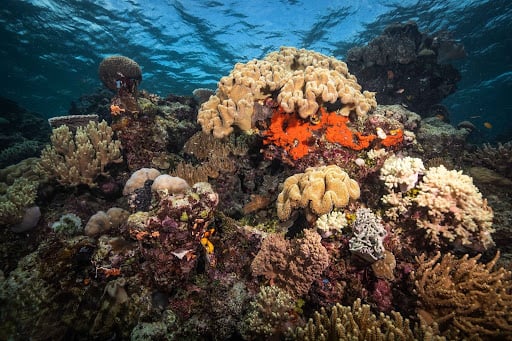
Expect fields of branching coral, massive boulder corals, table corals, lettuce coral, brain coral, and shallow hard coral gardens that create shelter for thousands of reef fish. In shallow water, sunlight turns these gardens into stained glass.
Soft corals and sea fans
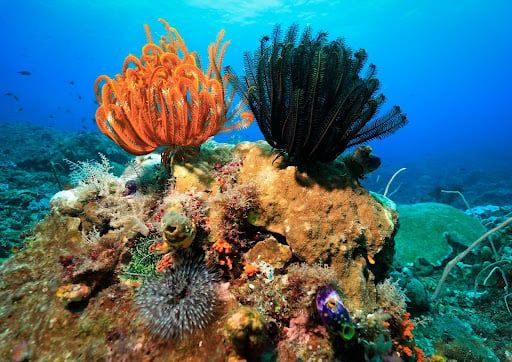
In current-fed areas, soft corals thrive because moving water delivers the nutrients they need to feed and grow. Sea fans spread wide across walls and slopes, often hiding tiny creatures like pygmy seahorses.
Reef fish everywhere
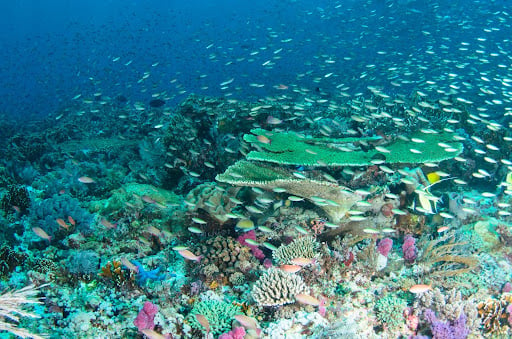
Anthias, damselfish, butterflyfish, angelfish, parrotfish, wrasse, sweetlips, snappers, and fusiliers are constant companions. At famous current-fed sites, the fish biomass can be extraordinary, with fusiliers, snappers, trevallies, barracuda, sweetlips, and anthias filling the reef from bottom to blue water.
Sharks and rays
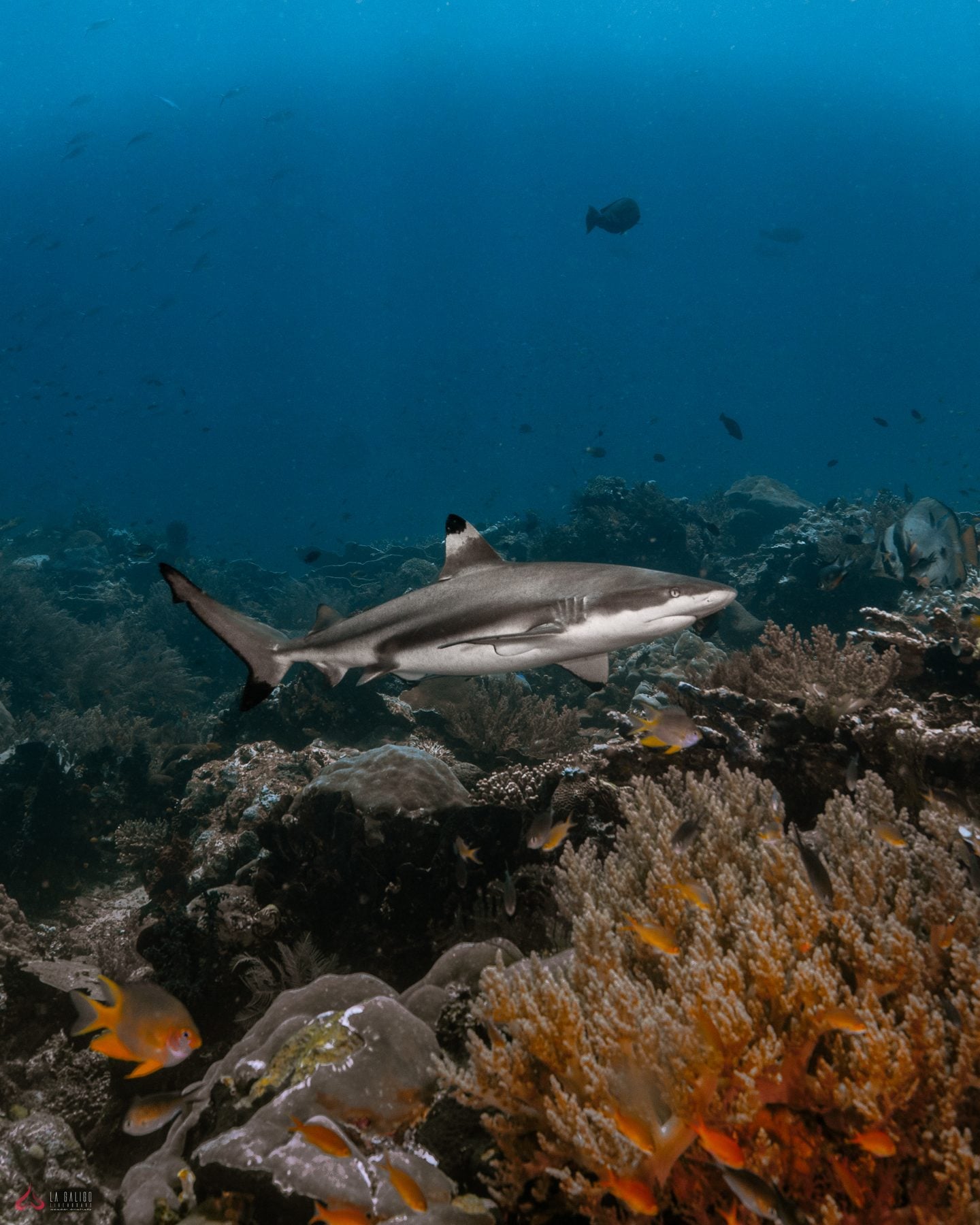
Blacktip reef sharks, whitetip reef sharks, and Raja Ampat’s iconic tasselled wobbegong sharks are regularly seen when conditions and timing are right. Manta rays are one of Raja Ampat’s great icons, especially at cleaning stations and feeding areas where divers may watch them circle slowly through plankton-rich water.
Macro life
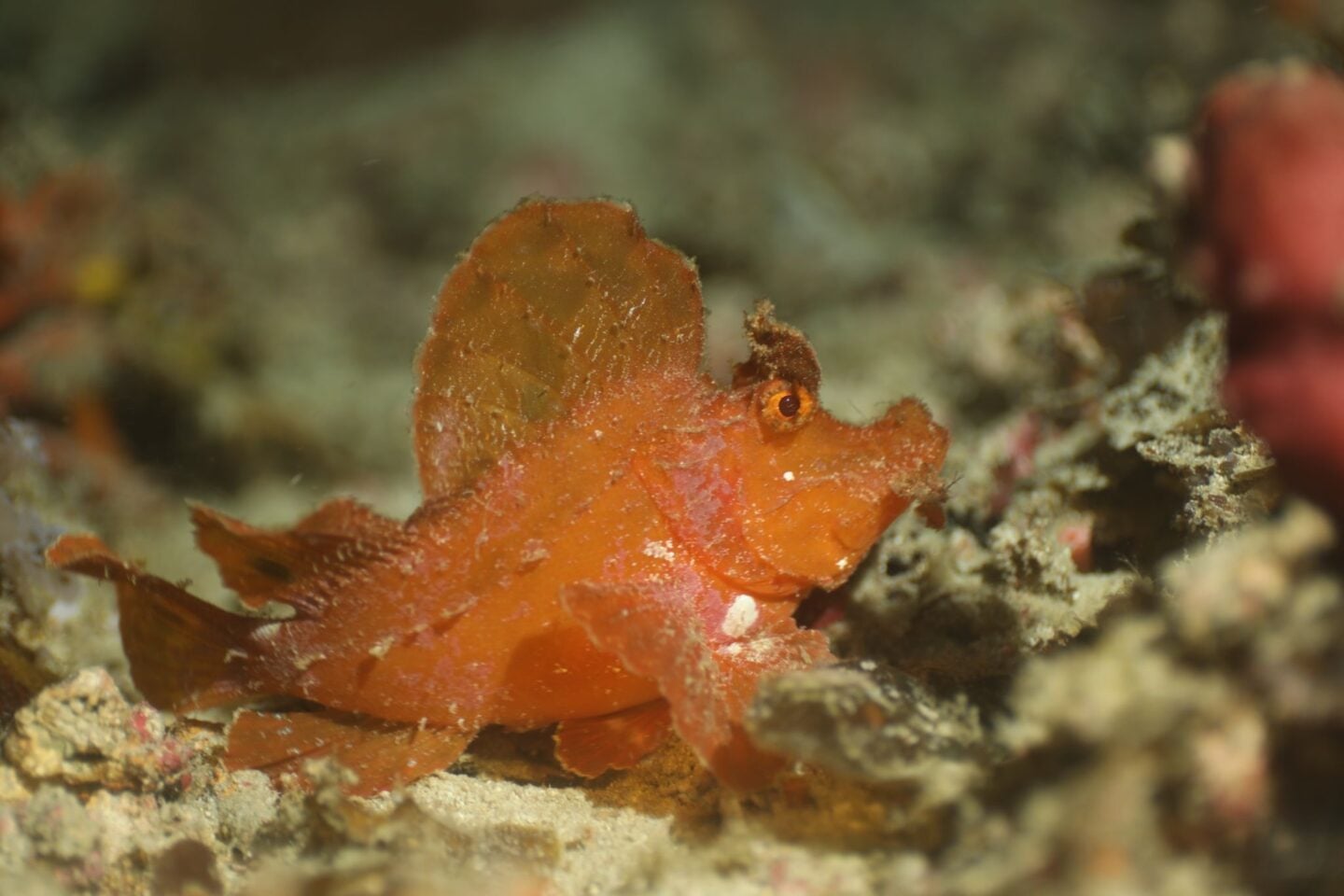
Look closer and the reef changes again. Nudibranchs, flatworms, shrimps, crabs, pipefish, and pygmy seahorses make Raja Ampat just as rewarding for macro photographers as it is for wide-angle shooters.
READ ALSO: Manta Rays of Raja Ampat: Fun Facts About the Ocean’s Gentle Giants
The Best Areas to Experience the Raja Ampat Coral Reef
Raja Ampat is large, and each area has its own flavor. Some reefs are wild and current-heavy. Others are calm, shallow, and perfect for long, slow dives.
Dampier Strait
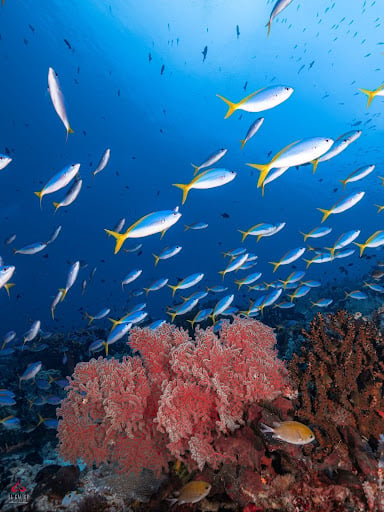
The Dampier Strait is one of Raja Ampat’s most famous diving areas, with well-known sites such as Cape Kri, Blue Magic, Sardine Reef, Chicken Reef, Manta Sandy, and Arborek Jetty. It is known for strong currents, healthy coral, and huge schools of fish. Sites here often feel loud underwater, not in sound, but in movement.
Everything is happening at once.
This area is excellent for divers who want action: schooling fish, reef sharks, manta encounters, vibrant coral slopes, and some of the most energetic current-fed reefs in Raja Ampat.
READ ALSO: Guide to the Dampier Strait: The Best Time to Go, Marine Life and Dive Sites
Misool
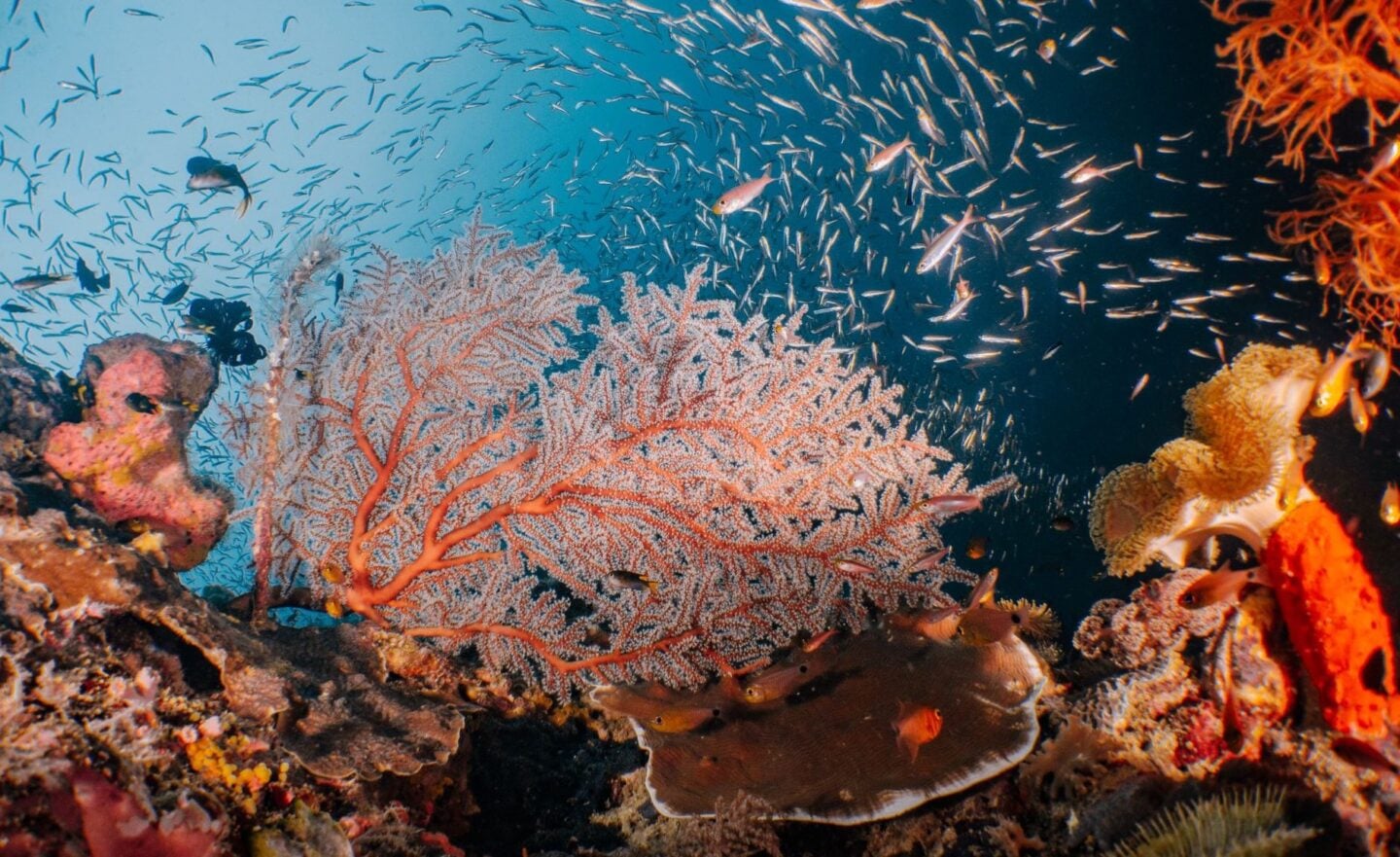
Misool is the dream sequence of southern Raja Ampat, known for soft coral walls, dramatic limestone islands, clear lagoons, and some of the region’s most photogenic reefscapes.
Located in southern Raja Ampat, Misool is known for sites such as Boo Windows, Magic Mountain, Four Kings, Nudi Rock, Yillet, and Tank Rock, where soft corals, sea fans, schooling fish, and dramatic underwater topography come together. The colors here can feel unreal, especially in the shallows.
For underwater photographers, Misool is dangerous territory. Not because of the wildlife, but because every ten seconds something appears that deserves a frame.
Penemu and Wayag
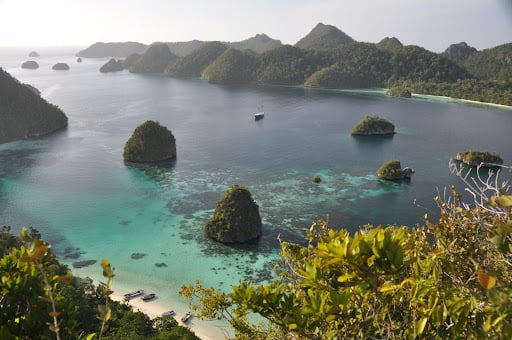
Fam, Penemu, and Wayag are famous for their karst landscapes above water, but their shallow coral gardens, reef slopes, and schooling fish make them just as compelling underwater. Expect coral gardens, reef slopes, schooling fish, and clear water when conditions are right.
This is classic Raja Ampat: karst islands above, coral kingdoms below.
Why Raja Ampat Coral Reefs Health Matters
A healthy Raja Ampat coral reef is not just beautiful. It is functional.
Coral reefs provide shelter and food for marine life. They protect coastlines from waves and erosion. They support fisheries. They help sustain local livelihoods through tourism. In Raja Ampat, reef conservation is not an abstract idea discussed in air-conditioned conference rooms. It is practical, immediate, and visible.
When reefs are healthy, fish return. When fish return, ecosystems stabilize. When ecosystems stabilize, local communities benefit.
Raja Ampat has become an important example of how marine protected areas, local stewardship, science, and responsible tourism can work together to protect reefs while supporting local communities. The reef is still vulnerable, of course. Climate change, rising sea temperatures, coral bleaching, plastic pollution, careless anchoring, sediment runoff, coastal development, mining pressure, and irresponsible tourism all pose risks.
Compared with many damaged reef systems around the world, Raja Ampat still shows rare resilience, but that resilience should not be treated as unlimited.
And that resilience is worth protecting.
How Divers Can Protect the Raja Ampat Coral Reef
Every diver who enters the water here becomes part of the story. You can either leave the reef as you found it, or you can damage something that took decades to grow.
Good diving behavior matters because one careless fin kick can damage coral that took years, or even decades, to grow.
Keep your buoyancy controlled, stay horizontal above the reef, do not touch coral, and never chase, block, or crowd marine life. Secure your gauges, alternate air source, camera clips, and reef hooks so nothing drags across the coral. Wear a rash guard or sun-protective layer where possible, and use mineral-based sunscreen only when needed, applying it well before entering the water. Never collect shells, coral, or marine creatures. Listen to dive briefings, especially about currents and protected areas.
For photographers, the better image usually comes from patience, not pressure; let marine life behave naturally and keep a respectful distance.
The reef should never pay the price for a photo. The pygmy seahorse does not owe you a portrait. The manta ray does not need your GoPro in its face.
The best divers in Raja Ampat move like ghosts. Calm, controlled, respectful. They see more because they disturb less.
When Is the Best Time to Experience the Raja Ampat Coral Reef?
Raja Ampat diving is possible for much of the year, but the main liveaboard season generally runs from October to April, especially for itineraries that include Misool in the south. During this period, conditions are often favorable for exploring both central and southern Raja Ampat, including Misool.
Visibility can vary depending on plankton, current, rain, wind, and tide, so the clearest day is not always the most biologically active day. That is part of diving in a place this alive. Crystal-clear water is beautiful, yes. Plankton-rich water may reduce visibility at times, but it also feeds the system and helps attract the mantas, schooling fish, and predators that make Raja Ampat so alive.
In other words, do not judge this place only by visibility. Raja Ampat is not a swimming pool. It is a wild ocean ecosystem, and that is exactly why it is worth crossing the world for.
Why a Liveaboard Is One of the Best Ways to Experience the Raja Ampat Coral Reef
A liveaboard gives you access, flexibility, and better timing across a remote island region. That is the practical truth.
Raja Ampat is remote, spread out, and full of dive sites that require careful timing with tides, currents, and weather. A good liveaboard crew knows how to read tides, currents, wind, visibility, and diver experience before deciding when to dive, wait, or move. They know when to dive a site, when to wait, when to move, and when conditions are lining up for something special.
On a Raja Ampat liveaboard, your day becomes beautifully simple.
Wake up. Dive. Eat. Dive again. Watch islands slide past the deck. Dive again. Talk about mantas over dinner. Sleep under a sky with more stars than streetlights.
It is not only about comfort; it is about access to remote reefs, flexible routing, and time in the water when the conditions are right.
Final Thoughts: The Reef That Changes Your Standards
The Raja Ampat coral reef has a way of changing your standards.
After diving here, other reefs may feel quieter. Less crowded with life. Less intense. Less feral. Raja Ampat recalibrates your idea of what a coral reef can be.
It is beautiful, yes, but not delicate in the way people often imagine beauty. It is muscular. Productive. Competitive. Ancient. A little chaotic. The kind of place that reminds you nature was never designed for your convenience.
And that is the point.
Raja Ampat is not just a destination to tick off a list; it is a living reef system that deserves careful planning, respectful diving, and responsible tourism. It is a place to witness, respect, and protect. For divers, it offers some of the richest coral reef diving on the planet. For the ocean, it remains one of the great strongholds of marine life.
Come prepared, dive with control, support responsible operators, and leave nothing behind but bubbles.
References
Yuanike, Y., Yulianda, F., Bengen, D. G., Dahuri, R., & Souhoka, J. (2019). A Biodiversity Assessment of Hard Corals in Dive Spots Within Dampier Straits Marine Protected Area in Raja Ampat, West Papua, Indonesia. Biodiversitas Journal of Biological Diversity.
Mangubhai, S., Wilson, J. R., Rumetna, L., Maturbongs, Y., & Purwanto. (2013). A Comparison of Zoning Analyses to Inform the Planning of a Marine Protected Area Network in Raja Ampat, Indonesia. Marine Policy.
Setyawan, E., Stevenson, B. C., Erdmann, M. V., Hasan, A. W., Sianipar, A. B., Mofu, I., et al. (2022). Population Estimates of Photo-Identified Individuals Using a Modified POPAN Model Reveal That Raja Ampat’s Reef Manta Rays Are Thriving. Frontiers in Marine Science.
Ampou, E. E., Hukom, F. D., Syahailatua, A., Limmon, G. V., Cappenberg, H. A. W., Souhoka, J., Setyastuti, A., et al. (2026). Post-ENSO 2024 Mass Bleaching and Early Signs of Resilience in Pachyseris speciosa Dominated Reefs of Raja Ampat, Indonesia. Scientific Reports.