
Love Lagoon is a small heart-shaped lagoon hidden among the limestone karst islands of Raja Ampat, Southwest Papua. From above, its shape is unmistakable: a calm pool of turquoise seawater surrounded by towering limestone cliffs.
The place is still relatively unknown compared to iconic sites like Piaynemo or Wayag. Yet this relative obscurity is precisely what makes Love Lagoon feel quieter and more intimate. Many travellers consider it one of the most unique natural views in the region.
For many visitors, Love Lagoon is a place that invites a pause, a moment to breathe deeply and truly appreciate how extraordinary the landscape of Raja Ampat can be.
The absence of large-scale infrastructure preserves the natural character of the area, offering a more exclusive and undisturbed experience. Instead, the setting is defined by limestone cliffs, calm seawater, and a view that can feel almost too perfect to be real.
Love Lagoon is more than just a photogenic destination. It is also a remarkable example of how geological processes and ocean forces over millions of years can create such unusual natural forms.
Quick Facts: Love Lagoon, Raja Ampat
Location: Misool, Raja Ampat, Southwest Papua
Unique Feature: Naturally heart-shaped lagoon
Best Way to See the Shape: From a viewpoint above the cliffs
Main Activities: Short trekking, photography, snorkelling around the surrounding reefs
Access: By boat from Sorong or as part of a liveaboard journey
Where Is Love Lagoon Located?
Love Lagoon is located in the Misool region, one of the four main areas of Raja Ampat. Misool lies in the southern part of the archipelago and is famous for its dramatic limestone islands and hidden lagoons.
The islands in Misool were formed from limestone that rose from the seabed millions of years ago. Over time, erosion from seawater shaped caves, small bays, and lagoons that now characterise the landscape of this region.
Love Lagoon sits on one of the small karst islands within this cluster. From sea level, the lagoon is almost invisible. The famous heart shape can only be seen from a viewpoint above the cliffs.
This is what makes Love Lagoon feel like a hidden natural secret: from below it appears to be just another quiet bay, but from above, it reveals a near-perfect heart shape.
How Did This Heart-Shaped Lagoon Form?
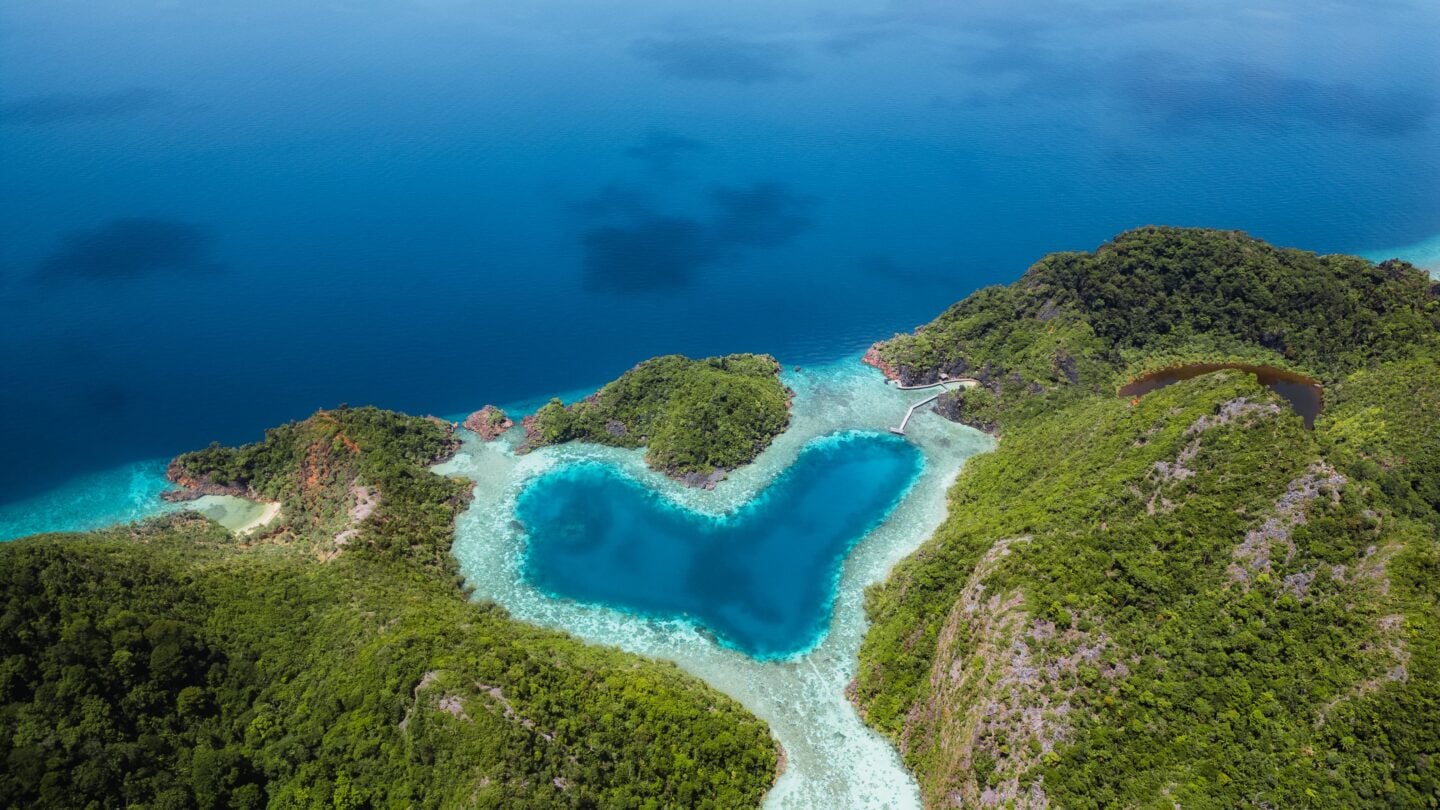
The heart shape of Love Lagoon is not man-made. It developed naturally through a long geological process.
Raja Ampat itself lies within the Coral Triangle, the region with the highest marine biodiversity on Earth. In addition to its famous coral reefs, the area also has a complex geological history.
The karst islands of Misool were formed from limestone created by ancient marine organisms such as corals and molluscs. Over millions of years, these layers hardened into limestone and were later lifted above sea level through tectonic activity.
Once exposed above the ocean, seawater gradually eroded the limestone. This erosion slowly carved depressions, narrow passages, and small lagoons between the karst cliffs.
In the case of Love Lagoon, this natural erosion produced a shape that, by coincidence, closely resembles a heart.
Similar formations are not uncommon in tropical karst environments, but the unusually symmetrical shape of Love Lagoon makes it one of the most recognisable examples in Raja Ampat.
The View from Above: Why Love Lagoon Is So Special
The first feeling most visitors experience upon reaching the Love Lagoon viewpoint is amazement.
From the top of the limestone cliffs, the lagoon appears as a calm turquoise pool enclosed by grey limestone walls. Because it is sheltered from open-ocean waves, the water inside the lagoon remains remarkably still.
Beyond the lagoon, the wider Raja Ampat sea stretches out in deeper shades of blue. The contrast between the lagoon and the surrounding ocean makes the heart shape even more visible.
Tropical vegetation grows between the limestone rocks, creating a striking mix of green, blue, and grey tones.
On clear days, visibility from the viewpoint is excellent. Visitors can often see the shifting colours of the water extending toward the surrounding coral reefs.
For this reason, many landscape photographers consider Love Lagoon one of the best photography spots in the Misool region.
The Trek to the Love Lagoon Viewpoint

Trail Details
To see Love Lagoon from above, visitors must complete a short trek to a viewpoint on the karst cliffs.
The walk usually takes around 15 to 30 minutes, depending on trail conditions and walking pace.
Although the distance is not long, the path is steep in places and can be rocky, so careful footing is recommended.
Sections of the trail consist of soil and exposed limestone, with tropical shrubs growing along the route.
Difficulty Level
The trek to Love Lagoon is generally considered easy to moderate.
However, because the terrain can be uneven and the tropical sun quite strong, visitors are advised to wear comfortable shoes and bring drinking water.
The climb is not merely a route to a photo spot. For many travellers, the short hike itself becomes part of the memorable experience.
Step by step, the trail leads higher until the lagoon slowly comes into view below.
Best Time to Visit Love Lagoon
The best time to visit Love Lagoon is usually early in the morning or later in the afternoon.
Morning
Morning offers cooler temperatures and softer sunlight.
At this time of day, the sea surface is often calmer, allowing the colours of the lagoon water to appear brighter and clearer.
Visitor numbers are also typically lower in the early morning, creating a quieter atmosphere.
Late Afternoon
Later in the afternoon, sunlight becomes warmer and more dramatic.
The shadows of the limestone cliffs create interesting contrasts on the water’s surface.
For photographers, this period is often considered one of the most beautiful moments to capture Love Lagoon.
Marine Life Around Love Lagoon
Although Love Lagoon is best known for its view from above, the surrounding waters are also part of the extraordinary marine ecosystem of Raja Ampat.
Raja Ampat is widely recognised as the global centre of marine biodiversity. Research by Conservation International indicates that the region hosts more than 500 species of coral and over 1,500 species of reef fish.
The waters around Misool, including areas near Love Lagoon, support healthy and diverse coral reef systems.
Marine life commonly found in this region includes:
- Reef fish such as butterflyfish and angelfish
- Parrotfish and wrasses
- Sea turtles
- Various nudibranch species and other macroorganisms
The Misool region is also known as a habitat for several pelagic species, such as tuna and barracuda.
For this reason, the Misool region is included in the diving routes of La Galigo Liveaboard, allowing guests to explore not only the famous landscapes above the surface but also the rich marine ecosystems below.
Activities You Can Do at Love Lagoon
Nature Photography
Love Lagoon is considered one of the most unique photography locations in Raja Ampat.
The lagoon’s heart-shaped formation creates a striking natural composition, particularly when viewed from the cliff-top viewpoint. Landscape photographers are often drawn to the dramatic contrast between the turquoise water, grey limestone karst, and lush tropical vegetation.
Snorkelling
In several areas around the lagoon and the surrounding karst islands of Misool, snorkelling is also possible.
The water is typically clear with good visibility, especially during the dry season. Snorkellers may encounter a variety of reef fish as well as healthy hard coral formations beneath the surface.
Exploring the Karst Islands
One of the most fascinating experiences in Misool is exploring the many small karst islands scattered throughout the region.
Many of these islands contain hidden coves, sea caves, and quiet beaches that rarely visited. For travellers who enjoy exploring nature, the landscape can feel like a labyrinth of islands, filled with unexpected discoveries.
How to Visit Love Lagoon
Travelling to Raja Ampat
Most journeys to Raja Ampat begin in Sorong, the largest city in Southwest Papua.
Sorong can be reached via flights from several major Indonesian cities, including Jakarta, Makassar, and Manado. From Sorong, travellers usually continue their journey by boat to the islands of Raja Ampat.
Getting to Misool
Love Lagoon is located in the Misool region, which lies in the southern part of Raja Ampat.
Because of the distance, the area is most easily reached through:
- Liveaboard diving trips
- Expedition vessels
- Selected resorts located in Misool
Sea journeys to Misool can take several hours or even overnight, depending on the type of vessel. For many travellers, however, this journey itself becomes part of the adventure.
Tips for Visiting Love Lagoon
Because Love Lagoon is located in a natural area with very limited infrastructure, visitors should come prepared.
Recommended items to bring include:
- Trekking shoes or outdoor sandals
- Sufficient drinking water
- A hat and sun protection
- A camera or smartphone with a fully charged battery
Visitors should also follow responsible tourism practices. The limestone islands of Raja Ampat are environmentally sensitive, and trekking paths should be followed carefully to avoid damaging vegetation.
All waste should be returned to the boat or disposed of at appropriate facilities.
Why Love Lagoon Is Worth Visiting
Raja Ampat is home to many extraordinary places, yet Love Lagoon offers something slightly different.
Its appeal lies not only in its unusual shape but also in the atmosphere it provides.
The place feels calm. Quiet. Free from large tourist facilities.
Love Lagoon reminds us that natural beauty need not be made spectacular by human design.
Sometimes all it takes is a small lagoon, shaped slowly by time and the ocean, that quietly resembles a heart.
And when travellers stand on the cliff above, looking down at the calm turquoise water, many realise a simple truth:
Raja Ampat is not only about its most famous destinations.
Verdict
Love Lagoon is one of the hidden corners of Raja Ampat that reveals the unique landscape of the Misool region. This small heart-shaped lagoon may not be as large or as widely known as some of the other viewpoints in Raja Ampat, yet its quiet atmosphere and natural beauty make the experience particularly memorable.
For travellers exploring Misool more deeply, Love Lagoon is a place worth visiting, whether to enjoy the view from the cliffs, capture photographs, or simply experience the calm of a largely untouched landscape.
La Galigo Liveaboard includes the Misool region in its sailing routes, bringing guests to some of the most remarkable locations in Raja Ampat. As part of a journey designed for exploration, Love Lagoon can become one of the most memorable moments during a voyage through this extraordinary archipelago.
FAQ
Where is Love Lagoon located in Raja Ampat?
Love Lagoon is located in the Misool region, in the southern part of the Raja Ampat archipelago, Southwest Papua. The lagoon lies among clusters of small karst islands and can only be reached by boat. From sea level, the lagoon’s shape is not immediately visible; the famous heart shape can only be seen from the viewpoint above the cliffs.
Why is Love Lagoon heart-shaped?
Love Lagoon gets its name from the lagoon’s heart-like shape when viewed from above. This formation developed naturally over millions of years through the erosion of limestone. Seawater slowly carved the karst formations, creating a depression that eventually formed the distinctive lagoon shape.
How can visitors reach Love Lagoon?
Most journeys to Love Lagoon begin in Sorong, the main city in Southwest Papua that has an airport. From Sorong, travellers typically continue by boat to Raja Ampat. Because Love Lagoon lies within the remote Misool region, it is most commonly visited as part of liveaboard trips or sea expeditions.
How long is the trek to the Love Lagoon viewpoint?
The trek to the Love Lagoon viewpoint usually takes around 15-30 minutes. The path is moderately steep and rocky, but remains a relatively short trek with an easy to moderate difficulty level. From the top of the cliff, visitors can clearly see the heart-shaped lagoon below.
When is the best time to visit Love Lagoon?
The best time to visit Love Lagoon is generally during the Raja Ampat dry season, typically between October and April, when sea conditions are relatively calm. Morning hours are often ideal for trekking because temperatures are cooler and the lighting is softer for photography.
Is snorkelling possible near Love Lagoon?
Yes. Snorkelling can be enjoyed in several areas around the karst islands of Misool, including waters near Love Lagoon. The region is known for good underwater visibility and healthy coral reefs inhabited by a variety of reef fish.
What should visitors bring when visiting Love Lagoon?
Because Love Lagoon is located on a small island without permanent tourism facilities, visitors are advised to bring drinking water, a hat or sun protection, reef-safe sunscreen, and comfortable trekking footwear. A camera or smartphone is also recommended to capture the view from the cliff-top viewpoint.
Is Love Lagoon crowded with tourists?
Compared with some famous viewpoints in Raja Ampat, such as Piaynemo, Love Lagoon remains relatively quiet. Its location in the Misool region means it is most often visited by travellers joining liveaboard journeys or sea expeditions.