
For many divers, the name Komodo carries an almost mythical appeal. Images of reef sharks patrolling coral pinnacles, massive schools of fish filling the blue, and giant manta rays gliding through cleaning stations have placed Komodo National Park firmly on dive bucket lists around the world.
Yet behind its reputation, one question almost always comes from newer divers:
“Is Komodo safe for beginners?”
Or put another way:
“My logbook is still short. Can I really enjoy diving in Komodo?”
The answer may surprise you, but it becomes clearer once you understand how diving conditions are structured within the park.
This article will help you understand:
- How currents shape the Komodo diving experience
- Why is biodiversity here so exceptional
- What “beginner-friendly Komodo diving” really looks like
- Which dive sites are best suited for first-time visitors
Everything is explained from a realistic perspective. There is no fear-mongering, nor any unnecessary glorification.
Is Komodo Safe for Beginners?
Yes. Komodo can be safe and highly enjoyable for beginners.
What matters most is not the total number of dives logged, but site selection, timing, and guidance. Komodo National Park spans a wide geographic area with highly varied ocean conditions. While some sites feature strong, fast-moving currents suited to experienced divers, many others offer calmer environments ideal for those newer to drift diving.
With proper planning, thorough briefings, and experienced dive guides, beginners can safely experience Komodo’s biodiversity without being exposed to unnecessary risk.
To understand why Komodo can be suitable even for less experienced divers, it is important to first understand the role currents play in shaping the region’s underwater environment. Currents are often what give Komodo its reputation. But they are also what make its marine life so extraordinarily rich.
Read More: Is It Safe for Beginners To Dive in Komodo?
Understanding Komodo’s Currents
Komodo is often described as one of the world’s most dynamic diving destinations. This is not only because of species diversity, but because of the sheer energy of the ocean.
Geographically, Komodo lies between the Indian Ocean to the south and the Flores Sea to the north, creating a dynamic meeting point of regional water movement. Water from both oceans flows through narrow island channels within the national park, creating strong, layered currents that are strongly influenced by tides.
These currents are not simply a technical challenge.
They are the source of life in Komodo.
Currents Create Life, Not Just Challenge
Currents transport nutrients from deeper waters into shallow reefs through upwelling. These nutrients trigger plankton blooms, which form the foundation of the marine food chain.
The chain reaction is clear:
- Plankton increases, attracting small fish
- Small fish draw in mid-level predators.
- Mid-level predators attract sharks, tuna, and trevally.
This is why fish biomass in Komodo is exceptionally high. Many divers describe the experience as “swimming through a giant aquarium”, but on a truly wild scale.
How Currents Shape the Way You Dive
Currents also define Komodo’s distinctive diving styles:
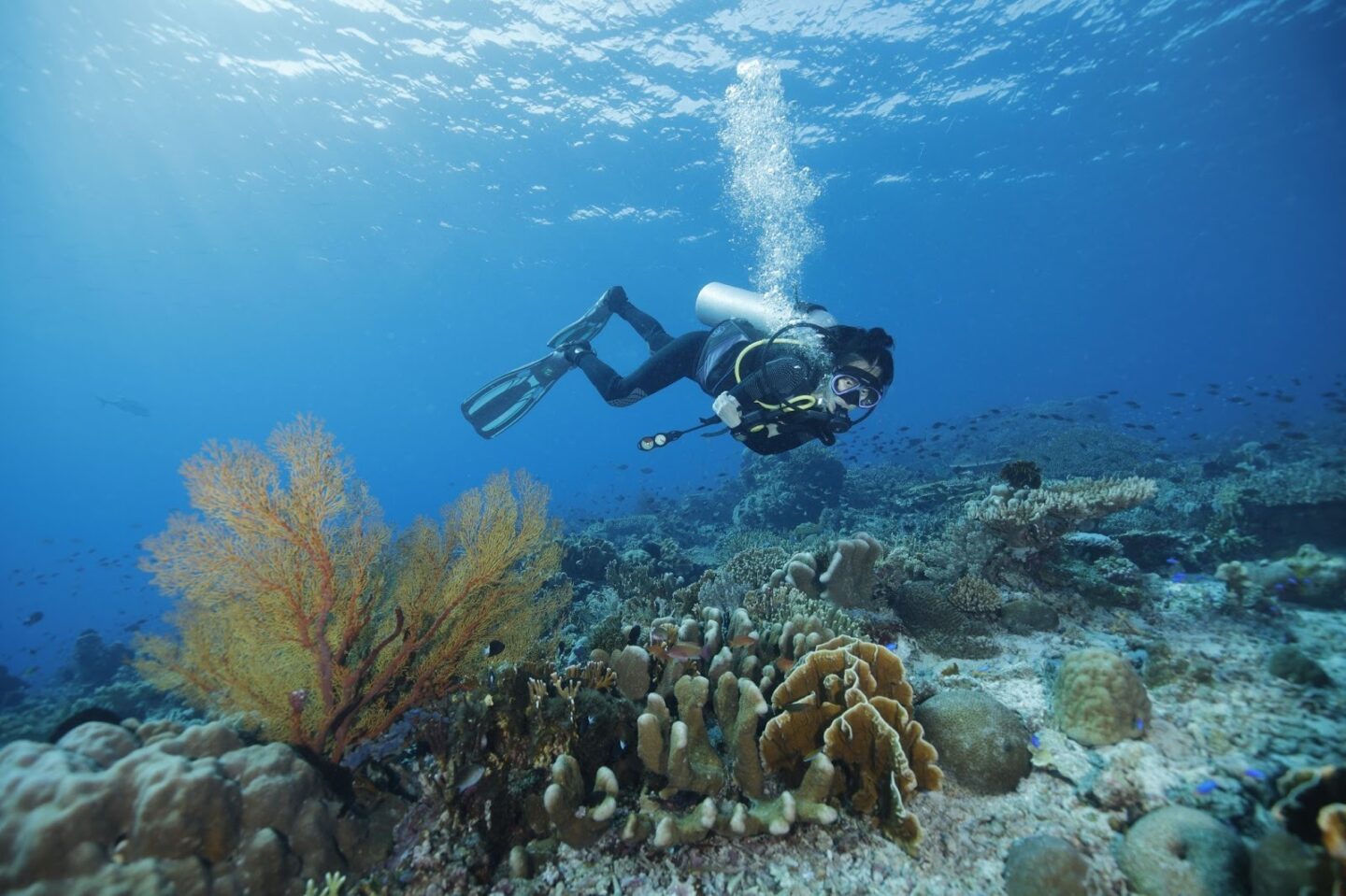
- Drift diving, moving with the current along reefs
- Negative entries, descending quickly to avoid surface flow
- Reef hook positioning, staying stationary while watching pelagic life.
- Split current diving, where one side is calm and the other is powerful
For beginners, this may feel different from diving in still water. Yet many divers actually find drift diving easier, as there is less need for strong finning.
Instead of fighting the ocean, you learn to work with it.
Is Komodo Only for Advanced Divers?
Not at all. Not every dive site in Komodo has strong currents.
In reality:
- Many reefs are located inside sheltered bays
- Several cleaning stations are shallow and calm.
- Drift dives can be very gentle.
- Check dives are often conducted in extremely calm locations.
Professional operators assess:
- Logged dive numbers
- Comfort in the current
- Air consumption
- Buoyancy control
Sites are chosen based on:
- Tide tables
- Moon phases
- Wind direction
This means beginners are not required to meet demanding conditions.
Komodo can be enjoyed gradually, and this is often the best way to experience it.
Best Komodo Dive Sites for Beginners
The following dive sites are widely regarded as beginner-friendly for first-time visitors and low-log divers, without compromising overall experience quality.
Siaba Kecil
Siaba Kecil is often referred to as “Turtle City”. The nickname is well earned. Green turtles and hawksbill turtles are seen on almost every dive.
Why it suits beginners:
- Very minimal current
- Shallow to mid-range depths
- Gentle slope topography that is easy to read
- Clear and straightforward exit points
Marine life remains rich:
- Turtles
- Sweetlips
- Batfish
- Cuttlefish
- Macro critters in sandy areas
This site is commonly used for:
- Check dives
- Refresher dives
- Initial adaptation before current-exposed sites
It feels like a soft opening before meeting Komodo’s wilder side.
Manta Point
Seeing manta rays is a dream for many divers, and Komodo is one of the best places in the world to make it happen.
Manta Point is a shallow cleaning station where mantas arrive to be serviced by small cleaner fish.
Site characteristics:
- Depths of around 5 to 12 metres
- Sandy bottom with coral bommies
- Mild surge rather than a strong current
Divers typically:
- Kneel or hover above the sand
- Wait calmly as mantas approach.
- Move very little
Encounters can be remarkably close while remaining ethical and non-intrusive. For beginners, this is often the first major emotional highlight of their Komodo experience.
Tatawa Besar
For those who want to experience drift diving without intimidation, Tatawa Besar is ideal. The site features a long coral slope with relatively stable, predictable currents.
Typical experience:
- Drifting above healthy coral
- Anthias and fusiliers filling the water column.
- Occasional sightings of sweetlips and trevally
Because the current is consistent, divers can:
- Focus on buoyancy
- Enjoy the scenery
- Learn positioning without panic.
Many beginners fall in love with drift diving here because it feels effortless.
Sebayur Kecil
Sebayur Kecil offers a combination of healthy reef and relatively calm conditions.
It is often used for:
- Warm-up dives
- Skill adaptation dives
- Night dives
Marine life includes:
- Juvenile reef sharks
- Clownfish
- Nudibranchs
- Lionfish
- Macro crustaceans
For beginner photographers, this is a comfortable place to start exploring underwater photography without current pressure.
Batu Bolong
Batu Bolong is one of Komodo’s most famous sites, a coral pinnacle rising from deep water.
Fish density here is extraordinary:
- Giant trevally
- Reef sharks
- Napoleon wrasse
- Barracuda
- Dense clouds of anthias
The upper section of the pinnacle can indeed experience strong currents. However, beginners are usually guided to:
- Sheltered sides
- Mid-depth zones
- Dense coral areas away from direct current lines
With proper briefing, this site can still be enjoyed without excessive pressure and often becomes a diver’s most memorable first Komodo dive.
Sites Beginners Usually Skip
For educational clarity, it is also helpful to know which sites are usually not prioritised for beginners:
- Castle Rock, an exposed seamount
- Crystal Rock, where the current direction can change quickly
- The Cauldron or Shotgun, a high-energy channel dive
These sites are not forbidden, but are best enjoyed once:
- Logged dives increase
- Comfort in the current improves.
- Air consumption becomes more efficient.
Komodo is not a test of bravery. A gradual approach leads to far greater enjoyment.
How Operators Keep Beginner Divers Safe
Many beginners feel reassured once they understand how dive planning works in Komodo.
Professional operators such as La Galigo Liveaboard consider:
Tide and Current Planning
Dives are scheduled during slack or manageable current windows.
Experience Assessment
Cruise directors and dive guides review:
- Log counts
- Certification levels
- Confidence during water entry
Flexible Routing
Especially on liveaboards, routes can be adjusted based on sea conditions rather than forced schedules.
This approach keeps beginner experiences safe without sacrificing Komodo’s highlights.
Tips for First-Time Komodo Divers
A few simple preparations can significantly improve comfort:
- Improve buoyancy before the trip.
- Stay physically relaxed. Currents feel stronger when the body is tense.
- Listen closely to briefings. Komodo briefings are detailed for a reason.
- Use proper exposure protection. Thermoclines can be cold, so a 3 – 5 mm wetsuit is recommended.
Komodo Is Not Just for Experts
Komodo is powerful, but not exclusive to experienced divers. The region offers a wide spectrum of experiences, from strong-current sites for advanced divers to gentle drift dives for intermediates and calm, sheltered reefs for beginners.
With proper site selection, beginner divers can fully experience Komodo’s essence. They can encounter manta rays up close, witness massive schooling fish, drift above healthy coral gardens, and meet turtles and reef sharks without entering conditions beyond their readiness.
Ultimately, Komodo is not about how bravely you face currents. It is about learning to read the ocean, respecting its rhythm, and experiencing one of the most vibrant ecosystems on Earth in a way that matches your current comfort and skill level.
If you want to experience Komodo through a safe, curated, and beginner-friendly approach, travelling with La Galigo Liveaboard can be an ideal choice. With daily condition-based site planning, comprehensive briefings, and an experienced team supporting divers of all levels, you can explore Komodo fully. There is no pressure, but there is still a strong sense of adventure.
FAQ
1. Is Komodo safe for beginner divers?
Yes. When diving with a professional operator who plans dives around guest experience and ocean conditions. While Komodo is known for strong currents, many sites are sheltered and calmer. Guides time entries carefully based on tides, wind, and current strength, allowing beginners to dive safely within their comfort limits.
2. What is the minimum number of logged dives needed?
There is no fixed minimum. However, divers with around 10–20 logged dives can usually enjoy beginner-friendly sites. More important than numbers are buoyancy control, air consumption, and comfort in light current. Guides typically assess guests during the first dives before progressing to more dynamic sites.
3. Do all Komodo dive sites have strong currents?
No. This is a common misconception. While some sites are current-driven, many others are sheltered, including bay reefs, cleaning stations, and gentle drift slopes. Several locations are regularly used for check dives and refreshers.
4. When is the best time for beginners to dive in Komodo?
Komodo is diveable year-round. Beginners often benefit from calmer sea periods, but daily conditions matter more than seasonality. Operators plan dives based on tides, moon phases, and wind. Adjusting sites to ensure safe, enjoyable experiences.
5. Is drift diving safe for beginners?
Yes, with proper guidance. Drift diving means moving with the current, which often requires less effort and improves air consumption. With good buoyancy and clear briefings, beginner-level drifts in Komodo can feel smooth and controlled rather than challenging.