
Tropical seas are known as some of the most biologically diverse environments on the planet. Colourful coral reefs, striking tropical fish, and many unusual marine creatures make these waters especially fascinating for divers and nature enthusiasts.
Among these marine animals, one species stands out for its extraordinary abilities. It is known as the mimic octopus.
This octopus not only camouflages itself like many other marine animals. It possesses a far more complex ability. It can imitate the shape, colour, and even the behaviour of various other marine species. This remarkable ability makes it one of the most impressive examples of mimicry in the ocean.
The species first attracted scientific attention in Indonesian waters in the late 1990s. Subsequent research has shown that the mimic octopus can imitate dangerous marine animals, such as lionfish and sea snakes, as a strategy to avoid predators.
This ability is not simply a visual trick. For the mimic octopus, mimicry is a highly effective survival strategy in a challenging marine environment. With its flexible body, colour-changing abilities, and adaptive behaviour, this animal demonstrates a remarkably creative way to survive.
For divers and travellers exploring tropical seas, encountering a mimic octopus in the wild often becomes one of the most fascinating underwater experiences.
What Is the Mimic Octopus
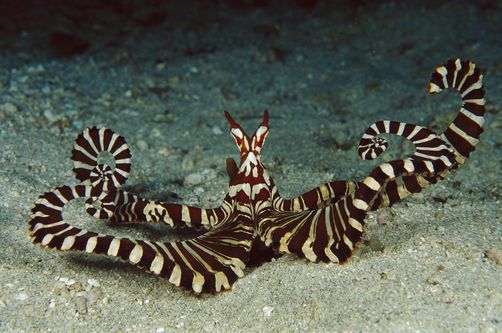
The mimic octopus, Thaumoctopus mimicus, is a species of octopus belonging to the cephalopod group.
However, even before it was formally described in scientific literature, this octopus had already attracted the attention of researchers because of its unusual behaviour.
Many early observations were made in the Indo-West Pacific region, particularly in the waters of Southeast Asia, such as those off Indonesia. This region is well known as one of the world’s centres of marine biodiversity.
Physically, the mimic octopus has a relatively slender body compared with many other octopus species. Its body colour is usually light brown with stripes or patch patterns that can change rapidly.
Like all octopuses, it has eight highly flexible arms and a complex nervous system. What truly distinguishes this species, however, is its ability to imitate many different marine animals.
Why the Mimic Octopus Is So Unique
Many marine animals can camouflage themselves within their surroundings. The mimic octopus possesses a far more complex ability known as dynamic mimicry.
This term describes the ability to actively imitate the form and behaviour of other animals.
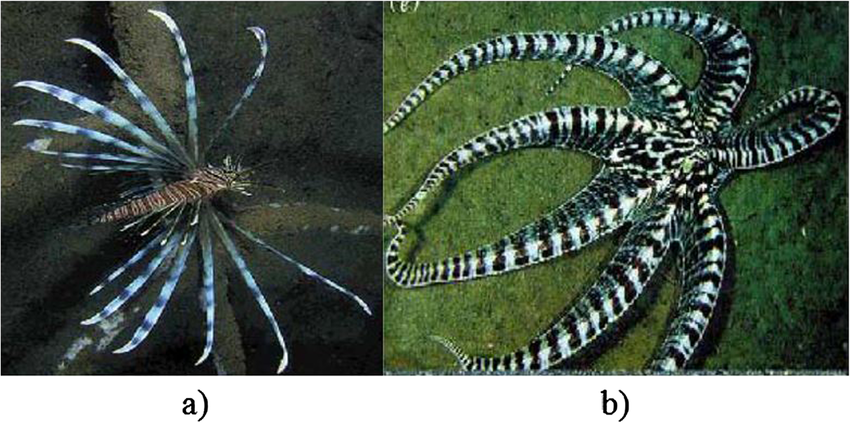
These changes involve more than just body colour. The octopus also adjusts how it swims, the position of its arms, and even the overall shape of its body.
What makes this ability even more remarkable is that the mimic octopus appears to choose which animal to imitate depending on the situation.
In certain conditions, it may imitate animals known to be dangerous to predators nearby. This strategy causes potential predators to hesitate before approaching.
Adaptive behaviour of this kind is rare in the animal kingdom and is one of the main reasons the mimic octopus fascinates scientists.
Read Also: Surprising and Rare Marine Animals Found in Indonesia
How the Mimic Octopus Changes Colour and Shape
The ability of the mimic octopus to change colour and body shape comes from biological characteristics typical of cephalopods.
The skin of an octopus contains specialised cells called chromatophores. These cells allow the octopus to change its body colour extremely quickly by expanding or contracting pigment within the skin.
These colour changes can occur very rapidly, allowing the octopus to adjust its appearance to match its surroundings.
In addition, octopuses possess skin structures that can change the texture of their body surface. The skin may appear smooth or rough depending on the situation.
The mimic octopus then uses its flexible body to form silhouettes that resemble other animals. By adjusting the position of its arms and its body posture, it can create highly convincing shapes.
The combination of colour change, texture change, and body shaping enables the mimic octopus to perform mimicry with remarkable effectiveness.
Animals the Mimic Octopus Can Imitate
Research has documented that the mimic octopus can imitate more than 10 – 15 different marine species.
One of the most famous examples is the lionfish. To imitate a lionfish, the mimic octopus spreads its arms outward in multiple directions so that they resemble the spiny fins of the fish.
Because lionfish are known for their venomous spines, many predators avoid them.
Another example is the sea snake. In certain situations, the mimic octopus inserts several of its arms into a burrow and leaves only two arms visible, moving them in a way that resembles a sea snake.
The striped pattern on its body helps reinforce this illusion.
The mimic octopus can also imitate flatfish by pressing its body close to the seabed and moving across the sand in a manner similar to a flatfish gliding along the bottom.
This mimicry behaviour often occurs when the octopus is in open areas on the seabed.
How the Mimic Octopus Hunts
The mimic octopus’s camouflage is not only useful for avoiding predators. It is also highly effective when hunting.
The mimic octopus usually hunts along sandy or muddy seabeds.
It moves slowly while exploring the sediment surface in search of prey such as small crustaceans or fish.
With its excellent camouflage ability, the octopus can approach prey without being easily detected.
When prey comes within reach, the octopus can move quickly to capture it.
This hunting strategy is very effective in relatively open seabed environments.
Where the Mimic Octopus Lives
The primary habitat of the mimic octopus lies in tropical Indo-Pacific waters, especially in Southeast Asia.
Some locations known for sightings include:
Indonesia
The most famous locations include:
Lembeh Strait
One of the best places in the world to see the mimic octopus. The area is famous for muck diving.
Bali
Especially around Tulamben and Amed.
Raja Ampat
Sightings are less common than in Lembeh, but the species can still be found in sandy bottom habitats.
Komodo National Park
Occasionally seen at dive sites with sandy substrates.
Other Indo-Pacific Regions
The species has also been reported in:
- Malaysia, especially Sabah
- The Philippines
- Papua New Guinea
- Thailand
However, most documented observations come from Indonesia because the region’s muddy and sandy habitats are particularly suitable for the mimic octopus.
Habitat and Behaviour
The favourite habitat of the mimic octopus is sand flats or mud flats, areas of seabed dominated by sand or mud. The species is generally found in soft sediment habitats at depths of approximately 0.5 – 37 metres.
These environments may appear simple compared with coral reefs, but they are actually home to many small marine organisms.
The mimic octopus usually lives in shallow to moderate depths.
Within these habitats, it is often seen emerging from small holes in the seabed that serve as shelter.
It may hide inside these burrows and emerge to search for food or explore the surrounding area.
This behaviour shows that the mimic octopus depends heavily on seabed environments for both protection and feeding opportunities.
Read Also: Fish Sleeping Behaviour
Can Divers See the Mimic Octopus?
For divers, seeing a mimic octopus in the wild often becomes a very memorable experience.
However, this species is not always easy to find. Its extraordinary camouflage ability often makes it difficult to detect, even for experienced divers.
In addition, its habitat on sandy seabeds makes it less visually striking than marine animals that live on coral reefs.
Even so, divers in several locations across the Indo-Pacific occasionally encounter this species.
The mimic octopus is often spotted during muck diving, a type of diving that focuses on small marine creatures living on sandy or muddy seabeds.
When it is finally seen, an encounter with a mimic octopus usually becomes one of the most fascinating moments of a dive.
Why Protecting Tropical Seafloor Habitats Matters
The habitats where the mimic octopus lives often receive less attention than coral reef ecosystems.
However, sandy and muddy seabeds play an important role in marine ecosystems.
These habitats provide shelter for many small organisms that form essential parts of the marine food web.
If these environments are disturbed by human activities such as pollution or habitat destruction, many species that depend on them may be affected.
Protecting tropical seafloor habitats therefore also means protecting many unique marine creatures that live there, including the mimic octopus.
Final Thought
The mimic octopus is one of the most fascinating marine creatures discovered in tropical waters.
By imitating various marine species, this octopus demonstrates a highly creative survival strategy.
From rapid colour changes to the ability to shape its body to resemble other animals, the mimic octopus uses a range of biological abilities to avoid predators and hunt for food.
Scientific research has helped us understand part of what makes this species so remarkable, but many aspects of its behaviour remain poorly understood.
For travellers and divers exploring tropical seas, the presence of the mimic octopus serves as a reminder that the underwater world still holds many extraordinary surprises.
And if one day you have the opportunity to see it in person, the experience will most likely become one of the most memorable moments of your diving journey.
Frequently Asked Questions
What is a mimic octopus?
The mimic octopus (Thaumoctopus mimicus) is a species of octopus known for its ability to mimic various marine animals. Unlike most octopuses that only camouflage themselves within their environment, the mimic octopus can imitate the shape, colour, and behaviour of other species, such as lionfish, sea snakes, and flatfish, as a survival strategy.
Where can the mimic octopus be found?
The mimic octopus lives in tropical Indo-Pacific waters, particularly in Southeast Asia. Many scientific observations come from Indonesia, including the waters of Sulawesi and Bali. The species has also been documented in other regions such as the Great Barrier Reef in Australia.
What animals can the mimic octopus imitate?
Scientific research shows that the mimic octopus can imitate several marine animals, including:
- Lionfish
- Sea snake
- Flatfish
In certain situations, the octopus imitates animals known to be dangerous to predators, helping it avoid attacks.
Why does the mimic octopus imitate other animals?
Mimicry helps the mimic octopus reduce the risk of predation. By imitating venomous or dangerous animals, predators may interpret it as a threat and choose to stay away.
How does the mimic octopus change its appearance?
Like other octopuses, the mimic octopus has specialised skin cells called chromatophores, which allow it to change colour extremely quickly. Its highly flexible body also allows it to alter its shape and posture, resembling other marine animals.
What does the mimic octopus eat?
The mimic octopus typically feeds on small crustaceans and small fish. It hunts along sandy or muddy seabeds, using camouflage to approach prey without being detected.
Can divers see a mimic octopus in the wild?
Seeing a mimic octopus in the wild is relatively rare, but it is possible. The species is most often encountered during muck diving in sandy or muddy seabed areas across the Indo-Pacific region.
Is the mimic octopus dangerous to humans?
No. The mimic octopus is not considered dangerous to humans. Like many marine animals, it usually avoids interaction and relies on camouflage or mimicry to protect itself.
References
Coker, D. J. (2013). Documentation of the mimic octopus Thaumoctopus mimicus in the Great Barrier Reef, Australia. Marine Biodiversity Records, 6, e90.
Gómez-Moreno, Á. (2019). The “mimic” or “mimetic” octopus? A cognitive-semiotic study. Biosemiotics, 12(3), 427–441.
Hanlon, R. T., Conroy, L. A., & Forsythe, J. W. (2008). Mimicry and foraging behaviour of two tropical sand-flat octopus species off North Sulawesi, Indonesia. Biological Journal of the Linnean Society, 93(1), 23–38.
Norman, M. D. (2001). Dynamic mimicry in an Indo-Malayan octopus. Proceedings of the Royal Society B: Biological Sciences, 268(1478), 1755–1758.
Norman, M. D., & Hochberg, F. G. (2005). The “mimic octopus” (Thaumoctopus mimicus n. gen. et sp.), a new octopus from the tropical Indo-West Pacific. Molluscan Research, 25(2), 57–70.