
Among the hundreds of fish species that live on tropical coral reefs, few play an ecological role as important as parrotfish. These brightly coloured fish are commonly seen while diving or snorkelling in tropical waters, including Raja Ampat and Komodo National Park.
However, parrotfish are not simply beautiful fish to observe. In many scientific studies on coral reef ecology, parrotfish are considered a keystone species that helps maintain coral health, control algae growth, and even produce the sand that forms tropical beaches.
Because of this crucial role, parrotfish are often known as reef guardians. Without them, many coral reef ecosystems could change dramatically.
This article explores parrotfish in detail, including their biology, unique behaviour, and their crucial role in marine ecosystems.
What Is a Parrotfish?
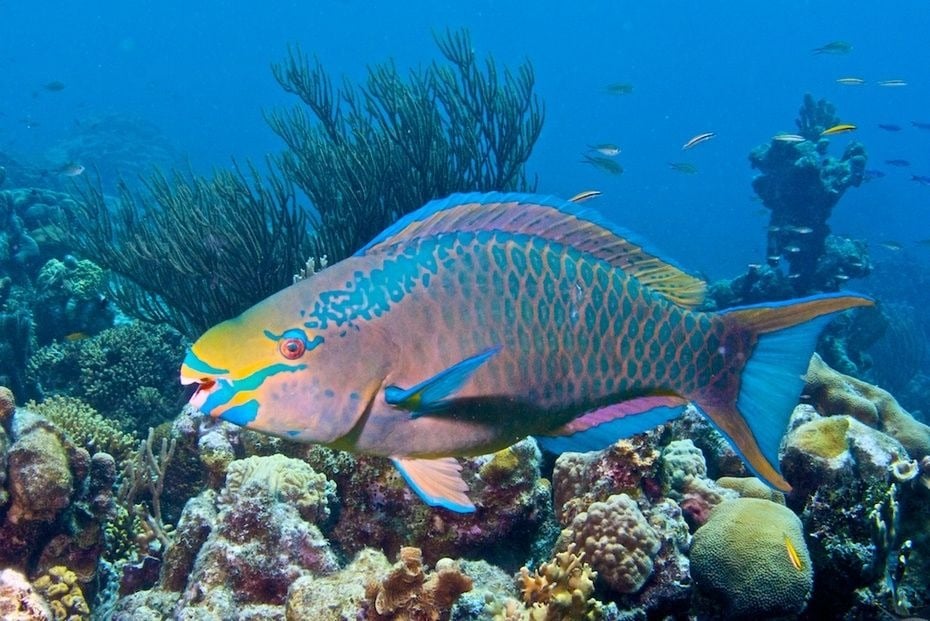
Parrotfish are a group of marine fish belonging to the family Scaridae that live in tropical coral reef ecosystems. The name parrotfish comes from the shape of their teeth, which are fused into a hard structure resembling a parrot’s beak.
Some species of parrotfish can live for up to 20 years.
In scientific literature on parrotfish biology, these fish are recognised as one of the primary herbivores within coral reef ecosystems. They feed on algae growing on coral surfaces and rocky reef substrates, an activity known as grazing.
Parrotfish play an important ecological role because their feeding behaviour can influence the structure and dynamics of coral reef ecosystems.
While feeding, parrotfish bite coral to consume algae and other microorganisms growing on it. This process also causes bioerosion, the gradual breakdown of coral skeletons that eventually produces carbonate sediment.
This is one of the reasons parrotfish are closely connected with coral reef ecosystems.
Why Parrotfish Are Important for Coral Reefs
Coral reefs are highly complex ecosystems that are extremely sensitive to environmental change. One of the main threats to coral reefs is excessive algae growth.
If algae grow unchecked, they can cover coral surfaces and prevent new coral colonies from forming.
This is where parrotfish play a crucial role.
Research shows that their grazing activity helps maintain the balance between coral and algae. By continuously feeding on algae, parrotfish create space where coral larvae can settle and grow.
In addition, parrotfish feeding behaviour also helps to:
- Clean coral surfaces
- Accelerate ecosystem recovery
- Maintain habitat diversity within coral reefs
Without herbivores such as parrotfish, many reef ecosystems could shift into algae-dominated reefs, where algae replace coral as the dominant organism.
Where Parrotfish Live
Parrotfish are found throughout tropical and subtropical oceans around the world. Their primary habitats include:
- Shallow coral reefs
- Coral lagoons
- Reef flats
- Reef slopes
Many species of parrotfish live in the Indo-Pacific region, which is known as the global centre of marine biodiversity. Regions such as the Coral Triangle have an exceptionally high diversity of parrotfish species.
Indonesia is one of the main habitats for parrotfish because it contains vast and diverse coral reef ecosystems. Areas such as Raja Ampat and Komodo National Park are known for their extraordinary marine biodiversity, including many species of parrotfish that can often be seen grazing on coral reefs.
Because they often live at relatively shallow depths, usually between 1 – 30 metres, parrotfish are frequently among the first fish observed by divers and snorkellers exploring tropical reefs. For many divers, watching groups of brightly coloured parrotfish feeding on algae across the reef is a common and memorable experience while exploring Indonesian waters.
Diving journeys to destinations such as Raja Ampat or Komodo often provide excellent opportunities to observe these fish directly. Liveaboard expeditions, such as those offered by La Galigo Liveaboard, allow divers to explore remote dive sites in both regions, where parrotfish and many other reef fish live within still-healthy coral ecosystems.
Types of Parrotfish You Are Likely to Encounter While Diving in Indonesia
More than 90 species of parrotfish have been identified worldwide, and many of them live in Indonesian waters.
Some species commonly seen while diving include:
Bumphead Parrotfish
One of the largest parrotfish species found on tropical coral reefs. This fish is easily recognised by the prominent forehead on its head, which gives rise to the name bumphead. Bumphead parrotfish can grow to more than 1.3 metres in length and weigh around 45 kilograms, making them one of the largest herbivorous fish in coral reef ecosystems.
Bullethead Parrotfish
A relatively common species on Indo-Pacific coral reefs, known for its brightly coloured body.
Blue-barred Parrotfish
Recognisable by its striking blue and green colouration.
Redlip Parrotfish
Distinguished by its characteristic red lips and frequently seen along reef slopes.
The diversity of species makes parrotfish one of the most recognisable groups of fish when diving in tropical waters.
The Unique Teeth and Beak of Parrotfish
One of the most distinctive features of parrotfish is the structure of their teeth.
Parrotfish teeth are tightly packed and fused to form a hard beak. This structure allows them to bite coral with considerable force.
Inside their throats, they also possess an additional structure known as pharyngeal teeth, which grind coral material into very small particles.
This system enables parrotfish to break down coral skeletons and process them as they feed.
This adaptation makes parrotfish one of the most effective fish involved in the process of bioerosion on coral reefs.
Bioerosion is a natural process in which marine organisms erode or break down hard structures such as coral, limestone, or the shells of other marine organisms. In parrotfish, this process occurs when they bite coral to consume algae and other microorganisms growing on it. During feeding, small portions of the coral skeleton are scraped away and enter the fish’s mouth. This material is then crushed by the teeth in the throat and eventually expelled as fine particles that become carbonate sediment.
Through this process, parrotfish not only remove algae from coral surfaces but also help generate sand that later becomes part of the reef and tropical beach sediments.
Read Also: Shark Teeth, all the facts and fiction
How Parrotfish Create Sand
One of the most fascinating facts about parrotfish is that they help create the sand on tropical beaches. When parrotfish bite coral to eat the algae growing on its surface, they also unintentionally scrape away small portions of the coral skeleton. This coral material is then broken down within the fish’s digestive system and eventually released as extremely fine carbonate sediment.
Research on sediment production by parrotfish shows that most of the material they produce indeed originates from coral skeletons that are eroded during the feeding process. The sediment produced usually measures around 125 – 1000 micrometres, a size very similar to the sand grains found on many tropical beaches.
In very large quantities, this sediment eventually becomes part of the sand within coral reef ecosystems. In some cases, the contribution is remarkable. A large parrotfish is estimated to produce up to about 360 kilograms of carbonate sand per year as a byproduct of its feeding activity. Ocean currents later transport this sediment and contribute to the formation of sand in lagoons, reefs, and tropical beaches.
Research on coral island formation has even shown that parrotfish can produce more than 85 percent of the new sediment that forms tropical coral islands. In other words, the feeding behaviour of these fish not only helps keep reefs free from algae but also contributes to the natural processes that form and maintain beaches in many tropical regions.
Different Feeding Roles of Parrotfish on Coral Reefs
A single parrotfish can take up to 20,000 bites of coral per day while searching for algae.
In coral reef ecology studies, parrotfish are generally divided into several groups based on how they feed on reef substrates.
Excavators
These species bite coral with considerable force and remove parts of the reef substrate.
Scrapers
These fish scrape the surface of coral without digging deeply into the structure.
Browsers
These species mainly feed on algae rather than coral.
These different feeding behaviours help create complex ecological dynamics within coral reef ecosystems.
Social Behaviour and Schools of Parrotfish
Parrotfish are often observed swimming in groups.
Some species form large schools consisting of dozens or even hundreds of individuals. These groups typically move together while feeding across coral reefs.
This social behaviour also helps reduce the risk of predation.
In certain species, parrotfish groups have a clear social structure, with a dominant male leading a group of females.
For divers and snorkellers, seeing a school of brightly coloured parrotfish grazing across a coral reef is often one of the most fascinating sights in tropical waters. Their slow movements while biting algae from coral surfaces provide a direct glimpse into how these fish help maintain the health of reef ecosystems.
Read Also: Fish Sleeping Behaviour
The Fascinating Sex Change of Parrotfish
One of the most intriguing aspects of parrotfish biology is their ability to change sex.
Many parrotfish species are sequential hermaphrodites, meaning they can change from female to male during their lifetime.
This change usually occurs when the dominant male in a group disappears. One of the females then transforms into a male and takes over as the group leader.
Dramatic changes in body colour often accompany this transformation.
The Strange Sleeping Habit of Parrotfish
Some parrotfish species have a very unusual sleeping behaviour.
At night, they can produce a transparent mucus layer that surrounds their body like a cocoon.
This layer is believed to help:
- Mask the fish’s body scent
- Protect them from predators
- Reduce the risk of parasites
This behaviour is one of the unique adaptations found among coral reef fish.
Threats to Parrotfish
Despite their important role in coral reef ecosystems, parrotfish populations face several threats.
Some of the main threats include:
Overfishing
In some regions, parrotfish are caught for human consumption.
Coral reef degradation
Coral bleaching and habitat damage can reduce parrotfish populations.
Climate change
Rising sea temperatures and ocean acidification can affect the ecosystems they live in.
If parrotfish populations decline, the balance of coral reef ecosystems can be disrupted.
Parrotfish and Humans
The relationship between humans and parrotfish is relatively complex. In many tropical regions, these fish have long been part of the diet of coastal communities and are caught as a source of local protein. However, scientists and marine conservation managers increasingly recognise that large-scale harvesting of parrotfish can have serious consequences for coral reef health.
This concern arises because parrotfish play a crucial role as primary herbivores on coral reefs. By feeding on algae that grow on coral surfaces, they help maintain ecological balance and create space for new coral to grow. When parrotfish populations decline due to overfishing, algae can proliferate unchecked, potentially preventing coral reefs from recovering.
Growing awareness of the importance of parrotfish has encouraged conservation efforts across many tropical marine regions. In Indonesia, for example, several conservation areas have introduced policies designed to protect coral reef ecosystems and the key species that inhabit them.
In Raja Ampat, an extensive network of Marine Protected Areas has been established to safeguard marine biodiversity. This zoning system restricts fishing activities in certain areas, allowing important herbivorous fish such as parrotfish to maintain healthy populations and continue their ecological role in supporting coral reef health.
Similar efforts are also implemented in Komodo National Park, where park management includes regulations on fishing activities, patrol programmes, and coral-reef monitoring initiatives. Through these management strategies, various reef fish species, including parrotfish, can survive and thrive in relatively protected ecosystems.
Conservation measures like these demonstrate that protecting parrotfish is not only about preserving a single species. It is also about ensuring that coral reefs remain healthy and capable of supporting the extraordinary diversity of marine life in the future.
Why Protecting Parrotfish Matters
Protecting parrotfish also means protecting coral reefs.
Without herbivores such as parrotfish, algae can proliferate unchecked and prevent new coral colonies from forming.
In addition, the role of parrotfish in producing carbonate sediment contributes to the formation and maintenance of tropical beaches.
In other words, parrotfish not only support coral reef health but also contribute to the stability of islands and coastlines.
Through habitat protection, sustainable fisheries management, and marine conservation initiatives, parrotfish populations can continue performing their essential roles as coral reef guardians and producers of tropical beach sand.
Final Thought
Parrotfish may appear to be ordinary reef fish to some people, but their ecological importance is far greater than it might seem. By feeding on algae that grow over coral, they help maintain the balance of coral reef ecosystems. Through bioerosion during feeding, parrotfish also produce carbonate sediment that eventually becomes part of the sand found on many tropical beaches.
This dual role makes parrotfish one of the most important species in maintaining the health and sustainability of coral reef ecosystems. From creating space for new coral to grow to contributing to the formation of coral islands, these fish’s daily activities have wide-ranging effects on marine environments.
For divers and ocean enthusiasts, seeing parrotfish grazing on coral reefs is not only an interesting sight. It is also a reminder of how complex and interconnected life in the ocean truly is. Protecting parrotfish also helps protect coral reefs, tropical beaches, and the marine ecosystems that support thousands of other species.
FAQ
What is a parrotfish?
Parrotfish are a group of marine fish belonging to the family Scaridae that live in tropical coral reef ecosystems. They are known for their teeth, which are fused to form a hard structure resembling a parrot’s beak. Parrotfish feed on algae growing on coral surfaces and play an important role in maintaining coral reef balance.
Why are parrotfish important for coral reefs?
Parrotfish help maintain coral reef health by feeding on algae that can otherwise cover and inhibit coral growth. Their feeding activity also creates space where coral larvae can settle and grow. Without herbivores such as parrotfish, many reefs risk becoming dominated by algae.
Do parrotfish really produce sand?
Yes. When parrotfish bite coral to consume algae, small fragments of coral skeleton are scraped away and enter the fish’s digestive system. This material is later released as fine carbonate sediment that becomes part of the sand found on coral reefs and tropical beaches. A large parrotfish can produce hundreds of kilograms of sand each year.
Where are parrotfish usually found?
Parrotfish live in tropical and subtropical oceans around the world, particularly within coral reef ecosystems. They are especially common in the Coral Triangle region, including the waters of Raja Ampat and Komodo National Park, which are known for their exceptional marine biodiversity.
How many species of parrotfish exist in the world?
Scientists have identified more than 90 species of parrotfish living in tropical and subtropical waters. These species display a wide variety of colours and are commonly observed on Indo-Pacific coral reefs.
Can parrotfish change sex?
Yes. Many parrotfish species are sequential hermaphrodites, meaning they can change from female to male during their lifetime. This transformation usually occurs when the dominant male in a group disappears, allowing one of the females to change sex and take over the role.
Why do parrotfish sleep inside a mucus layer?
Some species produce a transparent mucus cocoon around their bodies while sleeping. This layer is believed to mask their scent from predators and help protect them from parasites.
Are parrotfish threatened?
In some regions, parrotfish populations face pressure from overfishing and degradation of coral reef habitats. Because of their crucial role in reef health, several marine conservation areas now restrict parrotfish harvesting to maintain ecological balance.
References
Hoey, A. S., & Bonaldo, R. M. (2018). Biology of parrotfishes. CRC Press.
Hoey, A. S., Bellwood, D. R., & Choat, J. H. (2010). Influence of herbivory on the dynamics of coral reef ecosystems. Coral Reefs, 29(3), 1–12.
Perry, C. T., Kench, P. S., O’Leary, M. J., Morgan, K. M., & Januchowski-Hartley, F. (2015). Linking reef ecology to island building. Parrotfish are identified as major producers of island-building sediment. Geology, 43(6), 503–506.
Yarlett, R. T., Perry, C. T., & Wilson, R. W. (2021). Quantifying production rates and size fractions of parrotfish-derived sediment. A key functional role of Maldivian coral reefs. Ecology and Evolution, 11, 17797–17810.
Russ, G. R., Questel, S. L. A., Rizzari, J. R., & Alcala, A. C. (2020). Site-level variation in parrotfish grazing and bioerosion as a function of habitat and fishing pressure. Diversity, 12(10), 379.