
When people imagine sharks, they often think of large predators swimming actively in open water. However, in tropical coral reefs, including those in Raja Ampat, there is a type of shark that looks very different from that image. These sharks rarely swim long distances, often remain on the seabed, and possess extraordinary camouflage abilities. They are known as wobbegong sharks.
Wobbegongs are a group of sharks from the family Orectolobidae, often referred to as carpet sharks. This nickname comes from the complex patterns on their bodies, which resemble decorative carpets. These patterns are not merely visually striking. They function as natural camouflage, allowing the sharks to blend almost perfectly with coral and sand on the seabed.
In biodiversity hotspots such as Raja Ampat, wobbegongs are among the predators that attract the attention of divers and underwater photographers. They are not only visually unusual, but also possess hunting strategies that differ from those of most other sharks. Instead of chasing prey in open water, wobbegongs are ambush predators. They wait patiently for prey to approach before launching a rapid strike.
This camouflage ability often makes wobbegongs difficult to spot, even for experienced divers. Many divers only notice them after a dive guide points them out among the coral. Their flattened bodies, patterned colours, and resting position on the seabed make them appear like part of the reef itself.
These characteristics make wobbegongs among the most fascinating predators in the coral reef ecosystems of Raja Ampat.
Wobbegong Species in Raja Ampat
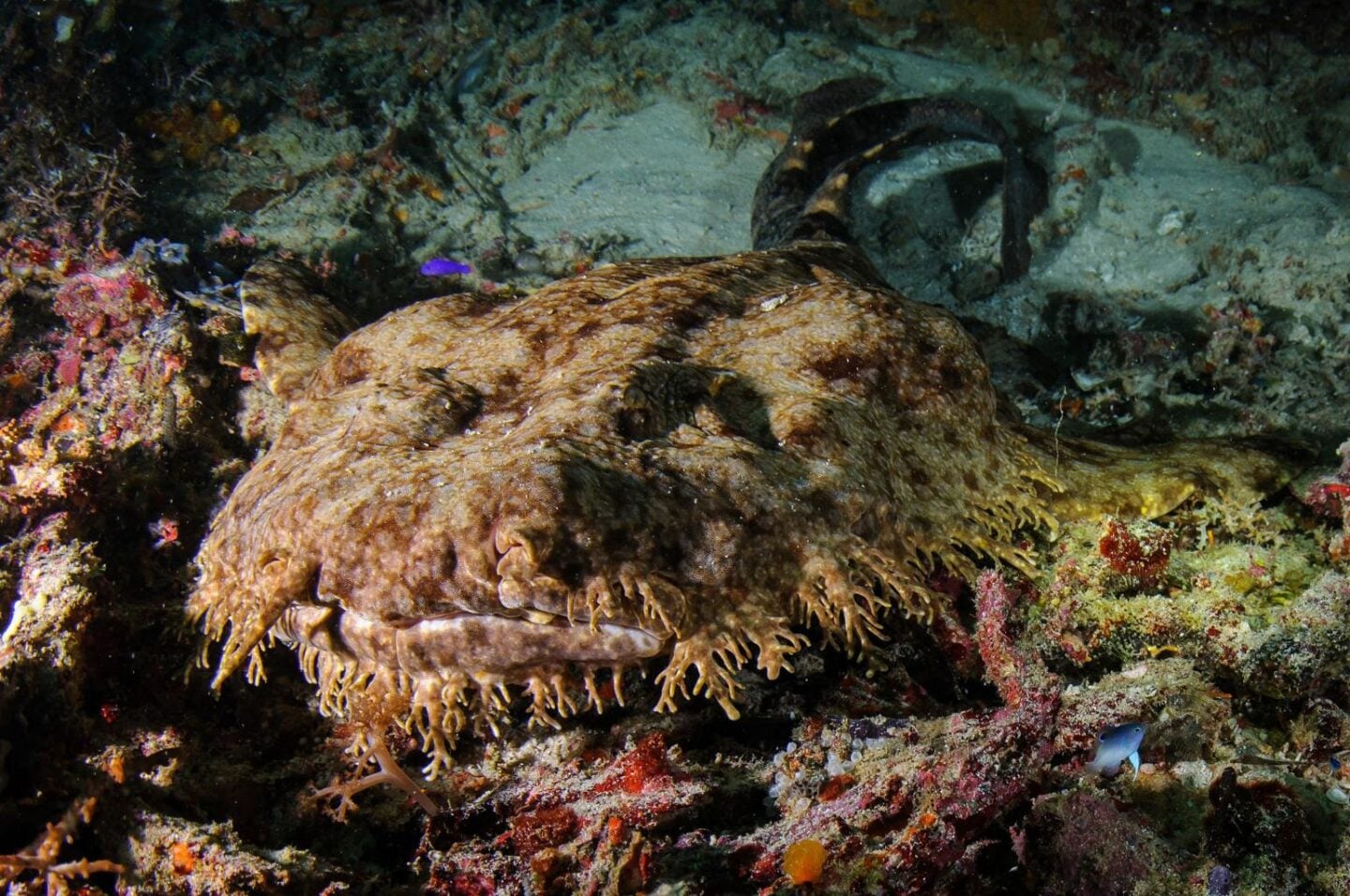
Although several wobbegong species occur across the Indo-Pacific region, divers in Raja Ampat most commonly encounter the tasselled wobbegong (Eucrossorhinus dasypogon), one of the most iconic carpet sharks in the region.
The most distinctive feature of this species is the presence of dermal lobes, or skin tassels, surrounding the mouth and head. These branching tissue structures help break up the outline of the shark’s body, allowing it to resemble coral, algae, or rocky reef surfaces.
The tasselled wobbegong is a bottom-dwelling shark typically found in tropical coral reef habitats, including reef caves, rocky crevices, and reef slopes. It usually rests motionless on the seabed during the day and becomes more active at night while searching for prey.
This species is distributed throughout the Indo-West Pacific, including eastern Indonesia, Papua New Guinea, and northern Australia.
For divers, the tasselled wobbegong is often seen lying almost invisibly on the reef floor. Its flattened body remains perfectly still, with only subtle eye and gill movements revealing that the “coral” is actually a shark.
Read Also: Shark Teeth, all the facts and fiction
Wobbegong Shark Size
The size of sharks is often one of the first questions people ask when discussing marine predators. Compared with many other shark species, wobbegongs are considered medium-sized or relatively small sharks.
In the tasselled wobbegong, the maximum body length can reach approximately 1.2 – 1.8 metres. This size can make the shark appear quite large when resting on the reef floor, especially because its flattened body spreads across the coral surface.
Meanwhile, the Papuan wobbegong (Orectolobus wardi) is much smaller. Data from FishBase records a maximum length of around 63 centimetres. With this size, the Papuan wobbegong is among the smaller species within the wobbegong group.
Although they are not as large as pelagic sharks such as tiger sharks or great white sharks, they are large enough to function as effective predators within coral reef ecosystems. Much of their prey consists of small fish or crustaceans living close to the seabed.
Their flat, wide bodies also help them remain stable on reef surfaces while waiting for prey to pass.
How Wobbegong Sharks Hunt
The hunting strategy of wobbegongs is very different from that of many other sharks. While pelagic sharks often chase prey at high speed in open water, wobbegongs use a much quieter approach.
They are ambush predators.
Most of the time, a wobbegong lies motionless on the seabed, usually among coral or sand. The pattern on its body makes it almost invisible to small fish swimming nearby.
When prey passes close enough, the wobbegong launches a rapid strike by suddenly opening its jaws. The jaws create a strong suction that pulls the prey directly into the mouth.
Typical wobbegong prey includes:
- Small fish
- Crustaceans such as shrimp and crabs
- Cephalopods such as squid
This strategy allows wobbegongs to hunt with high energy efficiency. They do not need to swim long distances or pursue prey over extended periods.
Many wobbegong species rest on reef floors during the day and become more active at night, when they feed. Biologically, this behaviour occurs because:
- Many prey species, such as small fish and crustaceans, are active at night
- Lower light conditions benefit predators that rely on camouflage
This behaviour aligns perfectly with the ambush hunting strategy used by wobbegongs.
Although they usually feed on small fish or crustaceans, wobbegongs can occasionally capture larger prey. One remarkable observation even recorded a wobbegong preying on a small reef shark.
You can see an example in this video:
https://www.lagaligoliveaboard.com/video/wobbegong-shark-eating-black-tip-reef-shark/
Where to See Wobbegong Sharks in Raja Ampat
For divers and ocean enthusiasts, encountering a wobbegong can be a memorable experience. Several regions in Raja Ampat are known as good locations to observe these sharks.
Dampier Strait
The Dampier Strait region is famous for nutrient-rich currents and exceptionally high biodiversity. The complex coral reef structures provide ideal hiding places for wobbegongs.
Misool
The southern region of Raja Ampat, especially Misool, is known for its exceptionally healthy and diverse coral reefs. The complex reef structures create ideal habitats for various reef predators, including wobbegongs.
Waigeo Island
Waigeo Island, the largest island in Raja Ampat, has many dive sites with rich coral reef ecosystems. In several locations, divers frequently encounter wobbegongs resting on the reef floor during the day.
For travellers who wish to explore these areas more extensively, liveaboard journeys are often the best option. La Galigo Liveaboard is a traditional phinisi vessel that takes guests diving across many iconic locations in Raja Ampat, from Dampier Strait to the vibrant reefs of Misool.
With carefully planned dive schedules and experienced guides, liveaboard journeys like these provide greater opportunities to encounter unique marine species, including wobbegongs that often remain hidden among coral reefs.
Read Also: 6 Best Places to Go Dive with Sharks
Are Wobbegong Sharks Dangerous?
In general, wobbegongs are not aggressive sharks towards humans. They tend to rely on camouflage rather than swimming away when divers are nearby.
However, like all wild animals, wobbegongs should always be treated with respect. Most recorded incidents occur when someone attempts to touch or disturb the shark.
During diving activities, several simple principles should always be followed:
- Do not touch the shark
- Do not approach too closely
- Avoid blocking their path
By maintaining distance and respecting marine wildlife, divers can observe wobbegongs without disturbing their natural behaviour.
Why Wobbegong Sharks Matter for Coral Reefs
Although they are rarely seen moving actively, wobbegongs play an important role in coral reef ecosystems.
As mid-level predators, they help regulate populations of small fish and benthic organisms. This balance is important for maintaining community structure within coral reef ecosystems.
Predators such as wobbegongs are also part of a complex food web. Without predators, populations of certain species could increase disproportionately, affecting the health of the ecosystem as a whole.
Final Thought
Among the hundreds of fish species living in the waters of Raja Ampat, the wobbegong shark occupies a unique position. Its flattened body, complex camouflage patterns, and distinctive hunting strategy make it one of the most fascinating predators on tropical coral reefs.
The two species most relevant to this region, the tasselled wobbegong and the Papuan wobbegong, demonstrate how evolutionary adaptations allow marine predators to survive effectively in complex coral environments.
For divers and ocean enthusiasts, encountering a wobbegong often becomes a memorable experience. This shark may not be as iconic as manta rays or whale sharks. However, precisely because of its hidden nature, the wobbegong has become another symbol of the remarkable and often unseen wonders beneath the waters of Raja Ampat.
In vibrant coral reefs full of life, the wobbegong remains calm and still. It waits patiently, blending into the reef and demonstrating that in the marine world, the most effective predators are not always the fastest, but often the most patient.
Frequently Asked Questions
1. What is a wobbegong shark?
A wobbegong shark is a group of bottom-dwelling sharks commonly known as carpet sharks because their body patterns resemble decorative carpets. These sharks have flattened bodies, complex colour patterns, and exceptional camouflage abilities. Wobbegongs typically rest on the seabed and use an ambush hunting strategy to capture prey.
2. Where do wobbegong sharks live?
Wobbegong sharks live in tropical and subtropical waters of the Indo-Pacific region. They are usually found in coral reef habitats, including reef caves, rocky crevices, and reef slopes. Biodiversity-rich regions such as Raja Ampat provide ideal habitats for these sharks due to the abundance of reef structures and food sources.
3. What species of wobbegong sharks are found in Raja Ampat?
Two species commonly associated with this region are the tasselled wobbegong (Eucrossorhinus dasypogon) and the Papuan wobbegong (Orectolobus wardi).
The tasselled wobbegong is easily recognised by the skin tassels around its mouth, while the Papuan wobbegong has body patterns that help it blend into the reef floor.
4. What do wobbegong sharks eat?
Wobbegong sharks are ambush predators that feed on a variety of small marine organisms. Their prey typically includes:
- Small fish
- Crustaceans such as shrimp and crabs
- Cephalopods such as squid
They usually remain motionless on the seabed and wait for prey to swim close enough before launching a rapid strike.
5. How big do wobbegong sharks get?
The size of wobbegongs varies by species. Tasselled wobbegongs can reach lengths of approximately 1.2 – 1.8 metres, while Papuan wobbegongs are typically smaller, with a maximum length of about 63 centimetres. Although they are not as large as some pelagic sharks, this size is sufficient for them to function as effective predators in coral reef ecosystems.
6. Are wobbegong sharks dangerous?
In general, wobbegong sharks are not aggressive towards humans. They rely more on camouflage than on fleeing when divers approach. However, like all wild animals, they should not be touched or disturbed. Maintaining a respectful distance is the safest way to observe them.
7. Do wobbegong sharks have teeth?
Yes, wobbegong sharks have teeth. Their teeth are relatively small but sharp, designed to grasp and hold slippery prey such as fish or squid. When attacking, they open their jaws quickly to suck prey into their mouths.
8. Are wobbegong sharks protected?
The conservation status of wobbegongs varies by species and region. Some species remain relatively stable, though they can still be affected by coral reef degradation and fishing. In marine conservation areas such as Raja Ampat, protecting coral reef ecosystems also helps safeguard populations of many marine species, including wobbegong sharks.
References
FishBase. (2024). Orectolobus wardi (Northern wobbegong).
Florida Museum of Natural History. (n.d.). Tasselled wobbegong (Eucrossorhinus dasypogon).
Compagno, L. J. V. (2001). Sharks of the world. An annotated and illustrated catalogue of shark species known to date (Vol. 2). Rome. Food and Agriculture Organisation of the United Nations.
Last, P. R., & Stevens, J. D. (2009). Sharks and rays of Australia (2nd ed.). Cambridge, MA. Harvard University Press.