
What Is a Dugong?
In calm tropical waters, particularly in the Indo-Pacific region, lives one of the most unique marine mammals in the world: the dugong. This animal is often called a “sea cow” because its feeding behaviour resembles that of grazing cattle. However, instead of feeding on grass on land, dugongs spend most of their time eating seagrass on the seabed.
The dugong has the scientific name Dugong dugon and belongs to the marine mammal order Sirenia. This group includes only a few living species, including dugongs and manatees. Unlike most other marine mammals, such as whales or dolphins, which are carnivorous, dugongs are true herbivores whose diet consists almost entirely of marine plants.
Overall, the dugong is the only surviving species in the genus Dugong, making it unique. Researchers study dugongs not only because of their unusual biology, but also because of their important role in maintaining the health of tropical coastal ecosystems.
One reason dugongs are especially interesting to scientists is their close relationship with seagrass meadows. The lives of dugongs depend heavily on this ecosystem. They feed, travel between habitats, and reproduce in shallow waters rich in seagrass.
Dugongs also hold a special appeal for divers and ocean enthusiasts. Seeing a dugong swimming slowly above a seagrass meadow is often considered a rare and remarkable experience. Its calm movements and non-aggressive nature have given it a reputation as one of the gentlest marine mammals in tropical seas.
Quick Facts: Dugong
Scientific name: Dugong dugon
Animal group: Sirenia (herbivorous marine mammals)
Average length: approximately 2.5 to 3 metres
Diet: Herbivorous, mainly seagrass
Habitat: Shallow coastal waters with seagrass meadows
Distribution: Indo-Pacific region, including Indonesia, Australia, Southeast Asia, and East Africa
Dugongs usually live in relatively calm coastal areas. They are most often found in shallow waters with seagrass growing on the seabed, because these areas provide their main food source.
The Gentle Appearance of the Dugong
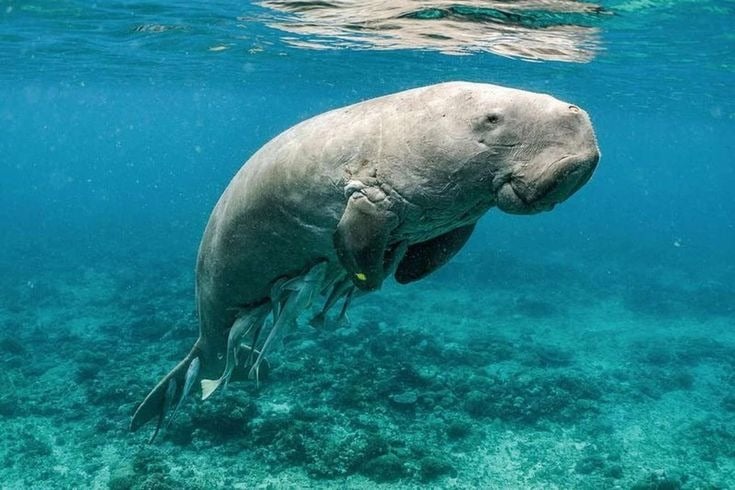
Physically, dugongs have a distinctive body shape that is easy to recognise. Their bodies are large and elongated, with skin that ranges from grey to brownish grey. From a distance, their body shape may resemble that of a small whale, although several characteristics clearly distinguish them.
One of the most noticeable features is their large head with a downward-facing snout. This structure is not accidental. The snout is specially adapted to help dugongs locate and uproot seagrass from the seabed.
At the front of the mouth, there are fine sensory bristles that help them detect seagrass on the seabed. When feeding, dugongs are often seen moving their snouts through the sediment to pull plants out by their roots.
Unlike manatees, which have paddle-shaped tails, dugongs have whale-like tails that help them swim more efficiently in open water.
Although their bodies are quite large, dugongs move very gently and slowly. Their swimming movements are often described as graceful and calm, further strengthening their reputation as one of the most peaceful creatures in the ocean.
Dugongs and Seagrass Meadows
The Seagrass Connection
One of the most important aspects of dugong life is their relationship with seagrass meadows. Seagrasses are flowering plants that live entirely in marine environments and form highly productive ecosystems in tropical coastal waters.
Most of the dugong diet consists of various seagrass species. When feeding, dugongs pull these plants from the seabed, leaving behind marks known as feeding trails.
These trails often appear as lines or open patches within seagrass meadows. For researchers, these patterns are frequently used to identify areas where dugongs are actively feeding.
Seagrass Is So Important
Seagrass meadows are not only a food source for dugongs. These ecosystems also play an important role in supporting marine life.
Seagrass provides habitat for many organisms, including:
- Juvenile fish
- Crustaceans
- Molluscs
- Various marine invertebrates
In addition, seagrass helps stabilise seabed sediment and plays a significant role in carbon storage.
For this reason, the presence of dugongs is often considered an indicator of the health of seagrass ecosystems. When dugong populations remain stable, it usually suggests that seagrass meadows in that region are still healthy enough to support them.
Sparse Seagrass Can Still Be Important
Interestingly, dugongs do not always require extremely dense seagrass meadows. Even sparse or scattered seagrass can still provide important habitat for them.
This suggests that dugongs can adapt their feeding behaviour to varying environmental conditions.
Read Also: Ocean Sunfish: Characteristics, Habitat and Predators of the Mola – Mola
Habitat and Distribution
Dugongs live in the Indo-Pacific region, one of the most biologically diverse marine areas in the world. This region stretches from East Africa to Australia and Southeast Asia.
Some areas known to support dugong populations include:
- Northern Australia
- Indonesia
- The Philippines
- Thailand
- Southern Japan
- Several regions of East Africa
Most dugongs are found in shallow coastal waters, particularly in areas with extensive seagrass meadows.
Lagoon and Coastal Ecosystems
Research shows that dugongs frequently use coral reef lagoons and coastal waters as their primary habitat.
These environments share several characteristics that are suitable for dugongs:
- Relatively shallow waters
- Moderate currents
- Seagrass meadows as a food source
Lagoons and coastal bays often provide ideal locations for dugongs to feed and rest.
Dugong in Indonesia
Indonesia is one of the countries with a relatively extensive dugong habitat. Dugongs can be found in several Indonesian waters, including the Riau Islands. The presence of dugongs around Bintan Island, for example, indicates that local communities still occasionally observe them in nearby waters. Local observations such as these help researchers better understand the distribution of dugongs in Southeast Asia.
In addition to the Riau Islands, dugongs are known to live in several other Indonesian coastal areas that still support healthy seagrass meadows. Some regions in Raja Ampat and waters around Nusa Tenggara have also been reported as potential dugong habitats because these areas contain relatively natural coastal ecosystems with abundant seagrass.
For divers and ocean enthusiasts, exploring regions such as Raja Ampat and Komodo National Park offers not only spectacular coral reefs but also the chance to encounter rare marine wildlife. Although encounters with dugongs cannot be predicted, divers occasionally report seeing them in shallow waters where seagrass is present.
Liveaboard diving trips allow divers to reach remote locations that are rarely visited. During such journeys, divers can explore a variety of marine habitats ranging from coral reefs and lagoons to coastal areas that support diverse marine life.
For those who wish to explore these regions in greater depth, journeys with La Galigo Liveaboard provide opportunities to dive at some of the best sites in Raja Ampat and Komodo National Park. In addition to experiencing spectacular coral reefs and extraordinary marine biodiversity, such trips may also offer the chance to encounter fascinating marine animals in their natural habitat, from colourful reef fish to rarely seen marine mammals such as the dugong.
How Dugongs Move and Travel
Although dugongs appear slow, they are capable of travelling considerable distances along coastlines. They can move between different seagrass areas in search of better feeding grounds. These movements are often influenced by several factors, including:
- Availability of seagrass
- Environmental conditions
- Seasonal changes
In some cases, dugongs may travel tens to hundreds of kilometres along coastlines. However, they generally remain within regions that provide stable and abundant seagrass meadows.
Dugong movements are also closely related to their feeding behaviour. Dugongs spend much of their time grazing on the seabed, feeding on seagrass in slow and steady movements. Research shows they may feed throughout the day, although feeding activity can increase when environmental conditions are favourable, such as when seagrass grows abundantly or when waters are relatively calm.
In some regions, dugongs also make seasonal movements in response to changes in coastal habitat conditions. If seagrass availability declines in one area, they may move to another region where seagrass remains healthy.
This behaviour shows that although dugongs appear calm and slow-moving, they actually possess a strong ability to adapt to environmental changes within their habitat.
Feeding Behaviour of Dugongs
Dugongs spend most of their time feeding. Because their diet consists almost entirely of marine plants, they need to consume relatively large amounts of seagrass each day.
Grazing on the Seafloor
When feeding, dugongs usually swim slowly above the seabed while lowering their snouts into the sediment. With the help of their flexible lips and snouts, they pull seagrass plants from the seabed.
This process often leaves visible marks known as feeding trails within seagrass meadows.
Selective Feeding
Dugongs do not eat all seagrass species randomly. They often show a preference for particular seagrass species, especially those with higher nutritional value.
By selecting more nutritious plants, dugongs are able to meet their energy needs more efficiently.
Threats to Dugong Populations
Although dugongs have lived in the ocean for millions of years, their populations in many regions now face increasing pressure.
Some of the main threats to dugongs include the following.
Loss of Seagrass Habitat
Because dugongs depend heavily on seagrass, damage to this ecosystem can significantly impact their survival.
Seagrass meadows can be damaged by several factors, including:
- Coastal development
- Pollution
- Changes in water quality
When seagrass declines, dugongs lose their primary food source.
Natural Predators of Dugongs
In tropical marine ecosystems, adult dugongs are relatively rarely preyed upon because of their large size. However, several predators are known to attack dugongs, particularly calves or weakened individuals.
1. Large sharks
Some large shark species may prey on dugongs, especially:
- Tiger shark (Galeocerdo cuvier)
- Great white shark (Carcharodon carcharias) in certain regions
2. Saltwater crocodiles
In certain regions, such as northern Australia and parts of Southeast Asia, saltwater crocodiles (Crocodylus porosus) also attack dugongs, particularly in coastal waters.
In general, dugong calves are more vulnerable to predators than adults. Today, however, the greatest threats to dugong populations come from human activities and the loss of seagrass habitats, which provide their primary food source.
Fishing Nets and Human Activities
Dugongs may also become accidentally entangled in fishing nets. Because they must surface regularly to breathe, becoming trapped in nets can be extremely dangerous.
Coastal Development
Uncontrolled coastal development can significantly alter dugong habitats and reduce the availability of seagrass meadows.
Dugong Conservation Efforts
Because of these threats, dugongs have become the focus of conservation efforts in many countries.
Protecting this species depends largely on protecting seagrass habitats.
Some important steps in dugong conservation include:
- Protection of seagrass meadows
- Management of fishing activities
- Research on dugong populations
- Education of coastal communities
Conservation efforts also involve cooperation between scientists, governments, and local communities.
Why Dugongs Matter for the Ocean
Dugongs are not only biologically fascinating animals, but they also play an important role in marine ecosystems.
By feeding on seagrass, dugongs help maintain the structure and dynamics of seagrass meadows. Their grazing activity can stimulate the growth of new plants, influencing seagrass structure and productivity, while also helping maintain ecological balance.
Because of this close relationship, dugongs are often considered a key species in seagrass ecosystems.
Protecting dugongs, therefore, also helps protect habitats that support many other marine species.
Read Also: What is Ocean Sound and Underwater Noise Pollution?
Verdict
Dugongs are among the most unique marine mammals living in tropical waters. With their large bodies, calm movements, and distinctive feeding behaviour, they are often called the “gentle sea cow of the tropics.”
Despite their peaceful appearance, dugongs play a very important ecological role. Their lives are closely connected with seagrass meadows, one of the most productive coastal ecosystems in the world.
Maintaining healthy seagrass ecosystems is essential for the future survival of dugongs. Without these habitats, dugong populations will become increasingly vulnerable to environmental pressures.
Dugongs help illustrate the complex relationship between marine mammals and coastal ecosystems. For divers and ocean enthusiasts, seeing a dugong swimming slowly above a seagrass meadow is a truly special experience.
This calm marine animal reminds us that even seemingly simple creatures can play an essential role in maintaining ocean balance.
Frequently Asked Questions
What is a dugong?
A dugong is a herbivorous marine mammal with the scientific name Dugong dugon. It belongs to the order Sirenia and is often called a “sea cow” because its feeding behaviour resembles cattle grazing in seagrass meadows.
Where do dugongs live?
Dugongs live in the Indo-Pacific region, particularly in shallow coastal waters with seagrass meadows. They can be found in countries such as Australia, Indonesia, the Philippines, and parts of East Africa.
What do dugongs eat?
Dugongs are herbivores that feed mainly on seagrass, which forms the primary component of their diet.
How big is a dugong?
Adult dugongs usually reach about 2.5 to 3 metres in length and may weigh several hundred kilograms.
Why are dugongs called sea cows?
Dugongs are called sea cows because their feeding behaviour resembles that of grazing cattle. They feed on seagrass growing on the seabed.
Are dugongs endangered?
Dugong populations in many regions are declining due to loss of seagrass habitat, human activities, and environmental changes.
Why are dugongs important for the ecosystem?
Dugongs help maintain healthy seagrass ecosystems, which provide habitat for many marine species and play an important role in ocean carbon storage.
Are dugongs and manatees the same?
No. Dugongs and manatees both belong to the order Sirenia, but they are different species. One of the most visible differences is their tail shape. Dugongs have a whale-like tail, while manatees have a rounded paddle-shaped tail.
Is a dugong a dolphin?
No. Dugongs are not dolphins. Dolphins belong to the cetacean group along with whales, while dugongs belong to Sirenia, a group of herbivorous marine mammals that feed on marine plants.
Are dugongs friendly to humans?
Dugongs are known to be calm animals and are generally not aggressive towards humans. They usually swim slowly and tend to avoid close interaction. However, like all wildlife, dugongs should be respected and not disturbed.
Is a dugong an herbivore, carnivore, or omnivore?
Dugongs are true herbivores. Their diet consists almost entirely of different species of seagrass growing on the seabed.
Why can’t you touch dugongs?
Dugongs are protected wildlife in many countries. Touching or disturbing them can cause stress or alter their natural behaviour. For this reason, many conservation regulations prohibit direct contact with dugongs to protect their well-being.
References
Anderson, P. K., Birtles, A., Marsh, H., & Preen, A. (2016). Dugong (Dugong dugon) feeding in tropical Australian seagrass meadows. PeerJ, 4, e2317.
Bordbar, L., & Shahraki, M. (2020). Dugong (Dugong dugon) movements and habitat use in a coral reef lagoonal ecosystem. Endangered Species Research, 42, 243–256.
Derville, S., Torres, L. G., & Garrigue, C. (2025). Sparse seagrass meadows are critical dugong habitat. Global Ecology and Conservation, 53, e03096.
Haris, A., Adibrata, S., & Pratama, R. (2020). Dugong’s presence confirmation in Bintan Island based on local observations. AACL Bioflux, 13(2), 651–656.
Mei, Z., Wang, D., & Turvey, S. T. (2023). Dugong (Dugong dugon) conservation in China: Status, threats, and prospects. Conservation Biology, 37(4), e14042.
Marsh, H., O’Shea, T. J., & Reynolds, J. E. (2022). Dugong dugon. The IUCN Red List of Threatened Species.