
What Is a Moray Eel?
Among the vibrant colours of tropical coral reefs, not all marine inhabitants stand out. Some choose to remain hidden, and one of the most iconic is the moray eel.
Moray eels belong to the family Muraenidae, a group of elongated, snake-like fish that have evolved specifically to live within narrow crevices of coral reefs. From an evolutionary perspective, moray eels are well-adapted as reef predators, with many species found in tropical waters worldwide.
Unlike most fish, moray eels do not have pectoral fins and have highly flexible bodies. This adaptation allows them to enter spaces inaccessible to other predators, a major advantage in complex reef environments.
For divers, moray eels are often seen as a head emerging from the reef. Although this may appear mysterious, it actually reflects their strategy as efficient ambush predators.
Quick Facts: Moray Eels
Scientific name: Family Muraenidae
Group: Anguilliformes
Size: approximately 50 cm to over 2 metres
Diet: Carnivorous, including fish, crustaceans, and cephalopods
Habitat: Coral reefs, rock crevices, small caves
Distribution: Indo-Pacific, Atlantic, Mediterranean
The Unique Appearance of Moray Eels
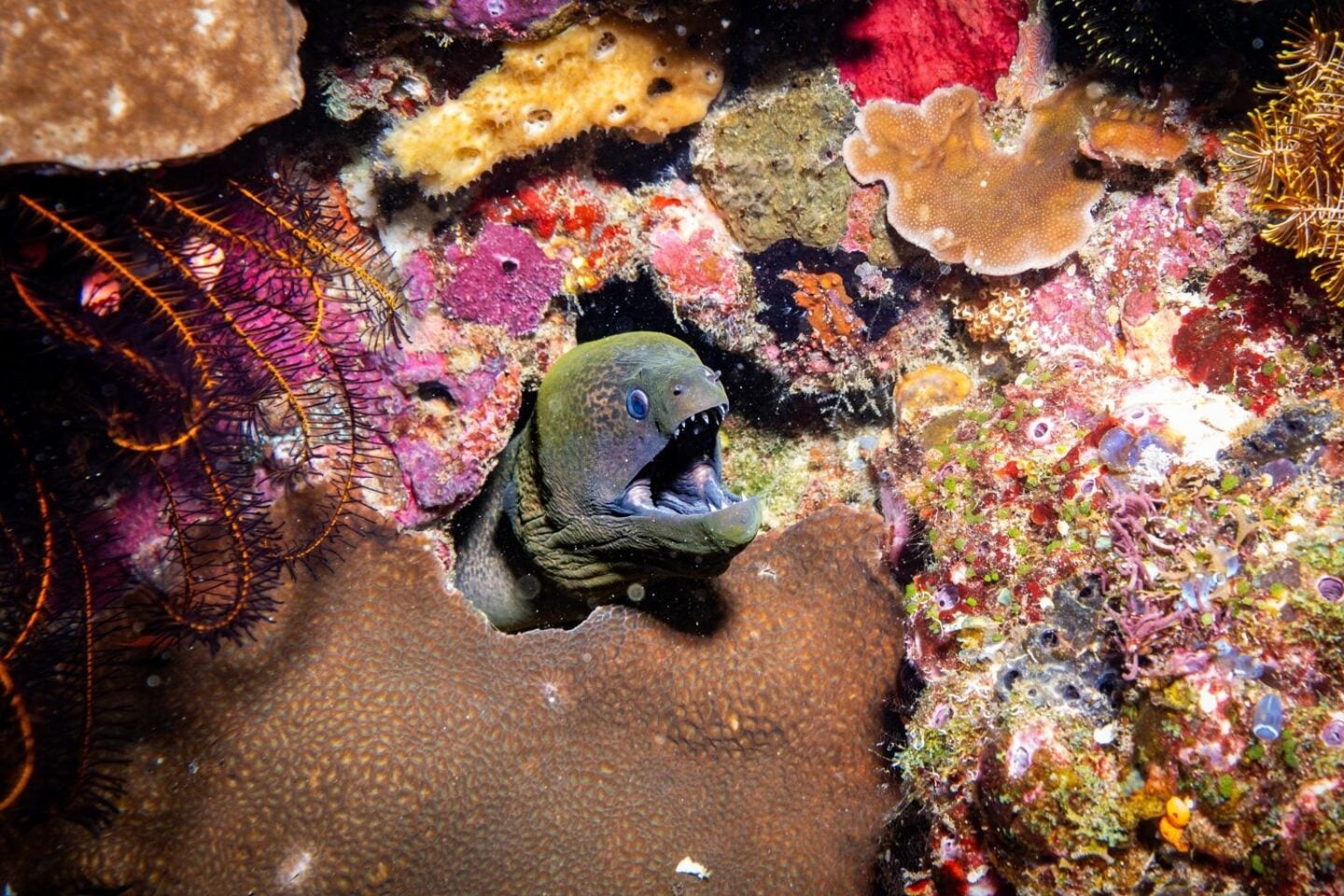
Visually, moray eels are easy to recognise. Their bodies are long and smooth, and they do not have clearly visible scales. Instead, they are covered with a protective layer of mucus that helps reduce friction and protect the skin.
Their colour patterns vary widely, ranging from spots and stripes to solid colours that assist with camouflage. This adaptation is not merely aesthetic, but also serves as an effective survival strategy for both hiding from predators and ambushing prey.
Although some closely related moray eel species can be difficult to distinguish morphologically, most species display clear and easily recognisable physical differences. In general, moray eels can usually be identified visually.
Why Moray Eels Always Open Their Mouth
One of the most commonly misunderstood behaviours among divers is the habit of moray eels repeatedly opening and closing their mouths.
This is not a sign of aggression.
Biologically, moray eels use a mechanism known as buccal pumping to breathe. This means they must actively open and close their mouths to move water over their gills.
Unlike many other fish that can pump water through body movement, moray eels rely heavily on this mechanism due to their elongated body shape and the confined nature of their habitat.
Moray Eels as Efficient Reef Predators
Moray eels are high-level predators within coral reef ecosystems. Phylogenetic and ecological analyses indicate that they play an important role in maintaining reef community structure.
As ambush predators, their hunting strategy is highly efficient:
- Hiding within reef crevices
- Waiting for prey to approach
- Striking rapidly at close range
Studies on the feeding preferences of Muraena helena show that moray eels consume:
- Fish
- Crustaceans such as crabs and shrimp
- Cephalopods
Interestingly, they are not rigid predators. Moray eels are opportunistic feeders, meaning they adjust their diet based on prey availability and body size.
Smaller moray eels tend to consume crustaceans
Larger moray eels more frequently prey on fish
This flexibility is one of the reasons they are highly successful as reef predators.
Read Also: 9 Species to Spot While Diving in Komodo Island
A Hidden Biological Detail: Reproduction
Although rarely observed by divers, moray eels also possess unique internal biological characteristics.
Recent research has found that some moray eel species exhibit gonadal asymmetry, in which the right gonad is longer than the left. This phenomenon is uncommon in fish and suggests a biological adaptation that is still being studied.
This serves as a reminder that even species commonly encountered while diving still hold many scientific mysteries.
Habitat and Life Inside the Reef
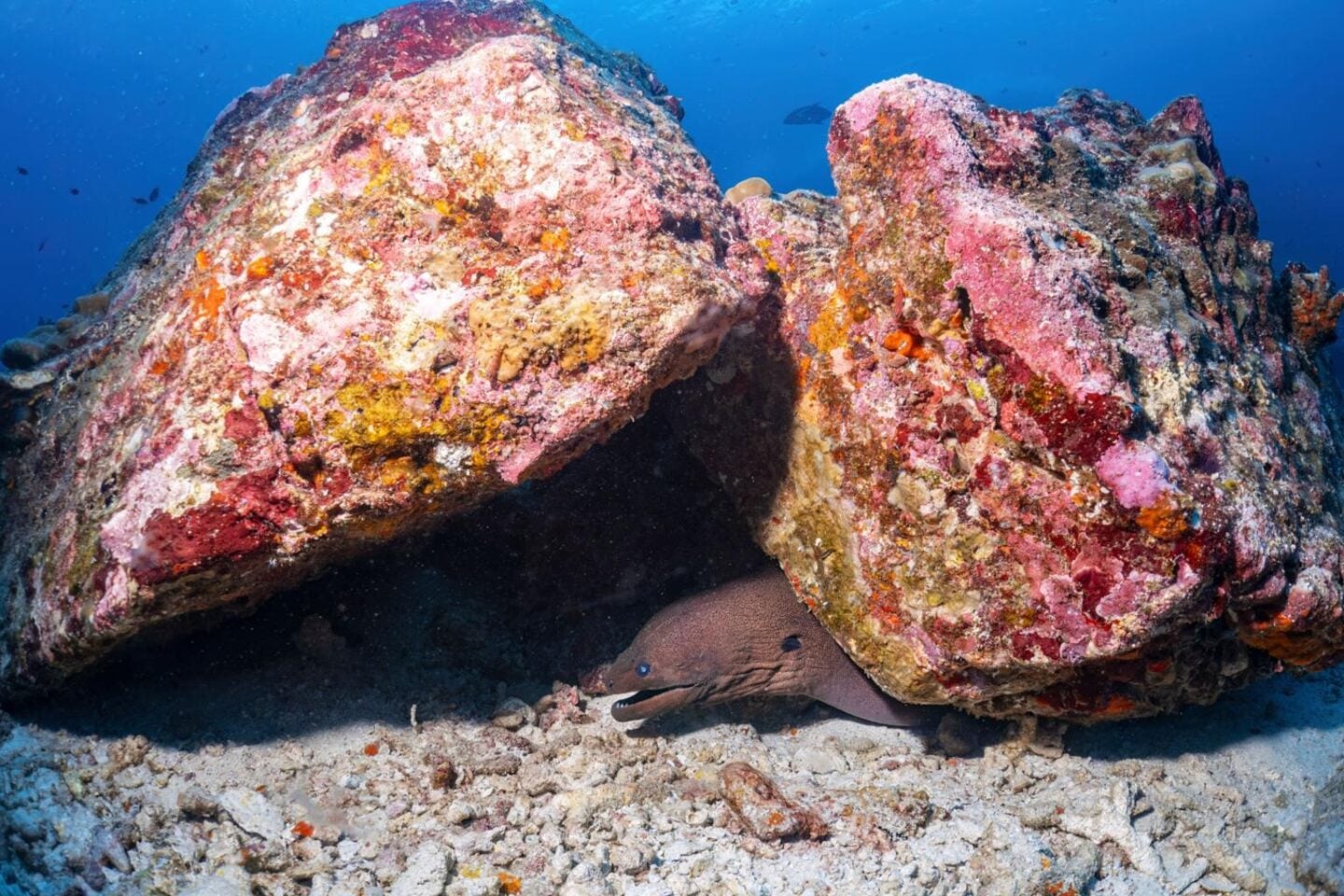
Moray eels depend heavily on the physical structure of coral reefs.
They are most commonly found in:
- Coral crevices
- Small caves
- Rock structures
- Reef walls
These environments provide:
- Protection from predators
- Ideal positions for hunting
- Safe resting places
Their long and flexible bodies allow them to exploit microhabitats that other fish cannot use, giving them a highly specialised niche within the ecosystem.
Activity Patterns
Most moray eels are nocturnal.
During the day, they remain hidden, with only the head visible
At night, they become active, hunting and leaving their shelter
For divers:
- Day dives: Moray eels are most often seen in a resting position
- Night dives: The chance of seeing moray eels swimming and hunting is much higher
This makes moray eels one of the highlights of day and night dives.
Are Moray Eels Dangerous?
Although they may appear intimidating, moray eels are not aggressive towards humans.
Most incidents occur due to:
- Getting too close
- Attempting to touch them
- Feeding them
Moray eels have limited vision and rely more on their sense of smell. In certain situations, they may mistake a hand for prey.
However, under normal conditions, they remain in place and do not attack. Observe, do not touch.
Divers Love Seeing Moray Eels
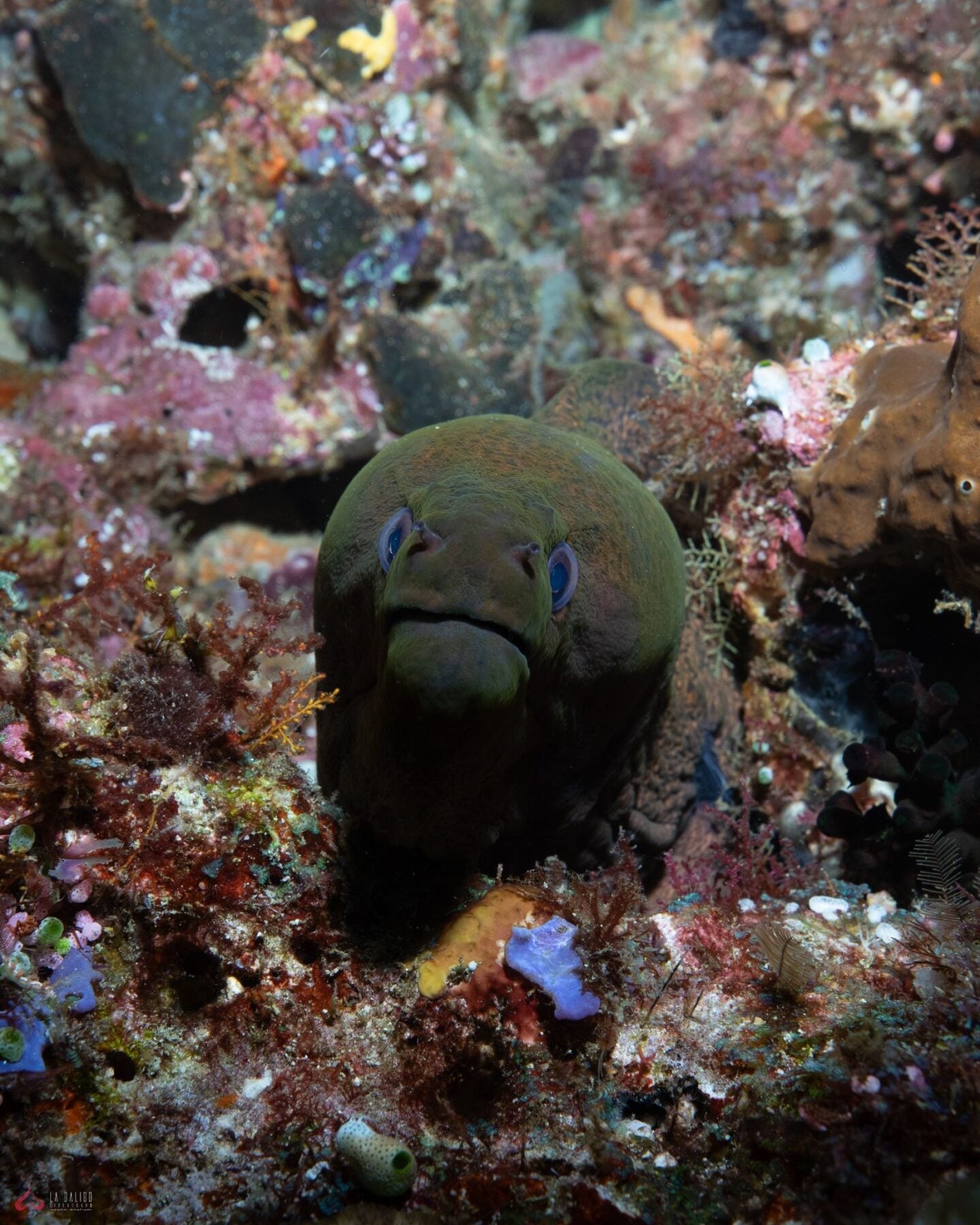
For many divers, moray eels are not just fish that hide. They are among the highlights that divers often anticipate on every dive, especially in world-class destinations such as Raja Ampat and Komodo National Park.
In both locations, the complexity of coral reefs creates an ideal habitat for moray eels. On almost every dive, you can find their heads emerging from reef crevices, as if they are observing divers in return. The experience of finding them, sometimes perfectly hidden and sometimes clearly visible, creates a sense that feels personal and rewarding.
During night dives, the situation changes. Moray eels that appear passive during the day begin to leave their shelters and actively hunt, revealing another side of them as efficient reef predators. Moments like these are often among the most memorable for divers.
To fully experience this, including visiting multiple top dive sites in Raja Ampat and Komodo, including remote areas with high moray eel activity, many divers choose liveaboard trips. La Galigo Liveaboard offers this type of exploration experience, allowing you to access the best moray eel habitats with greater reach and more flexible dive schedules.
Verdict
A Secretive Predator That Defines the Reef
Moray eels may not be as visually striking as other reef fish, but ecologically, they are highly important.
- They are adaptive predators
- They have a highly flexible diet
- They demonstrate biological complexity at the genetic and reproductive levels
Behind their often misunderstood appearance, moray eels are a perfect example of how evolution shapes species to fit their specific habitats.
For divers, the ocean is a reminder that its beauty is not always obvious. Sometimes, it is hidden within the crevices of the reef.
FAQ
What do moray eels eat?
Moray eels eat fish, crustaceans, and cephalopods. Their diet varies with size and environment.
Are moray eels aggressive?
No. They are defensive, not aggressive.
Why do they open their mouth?
To breathe through buccal pumping.
Are they important to reefs?
Yes. As predators, they help maintain the balance of coral reef ecosystems.
Are moray eels still being studied?
Yes. Recent studies have revealed new biological aspects, including reproductive organ asymmetry and genetic complexity.
Do moray eels bite humans?
Moray eels rarely bite humans. Most cases occur due to mistakes, such as when a diver’s hand is too close or resembles food. They do not hunt humans but may act defensively if disturbed.
Can moray eels see well?
Not very well. Moray eels have relatively limited vision and rely more on their sense of smell to detect prey. This explains why they may sometimes mistake objects for food.
Where is the best place to see moray eels while diving?
Moray eels are most easily found in tropical coral reefs with complex structures, such as Raja Ampat and Komodo National Park, especially in reef crevices, reef walls, and rocky areas.
Are moray eels active during the day?
Most are more active at night, but they can still be seen during the day in a hidden position. Their activity increases during night dives when they come out to hunt.
Do moray eels live alone or in groups?
Moray eels are generally solitary. They maintain their own shelter within the reef and are rarely seen in groups, except under certain conditions, such as in high-density areas.
How aggressive are moray eels?
Moray eels are generally calm and avoid confrontation. They may only show defensive behavior if provoked or cornered.
Can a moray eel sting you?
No. Moray eels do not have a sting. However, they can bite if they feel threatened.
Who eats moray eels?
Large predators such as sharks and groupers may prey on moray eels, especially smaller individuals.
What is special about moray eels?
They have a highly flexible body, strong jaws, and unique adaptations that allow them to hunt effectively within narrow reef crevices.
How poisonous are moray eels?
Moray eels are not venomous, but some can accumulate toxins like ciguatera through their diet, which is mainly a concern if consumed, not during diving.
Are moray eels electric?
No. Unlike electric eels, moray eels do not produce electricity.
Are moray eels friendly?
They are not social animals, but they are also not aggressive. When left undisturbed, they typically ignore divers.
References
Anastasopoulou, A., Mytilineou, C., & Smith, C. J. (2013).
Food preferences of the Mediterranean moray eel (Muraena helena) in the southern Adriatic Sea. Journal of Applied Ichthyology, 29(3), 527–534.
Reece, J. S., Bowen, B. W., Joshi, K., Goz, V., & Larson, A. (2010).
Phylogenetics of moray eels (Muraenidae) demonstrates multiple origins of a shell-crushing jaw (pharyngeal jaws). Molecular Phylogenetics and Evolution, 57(2), 829–835.
Bineesh, K. K., Akhilesh, K. V., Gopalakrishnan, A., Basheer, V. S., & Jena, J. K. (2018).
DNA barcoding reveals the identity of Gymnothorax minor (Temminck & Schlegel, 1846) (Anguilliformes: Muraenidae). Mitochondrial DNA Part B, 3(1), 151–153.
Siu, K. K. W., Leung, K. M. Y., & colleagues. (2023).
Directional asymmetry in gonad length of moray eels. Scientific Reports, 13, Article 29218.