
In the underwater world, two animals often cause confusion: dugongs and manatees. Both are commonly referred to as “sea cows” due to their grazing behaviour and their slow, gentle movement. At a glance, they appear quite similar, with large bodies, soft facial features, and calm behaviour.
However, despite these similarities, dugongs and manatees have several fundamental differences.
Both belong to the order Sirenia, a group of herbivorous marine mammals that have evolved over tens of millions of years. Although they share the same evolutionary lineage, dugongs and manatees have evolved differently in body shape, habitat, and feeding behaviour.
This article explains these differences clearly, especially if you are a diver or ocean enthusiast who wants to recognise them more accurately.
Comparison: Dugong vs Manatee
| Feature | Dugong | Manatee |
| Tail | Forked like a whale (fluke) | Rounded like a paddle |
| Habitat | Marine | Freshwater and estuarine |
| Diet | Seagrass (specialised) | Various plants |
| Distribution | Indo-Pacific | Americas and Africa |
| Snout | Downward-facing | More rounded |
| Feeding Style | Uproots seagrass | Grasps vegetation |
Dugongs are marine specialists, while manatees are flexible generalists.
What Are Dugongs and Manatees?
Dugongs and manatees belong to the order Sirenia, the only group of marine mammals that are entirely herbivorous. Based on scientific literature such as Manatees and Dugongs, this group is evolutionarily closer to elephants than to whales.
One of the most fundamental differences is the number of species:
- Dugongs have only one species, Dugong dugon
- Manatees have three species:
- West Indian manatee
- Amazonian manatee
- West African manatee
This difference is not only numerical but also reflects distinct evolutionary pathways. Dugongs tend to maintain a highly specialised marine lifestyle, whereas manatees have evolved to be more flexible and able to inhabit various aquatic environments.
From an evolutionary perspective, this reflects two survival strategies:
- Specialisation in dugongs, which is highly efficient in a single environment
- Flexibility in manatees, which allows adaptation across multiple environments
Key Differences Between Dugongs and Manatees
1. Tail Shape: Fluke vs Paddle
The most recognisable difference is the shape of the tail.
- Dugongs have a forked tail similar to a whale’s
- Manatees have a wide, paddle-shaped tail
This tail shape is not only a visual difference, but also reflects environmental adaptation. Dugongs, which live in open marine environments, require efficient swimming, particularly in currents, while manatees, which often inhabit calmer waters, do not require high speed.
2. Habitat: Marine vs Freshwater Flexibility
Dugongs are marine specialists. They live almost entirely in shallow marine waters, particularly in seagrass meadows.
In contrast, manatees are much more flexible:
- They can live in freshwater, such as rivers and lakes
- They can live in estuaries
- They can also enter marine environments
Research shows that manatees have physiological adaptations that allow them to move between freshwater and marine environments, whereas dugongs are more dependent on marine habitats.
3. Head Shape and Snout Orientation
Head shape also reveals important differences:
- Dugongs have a downward-facing snout
- Manatees have a more rounded and flexible face
This structure is directly related to feeding behaviour. Dugongs are adapted to feed on seagrass from the seafloor, while manatees have a more flexible mouth suited to a variety of plant types.
4. Feeding Behaviour: Specialist vs Generalist
One of the most scientifically important differences is feeding behaviour.
Studies on orofacial morphology show that:
- Dugongs use benthic feeding by uprooting seagrass from the seabed
- Manatees use prehensile feeding by grasping vegetation with their lips
This means:
- Dugongs are specialist feeders
- Manatees are generalist feeders
Biologically, this difference is supported by highly specific anatomical mechanisms. Dugongs have a downward-facing snout and a strong, rigid upper lip, allowing them to dig seagrass from the seabed sediment. When feeding, dugongs use sweeping motions to uproot the plants, often leaving visible feeding trails on the seabed. This process removes not only the leaves but also the entire plant, including the roots.
In contrast, manatees have much more flexible lips equipped with fine sensory hairs called vibrissae. These structures function as both tactile sensors and grasping tools, enabling manatees to grasp, pull, and bring a variety of vegetation into their mouths with precision. This mechanism, known as prehensile feeding, enables manatees to consume a wide variety of plants in both freshwater and marine environments.
This difference explains why dugongs are highly dependent on a single habitat type, seagrass meadows, while manatees can adapt to different environments and food sources.
5. Body Shape and Movement
Dugongs have a more streamlined body, suitable for swimming in marine environments. Manatees have a rounder, bulkier body and slower movement that suit calmer aquatic environments.
Also Read: What Animals Eat Manta Rays?
Dugongs and Manatees Evolved Differently
The differences between dugongs and manatees are not accidental. They are the result of different evolutionary pressures.
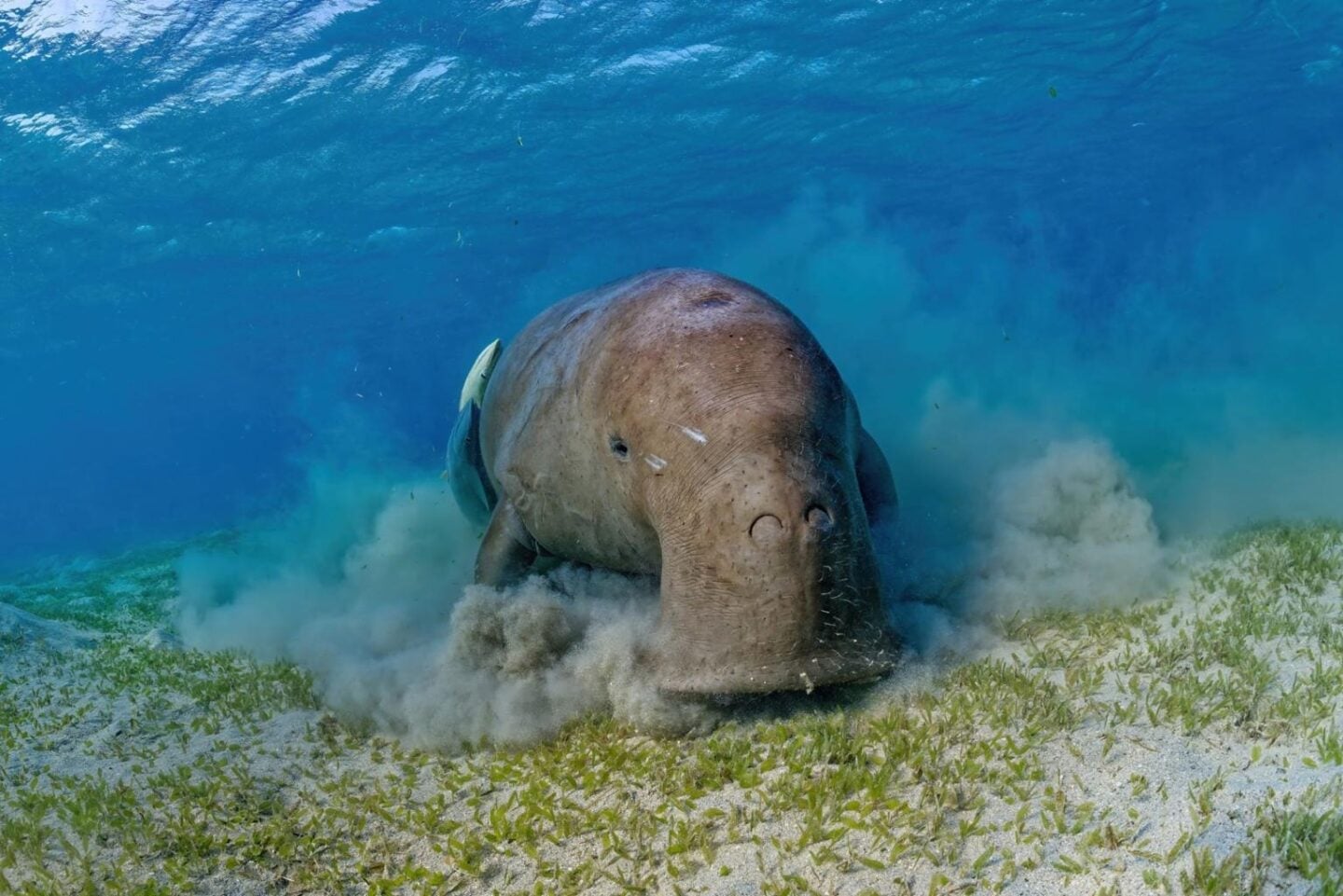
Dugongs evolved in marine environments that are relatively stable yet highly specific: seagrass meadows. As a result, they developed:
- A downward-facing snout
- Specialised teeth and mouth structure
- Focused feeding behaviour
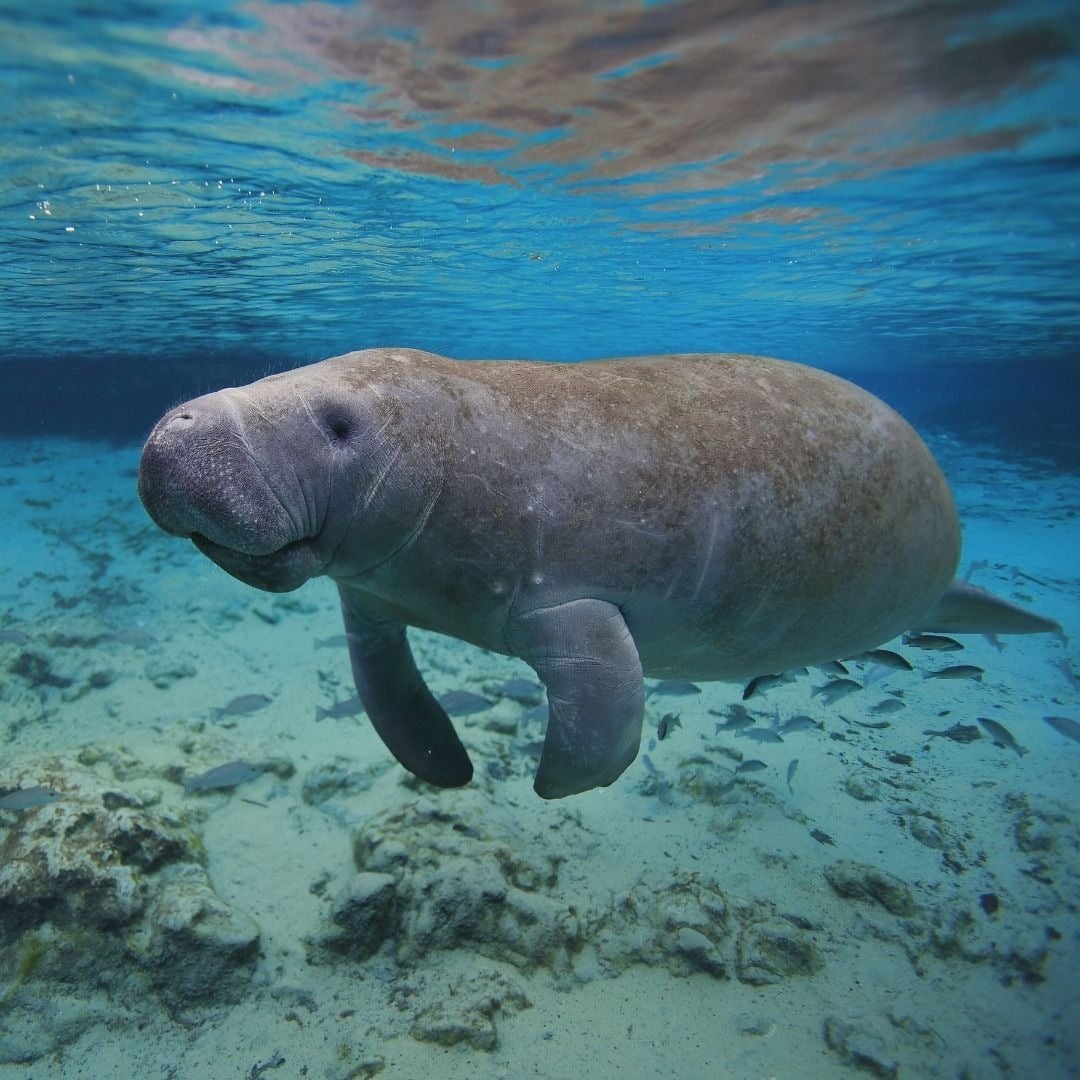
In contrast, manatees inhabit more varied environments such as rivers, estuaries, and coastal waters. This has driven the evolution of:
- Physiological flexibility
- Dietary variation
- A more versatile mouth structure
Morphological and feeding studies show that these differences are closely related to survival strategies:
- Dugongs achieve high efficiency within a single niche
- Manatees maintain broad adaptability
Where Can You Find Dugongs vs Manatees?
Their distribution is geographically very different.
Dugongs are found in the Indo-Pacific region:
- Indonesia
- Australia
- Southeast Asia
Manatees are found in:
- The Americas, including Florida, the Caribbean, and the Amazon
- West Africa
If you see a “sea cow” in Indonesian waters, it is almost certainly a dugong.
Dugongs are found in the Indo-Pacific, including Indonesian waters, and typically live in shallow coastal areas with seagrass meadows. In Indonesia, areas such as Raja Ampat and Komodo provide suitable habitats, making them ecologically possible locations for dugong sightings, although encounters are not always predictable.
Through diving trips in these regions, La Galigo Liveaboard takes divers to explore remote locations with well-preserved marine ecosystems, including seagrass areas that are important habitats for dugongs. By reaching dive sites farther from crowded areas, the opportunity to observe unique marine life, including the possibility of encountering dugongs in the wild, increases, though it still depends on natural conditions and chance.
Which One Will You See While Diving?
For divers in Indonesia, the answer is simple: dugong.
Dugongs are usually found in:
- Shallow waters
- Seagrass areas
- Locations with minimal disturbance
However, they are not easy to find. Dugongs tend to be shy and sensitive to human activity.
Unlike manatees, which are sometimes seen in rivers or estuaries in the Americas, encountering a dugong in the wild is often considered a rare and special experience.
When Is the Best Time to See Dugongs?
For divers, understanding when dugongs are most likely to be seen can significantly increase the chances of an encounter. Dugongs are generally seen during the day when they are actively feeding in seagrass meadows. This feeding activity keeps them in shallow waters for longer periods, making them easier to observe compared to when they are simply passing through.
In addition, dugongs periodically surface to breathe, usually only for a short time before returning to the seabed. This moment often provides the best opportunity for divers to see them up close.
Several factors also strongly influence the likelihood of sightings, such as calm sea conditions, good visibility, and the presence of healthy seagrass meadows as their primary food source. In locations with well-preserved seagrass ecosystems and minimal disturbance, the chances of seeing dugongs tend to be higher, though it can never be guaranteed due to their sensitivity and tendency to avoid humans.
Why These Differences Matter for Conservation
The differences between dugongs and manatees have significant implications for conservation.
Dugongs are highly dependent on seagrass ecosystems. When seagrass meadows are damaged due to:
- Pollution
- Coastal activities
- Climate change
Their populations are immediately at risk.
Manatees, although more flexible, still face threats such as:
- Boat collisions
- Habitat loss
- Changes in water quality
This means that although their survival strategies differ, both species remain vulnerable and require protection.
Also Read: Whales and Their Ability to Hold Their Breath
Similar Appearance, Very Different Lives
Dugongs and manatees may look similar on the surface, but they actually live very different lives.
- Dugongs are marine specialists that depend on seagrass
- Manatees are generalists that can live in various aquatic environments
These differences reflect two distinct evolutionary strategies, both effective but with unique consequences.
For us as divers or ocean enthusiasts, understanding these differences is not only about knowledge but also the first step towards appreciating and protecting them more deeply.
Because in the end, although they are both called “sea cows”, dugongs and manatees represent two very different evolutionary stories, and both are equally remarkable.
FAQ
1. What is the main difference between a dugong and a manatee?
The main difference lies in tail shape, habitat, and feeding behaviour. Dugongs have a forked tail like a whale and live in the sea, while manatees have a rounded paddle-shaped tail and can live in both freshwater and marine environments. In addition, dugongs are specialised seagrass feeders, whereas manatees have a more flexible diet.
2. Are dugongs and manatees the same animal?
No. Dugongs and manatees are different animals, although both belong to the order Sirenia. Dugongs have only one species, while manatees have three species distributed across different regions of the world.
3. Where do dugongs live?
Dugongs live in the Indo-Pacific region, including Indonesia, Australia, and Southeast Asia. They are usually found in shallow waters with seagrass meadows as their primary food source.
4. Where do manatees live?
Manatees are found in the Americas and Africa, including Florida, the Caribbean, the Amazon River, and West Africa. They can live in various types of water, from freshwater rivers to marine environments.
5. Can dugongs be found in Indonesia?
Yes, dugongs can be found in Indonesia, particularly in shallow waters with seagrass meadows. However, they are not always easy to see because of their sensitivity and tendency to avoid humans.
6. Are manatees found in Indonesia?
No. Manatees are not found in Indonesia. They only live in the Americas and Africa.
7. Why do dugongs only eat seagrass?
Dugongs are specialist feeders that are biologically adapted to eat seagrass. Their mouth and snout structure allows them to uproot seagrass from the seabed, making them highly dependent on this ecosystem.
8. How do manatees eat?
Manatees use flexible lips equipped with sensory hairs called vibrissae to grasp and pull plants. This feeding method allows them to consume a variety of vegetation in both freshwater and marine environments.
9. Which is larger, a dugong or a manatee?
In general, manatees tend to have a larger and rounder body than dugongs. Dugongs have a more streamlined body, suited to their marine habitat.
10. Are dugongs dangerous to humans?
No. Dugongs are very gentle and non-aggressive animals. They tend to avoid humans and are sensitive to disturbance.
11. When is the best time to see dugongs while diving?
Dugongs are most often seen during the day when they are feeding in seagrass meadows. Calm sea conditions, good visibility, and healthy seagrass ecosystems can increase the chances of sightings.
12. Why are dugongs harder to find than manatees?
Dugongs are harder to find because they depend on specific habitats, such as seagrass meadows, and are sensitive to human disturbance. In addition, they live in open marine environments rather than in rivers or easily accessible areas, unlike manatees.
13. Are dugongs and manatees protected animals?
Yes. Both dugongs and manatees are protected animals because their populations are vulnerable to threats such as habitat loss, pollution, and human activity.
References
Domning, D. P., & Hayek, L.-A. C. (1986). Functional morphology of the muscular-vibrissal complex in sirenians: Orofacial morphology and feeding behaviour of dugongs and manatees. Journal of Zoology. Cambridge University Press.
Al-Sawaf, M. B., et al. (2023). Histological study of the dugong (Dugong dugon) organs. Animals, 13(16), 2614.
Marsh, H., & Sobtzick, S. (2019). Sirenia. In Encyclopedia of Marine Mammals (3rd ed.). Elsevier.
Queensland Government. (n.d.). Dugong vs manatee: What’s the difference?