Breathing control is not just a beginner skill. For experienced divers, it is one of the simplest ways to fine-tune buoyancy, reduce unnecessary movement, manage stress in current, and stay more comfortable during multiple dives on a liveaboard.
You may already focus on your equipment, dive site conditions, camera setup, or dive computer. Those things matter. But the way you breathe affects almost every part of your dive, from your buoyancy and air consumption to your trim, awareness, and ability to stay calm when conditions change.
Good breathing control does not mean holding your breath or trying to breathe as little as possible. In scuba diving, you should never hold your breath. Breathing control means breathing slowly, continuously, and with awareness, so your body stays relaxed and your movements stay controlled.
This is especially useful when you are diving in places like Raja Ampat and Komodo, where you may experience current, reef slopes, drift dives, rich coral environments, and multiple dives per day on a liveaboard.
What Breathing Control Means for Experienced Divers
For experienced divers, breathing control is not about learning how to breathe underwater for the first time. It is about refining how you move, hover, respond to current, manage your effort, and stay relaxed during the dive.
The goal is not to use as little air as possible. The goal is to breathe calmly, continuously, and efficiently.
Better breathing control can help you:
- Improve buoyancy control
- Reduce unnecessary movement
- Manage air consumption more efficiently
- Stay calmer in current or task-loaded situations
- Keep better trim
- Reduce fatigue during multiple dives
- Stay more stable near the reef
- Protect coral and marine life by maintaining better control
- Improve your stability for underwater photography or videography
When your breathing is steady, your body usually becomes more relaxed. You find less aggressively, make fewer unnecessary corrections, and become more aware of your buddy, depth, air pressure, and surroundings.
In simple terms: better breathing helps you become a smoother, calmer, and more controlled diver.
Why Breathing Control Still Matters When You Are Experienced
Experienced divers can still lose control of their breathing.
It can happen when you are swimming against current, descending too quickly, adjusting camera gear, dealing with a mask leak, managing a reef hook, deploying an SMB, or simply feeling tired after several dives in one day.
The more task-loaded you are, the more important your breathing becomes.
When you breathe too fast, your body can become tense. That tension often leads to stronger finning, more movement, and even faster breathing. It creates a cycle that makes the dive harder than it needs to be.
Controlled breathing helps break that cycle.
When you slow your breathing, you give yourself space to think, communicate, and respond properly. This is valuable on any dive, but it becomes especially important on liveaboard trips where you may be diving several times a day in changing conditions.
The Golden Rule: Never Hold Your Breath
The most important rule in scuba diving still applies, no matter how experienced you are:
Never hold your breath.
As you ascend, air expands in your lungs. If you hold your breath while ascending, expanding air can cause serious injury. This is why you are trained to breathe continuously throughout the dive.
Breathing control is not about stopping your breath to save air. It is about keeping your breathing calm, slow, and continuous.
You should also avoid skip breathing. Skip breathing happens when you intentionally delay breaths to reduce air use. It may seem like a shortcut, but it can increase carbon dioxide buildup and make you feel uncomfortable, stressed, or anxious underwater.
The safer approach is simple:
Breathe continuously. Exhale properly. Stay relaxed.
For more general safety guidance, you can also read our guide to essential scuba diving safety practices.
Technique 1: Slow, Relaxed Breathing
Slow, relaxed breathing is the foundation of good breathing control.
Instead of taking short, shallow breaths from your chest, focus on breathing steadily and comfortably. Your breathing should feel relaxed, not forced.
A simple rhythm is:
- Inhale slowly
- Exhale slowly
- Keep breathing continuously
- Avoid pausing or holding your breath
Your exhale is just as important as your inhale. Many divers focus on taking air in but forget to release air fully. When you do not exhale properly, your breathing can feel tight, rushed, or inefficient.
A full, relaxed exhale helps your body settle. It can also reduce the feeling of rushed breathing, especially after swimming, adjusting equipment, or handling a small issue underwater.
Technique 2: Diaphragmatic Breathing
Diaphragmatic breathing, often called belly breathing, can help you avoid shallow chest breathing.
On land, you can practice by placing one hand on your chest and one hand on your stomach. When you inhale, your stomach should move more than your chest. When you exhale, your stomach relaxes back.
Underwater, you do not need to exaggerate the movement. The goal is to keep your breathing low, calm, and steady instead of tight and high in your chest.
This technique can be useful when you feel nervous, cold, excited, tired, or slightly overloaded during a dive. It can also help before entry, especially if the dive deck is busy or you are preparing for a site with current.
Technique 3: Extend Your Exhale
One of the easiest ways to calm your breathing underwater is to make your exhale slightly longer than your inhale.
For example:
- Inhale for around 3 seconds
- Exhale for around 4 or 5 seconds
This is only a relaxed rhythm, not a strict rule. Do not force it. If it feels uncomfortable, return to normal continuous breathing.
A slightly longer exhale can help reduce tension and slow your breathing rate. It can be especially useful after swimming against current, correcting your position, adjusting equipment, or dealing with a small problem underwater.
When in doubt, slow the exhale first.
Technique 4: Use Breathing for Fine Buoyancy Control
Your lungs affect your buoyancy.
When you inhale, your lungs expand and you become slightly more buoyant. When you exhale, your lung volume decreases and you become slightly less buoyant.
You can use this for small buoyancy refinements, especially when hovering, approaching marine life slowly, staying steady for photography, or maintaining position without constantly adding or dumping air from your BCD.
However, breathing should only be used for fine adjustments. Do not use your lungs to compensate for poor weighting or major buoyancy problems. If you are too heavy or too light, adjust your BCD or weighting properly.
Most importantly, never hold your breath to stay in position or avoid ascending.
Think of it this way:
- Use your BCD for bigger buoyancy changes
- Use your breathing for small refinements
- Use proper weighting and trim to make both easier
When diving near coral, keep enough distance from the reef so you never rely on last-second breath control to avoid contact. Better breathing should help you stay clear of the reef, not encourage you to get too close.
READ ALSO: Buoyancy Control: The Importance, Techniques and Tips
Technique 5: Stop, Breathe, Think, Act
If something feels wrong underwater, do not rush.
Use this simple method:
- Stop
- Breathe
- Think
- Act
First, stop unnecessary movement if it is safe to do so. Then focus on slow, continuous breathing. Once your breathing is under control, think about the problem and choose the right action.
This technique works for many common underwater situations, such as:
- Mask leaks
- Minor gear adjustments
- Unexpected current
- Buoyancy issues
- Camera or accessory problems
- Momentary stress
- Confusion about direction or position
If needed, signal your buddy or dive guide early. Most underwater problems are easier to solve when you are breathing calmly and communicating clearly.
When you stay calm, your buddy and dive guide can help you more effectively. Slow, continuous breathing gives you the space to communicate, assess the situation, and respond properly.
For more on this, read our guide to buddy communication underwater.
Technique 6: Move Less, Breathe Better
Breathing control is closely connected to movement.
The more you move, the more energy you use. Fast finning, poor trim, hand swimming, fighting current, and carrying too much unsecured gear can all increase your breathing rate.
To improve your breathing, improve your movement:
- Fin slowly and efficiently
- Keep good trim
- Stay streamlined
- Avoid using your hands
- Do not fight current unnecessarily
- Secure dangling accessories
- Pause when you need to reset
- Let the dive guide’s briefing help you choose the right position and rhythm
This is especially important in Raja Ampat and Komodo, where current, reef slopes, and drift dives can be part of the experience. When you stay relaxed and streamlined, you usually breathe more comfortably and use your energy more efficiently.
This does not mean you should ignore current or become passive underwater. It means you should avoid wasting energy by fighting the water when a better position, slower finning rhythm, or calmer breathing pattern would help more.
READ ALSO: The 6 Best Finning Techniques for Divers from Beginners to Pro
Technique 7: Relax Before Entering the Water
Good breathing control starts before the dive.
If you are rushed on the boat, your breathing may already be fast before you enter the water. A short moment of calm before entry can help set the tone for the dive.
Before the dive:
- Listen carefully to the briefing
- Check your equipment
- Complete your buddy check
- Secure your accessories
- Relax your shoulders
- Take a few slow breaths
- Enter the water calmly
This is especially useful on liveaboard trips, where you may be doing several dives per day. A calm start usually leads to a calmer descent, better awareness, and smoother control underwater.
READ ALSO: 4 Best Methods to Enter the Water for Scuba Diving
Breathing Control for Current Diving
Current can make your breathing change quickly.
When you feel current, your first reaction may be to kick harder. Sometimes that is necessary for a short moment, but fighting current for too long can increase your breathing rate, raise your stress level, and use more energy than needed.
Instead, focus on staying calm and efficient.
Use your breathing to slow your response. Listen to the dive briefing, follow the guide’s instructions, stay close to your buddy, and avoid unnecessary movement. If the plan is to drift, let the water do some of the work instead of trying to control every meter of the dive.
In destinations such as Raja Ampat and Komodo, current can be part of what makes the diving exciting and full of life. Good breathing control helps you enjoy that experience with more comfort and confidence.
Breathing Control for Underwater Photography
If you bring a camera underwater, your breathing becomes even more important.
Underwater photography often makes divers slow down, focus on a subject, and hold position near the reef. This is where poor breathing and poor buoyancy can create problems.
You should never hold your breath to stay still for a shot. Instead, use slow, continuous breathing, proper trim, and careful fin control to keep your position.
Better breathing can help you:
- Approach marine life more calmly
- Reduce sudden movement
- Stay stable while composing a shot
- Avoid touching or damaging coral
- Reduce stress when handling camera gear
- Maintain better awareness of your buddy, depth, and air
A good photo is never worth damaging the reef. Stay clear, stay calm, and let your breathing support your control.
Common Breathing Mistakes Experienced Divers Still Make
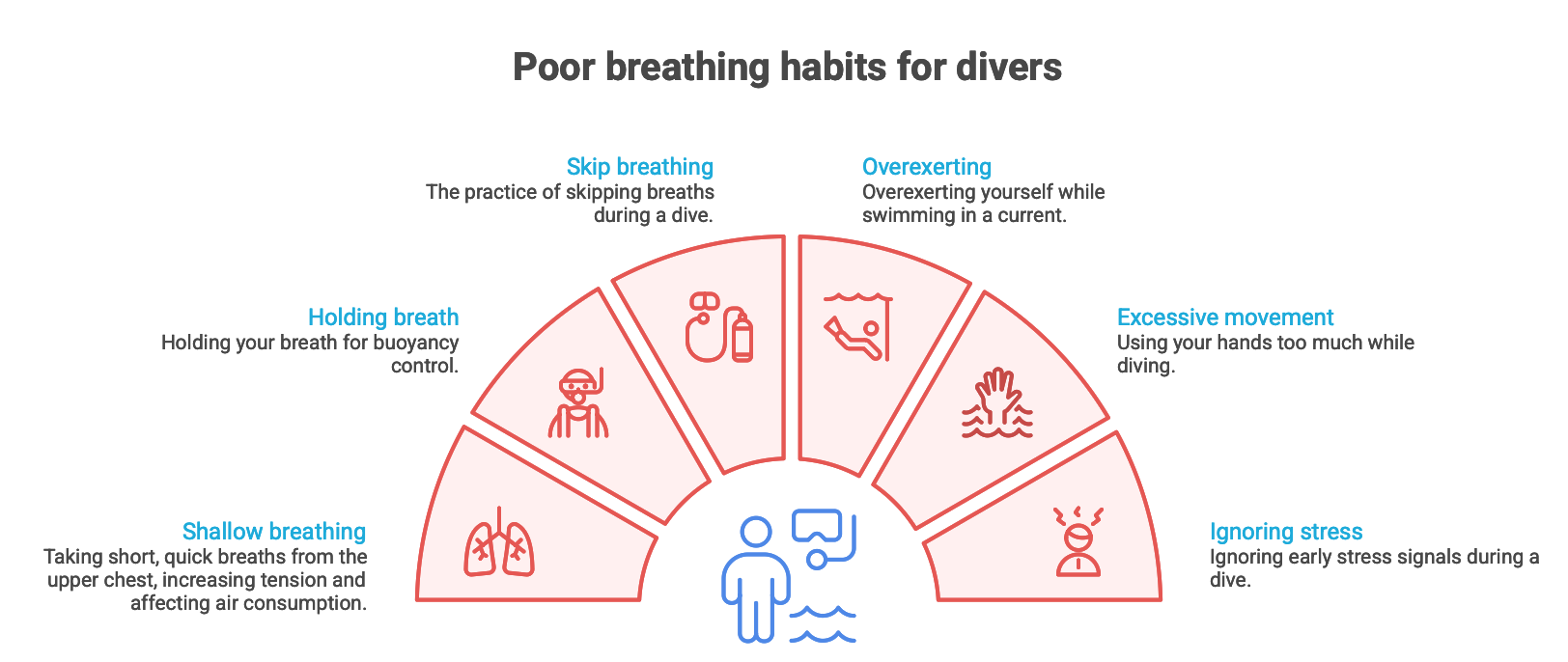
Even experienced divers can fall into poor breathing habits, especially when conditions change or the dive becomes task-loaded.
Shallow breathing
This happens when you take short, quick breaths from the upper chest. It can increase tension, make you feel less comfortable, and affect your air consumption.
Holding your breath for buoyancy
This is unsafe and should always be avoided. Use your breathing for small refinements only, and keep breathing continuously.
Skip breathing
Trying to save air by delaying breaths can increase carbon dioxide buildup and make you feel uncomfortable or stressed. It is not a good gas-saving strategy.
Overexerting in current
Swimming too hard for too long can quickly increase your breathing rate. Better positioning, streamlined movement, and calm breathing are often more effective.
Using your hands too much
Hand swimming usually creates extra movement and effort. It can also make your trim worse and increase your breathing rate.
Ignoring early stress signals
If your breathing starts to become fast or uneven, treat it as useful feedback. Slow down, reduce movement, communicate if needed, and reset before the situation grows.
The solution is usually simple:
Slow down. Keep breathing continuously. Reduce unnecessary movement. Communicate early.
Breathing Control and Air Consumption
Many divers want better breathing control because they want to use air more efficiently.
That makes sense, but it is important to be realistic. Controlled breathing can help improve air consumption, but it is not the only factor.
Your air use also depends on:
- Depth
- Current
- Body size
- Fitness
- Experience
- Equipment setup
- Weighting
- Trim
- Workload
- Stress level
- Water temperature
- How much you move during the dive
Still, breathing control makes a real difference.
When you stay calm, relaxed, and efficient, you usually move less and make fewer unnecessary corrections. This can lead to easier, more comfortable dives and better gas management.
The goal is not to breathe as little as possible. The goal is to breathe calmly, continuously, and efficiently.
Breathing Control and Buoyancy
Breathing control and buoyancy are closely connected.
If your breathing is fast and uneven, your buoyancy may also become unstable. You may rise and fall too much, add and dump air too often, or struggle to stay still near the reef.
When your breathing is slow and steady, buoyancy becomes easier to control.
This is especially important in rich marine environments such as Raja Ampat and Komodo. Good buoyancy helps you stay clear of coral, avoid disturbing marine life, and enjoy the reef without causing damage.
Better breathing helps you stay clear of the reef and protect the marine life you came to see.
That makes you a more controlled diver and a more responsible guest in the ocean.
READ ALSO: How Do You Breathe While Scuba Diving?
Final Thoughts
Breathing control can improve many parts of your scuba diving. It helps you stay calm, breathe more efficiently, control buoyancy, reduce fatigue, protect the reef, and enjoy each dive with more confidence.
Start with the essentials:
- Breathe slowly
- Exhale fully
- Never hold your breath
- Avoid skip breathing
- Move less
- Stay streamlined
- Use your breath only for small buoyancy refinements
- Communicate early if something feels wrong
Whether you are joining a Raja Ampat or Komodo liveaboard, better breathing helps you dive with more control, awareness, and comfort.
Calm breathing is not just a basic skill. It is one of the habits that makes experienced divers smoother underwater.