
Indonesia is renowned for having some of the world’s most spectacular coral reefs. Beneath these vibrant reefs lives a wide variety of species that help maintain the balance of the marine ecosystem, including the hawksbill turtle (Eretmochelys imbricata).
While diving with us aboard La Galigo Liveaboard, you may have the opportunity to see these turtles gliding gracefully among the coral or foraging within the reef’s crevices. Their elegant appearance is certainly captivating, but the appeal of hawksbill turtles extends far beyond their beauty. They also play a vital role in maintaining the health of coral reefs, which provide habitat for thousands of marine organisms.
Unfortunately, the hawksbill turtle is also one of the world’s most endangered sea turtle species. Its population continues to face pressure from shell trade, habitat loss, and environmental change.
In this article, we invite you to discover more about the hawksbill turtle, from its distinctive characteristics and habitat to fascinating facts and the reasons why it is so important to Indonesia’s marine ecosystems.
Quick Facts About Hawksbill Turtles
| Fact | Description |
| Scientific name | Eretmochelys imbricata |
| Common name | Hawksbill Turtle |
| Family | Cheloniidae |
| Size | Carapace length of approximately 70 to 90 cm |
| Weight | Approximately 45 to 70 kg |
| Lifespan | Estimated to exceed 50 years |
| Primary diet | Marine sponges, sea anemones, and various invertebrates |
| Habitat | Tropical coral reefs |
| Conservation status | Critically Endangered |
| Found in Indonesia? | Yes |
What Is a Hawksbill Turtle?
The hawksbill turtle is one of the world’s seven sea turtle species. It is found throughout tropical and subtropical waters, including the Indo-Pacific region, which is renowned for its exceptional marine biodiversity.
Indonesia is one of the most important habitats for hawksbill turtles because of its extensive and healthy coral reefs. From Raja Ampat to Komodo, hawksbill turtles rely on coral reefs for feeding, shelter, and nesting.
How to Identify a Hawksbill Turtle
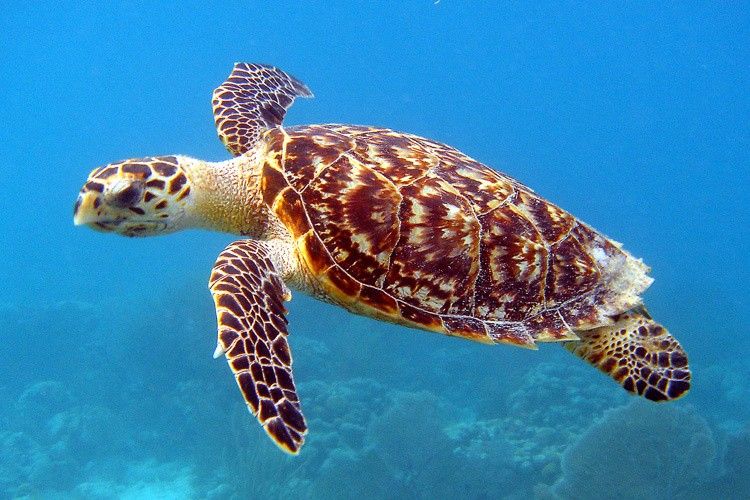
At first glance, all sea turtles may appear similar. However, hawksbill turtles have several distinctive features that make them relatively easy to identify.
The most noticeable characteristic is their sharply curved beak, which resembles a hawk’s beak. This unique feature is the origin of their common name, “hawksbill”.
Their shell also displays a striking natural pattern of brown, yellow, and black. The overlapping scutes on the carapace create a distinctive appearance that sets them apart from other sea turtle species.
They are also relatively small compared with leatherback turtles, which can grow to over two metres in length.
Where Are Hawksbill Turtles Found?
Hawksbill turtles inhabit tropical waters around the world, but they are most commonly found in regions with extensive coral reefs.
Indonesia is one of the most important areas for this species because it lies at the heart of the Coral Triangle, the region with the highest marine biodiversity on Earth.
If you join us, some of the destinations where you may have the opportunity to see hawksbill turtles include:
- Raja Ampat
- Komodo National Park
- Wakatobi
- Alor
- Bunaken
- Derawan Islands
Remember that all wildlife lives freely in its natural environment. Every encounter is a natural experience that can never be guaranteed, which is precisely what makes each sighting so special.
What Do Hawksbill Turtles Eat?
One of the things that makes hawksbill turtles so unique is their diet.
Unlike adult green turtles, which primarily feed on seagrass and marine plants, hawksbill turtles spend much of their time feeding on marine sponges.
This diet may seem simple, but it is one of the main reasons why they are so important to marine ecosystems.
Read Also: Ocean Sunfish: Characteristics, Habitat and Predators of the Mola – Mola
Why Are They One of the Few Animals That Eat Marine Sponges?
Marine sponges are not an easy food source.
Many sponges have tough textures, grow deep within coral crevices, and even contain chemical compounds that discourage most predators from eating them.
This is where the hawksbill turtle’s unique adaptation becomes apparent.
Its narrow, curved beak allows it to reach sponges hidden within the reef. This specialised adaptation lets hawksbill turtles exploit a food source rarely used by other marine animals.
Because they feed on such a specialised diet, hawksbill turtles also play a very different ecological role from other sea turtle species.
Why Are Hawksbill Turtles Important?
You might wonder why a single species of sea turtle can be so important to the ocean.
The answer lies in the close relationship between hawksbill turtles and coral reefs.
Coral reefs are home to around a quarter of all marine species, despite covering only a small fraction of the ocean floor. To remain healthy, these ecosystems depend on a delicate balance between the many organisms that live within them.
Hawksbill turtles help maintain that balance.
Keeping Sponge Populations Under Control
Marine sponges are a natural part of coral reef ecosystems.
However, if their populations grow unchecked, sponges can overgrow living corals and compete with them for space.
By feeding naturally on marine sponges, hawksbill turtles help create space for coral colonies to continue growing.
Put simply, they act like underwater gardeners, helping to keep coral reefs in balance.
Without this role, certain sponge species could dominate parts of the reef, reducing the space available for corals to thrive.
Supporting Healthy Coral Reef Ecosystems
The benefits of the hawksbill turtle’s feeding behaviour extend far beyond controlling sponge populations.
When corals have room to grow, more reef fish, crustaceans, molluscs, and countless other marine organisms gain access to the habitats they depend on.
This means that a single sea turtle species can benefit the entire ecosystem.
That is why hawksbill turtles are often considered an important indicator of healthy coral reefs.
Why Healthy Coral Reefs Need Hawksbill Turtles
The relationship between hawksbill turtles and coral reefs is mutually beneficial.
Coral reefs provide food and shelter for the turtles.
In return, hawksbill turtles help ensure corals have the space they need to grow and flourish.
This close relationship means that the loss of one species can affect many other organisms within the ecosystem.
For this reason, protecting hawksbill turtles is about far more than saving a single species. It is about preserving the health of entire marine ecosystems that support thousands of forms of life.
When you dive in Indonesia, the vibrant coral reefs you see are not simply there by chance. Behind their beauty are countless natural relationships working together every day, and the hawksbill turtle is an essential part of that balance.
Where Can You See Hawksbill Turtles in Indonesia?
Indonesia offers some of the world’s best opportunities to see hawksbill turtles in their natural habitat.
With thousands of islands and extensive coral reef systems, the chances of encountering hawksbill turtles are relatively high, particularly in areas where the reefs remain healthy.
Raja Ampat
Raja Ampat is recognised as one of the world’s richest marine biodiversity hotspots.
Here, hawksbill turtles are often seen foraging along reef slopes, around coral bommies, and within shallow lagoons. The exceptional condition of the coral reefs makes this region an ideal habitat for several sea turtle species.
During your journey with us, you may have the opportunity to see a hawksbill turtle swimming gracefully among the coral, surrounded by colourful reef fish and, on occasion, accompanied by passing manta rays.
Komodo National Park
Komodo is famous not only for its dragons but also for exhilarating drift dives.
The National Park is also home to several species of sea turtles, including the hawksbill turtle.
At certain dive sites, divers often see hawksbill turtles feeding on marine sponges or resting beneath coral formations. Because they are accustomed to living in relatively undisturbed natural environments, they often remain calm as long as divers maintain a respectful distance.
Wakatobi and Other Coral Reef Destinations
In addition to Raja Ampat and Komodo, you may also encounter hawksbill turtles in destinations such as Wakatobi, Bunaken, Alor, and the Derawan Islands.
Even so, remember that wildlife does not follow a schedule. Every dive offers a different experience, and that unpredictability makes each encounter feel so special.
Why Are Hawksbill Turtles Endangered?
Despite their beauty, hawksbill turtles have faced numerous threats that have caused their populations to decline over the past several decades.
Most of these threats result from human activities.
The Historic Tortoiseshell Trade
The greatest threat to hawksbill turtles has been the trade in their shells.
For centuries, the overlapping scutes of their shells were used to produce luxury items such as combs, spectacle frames, jewellery boxes, and decorative accessories. This material became known as tortoiseshell, or bekko.
Demand for these products led to the hunting of millions of hawksbill turtles over more than a century. Although international trade is now prohibited, illegal trade still occurs in some regions, including parts of Southeast Asia.
Habitat Loss and Climate Change
Environmental change has created additional challenges for hawksbill turtles.
The beaches where they nest are increasingly threatened by coastal development, erosion, and climate change.
As temperatures rise, hawksbill turtles have shown an ability to adapt by selecting nesting sites beneath coastal vegetation, where there is more shade. This helps keep nest temperatures more stable, improving the chances of successful egg development. For this reason, natural coastal vegetation plays an important role in supporting successful hatching.
Bycatch and Marine Plastic Pollution
Not all threats are direct.
Hawksbill turtles can become accidentally entangled in fishing gear or ingest plastic debris that they mistake for food.
Collisions with boats and coral reef degradation also reduce the quality of the habitats they rely on for survival.
Because these threats occur simultaneously, protecting hawksbill turtles requires a comprehensive approach that includes habitat conservation, reducing marine pollution, and promoting more responsible tourism and fishing practices.
How Divers Can Help Protect Hawksbill Turtles
As a diver, you can also help protect this remarkable species.
The following simple actions can make a meaningful difference.
Keep a Respectful Distance
If you encounter a hawksbill turtle, enjoy the experience from a safe distance.
Giving the turtle space allows it to feed, breathe, or rest without disturbance.
Never Touch or Feed Sea Turtles
Touching sea turtles can cause unnecessary stress and alter their natural behaviour.
Feeding them is also discouraged, as it may make wild animals dependent on humans and change their natural feeding habits.
Let them live as they would naturally in the wild.
Support Responsible Marine Tourism
Choosing operators that follow sustainable tourism practices is another way to support marine conservation.
At La Galigo, we believe that the best diving experiences are those that respect marine life.
Experience Indonesia’s Coral Reefs Responsibly
Encountering a hawksbill turtle in its natural habitat is an experience that is difficult to forget. Watching one glide gracefully through the coral reminds you that every species plays an important role in maintaining healthy oceans.
When you explore Raja Ampat, Komodo, or other diving destinations with us, you do more than enjoy Indonesia’s extraordinary underwater world. You are also supporting tourism that respects nature and helps preserve marine ecosystems for future generations.
Frequently Asked Questions
What distinguishes hawksbill turtles from other sea turtles?
The easiest way to identify a hawksbill turtle is by its sharply curved, hawk-like beak and its beautifully patterned shell with overlapping scutes.
What do hawksbill turtles eat?
Their diet consists primarily of marine sponges, along with certain species of sea anemones and other marine invertebrates.
Why are hawksbill turtles important for coral reefs?
By feeding on marine sponges, hawksbill turtles help prevent sponges from dominating coral surfaces. This creates space for corals to continue growing and supports marine biodiversity.
Where are the best places to see hawksbill turtles in Indonesia?
Some of the best locations include Raja Ampat, Komodo National Park, Wakatobi, Bunaken, Alor, and the Derawan Islands. As they are wild animals, every encounter depends on natural conditions and can never be guaranteed.
Why are hawksbill turtles endangered?
The primary threats include the illegal tortoiseshell trade, habitat loss, climate change, entanglement in fishing gear, and marine pollution. Although hawksbill turtles are protected in many countries, the species still requires ongoing conservation efforts.
References
Jeethvendra, K., Nishizawa, H., Alin, J., Muin, H., & Joseph, J. (2023). Illegal tortoiseshell harvest of hawksbill turtles (Eretmochelys imbricata) in Southeast Asia: Evidence from Baturua Reef, Semporna, Sabah, Malaysia. Journal of Sustainability Science and Management, 18(7), 53–66.
Nabila, N. P., Noer, M. I., Hidayat, E. T., & Andreina, T. C. (2025). Nesting selection of hawksbill turtles, Eretmochelys imbricata (Linnaeus, 1766), in Kepulauan Seribu, Indonesia, in response to sea surface temperatures. Bioma: Jurnal Biologi Indonesia, 21(1), 1–9.