
When we are on a boat or diving in clear tropical waters, the ocean often feels quiet. There is no traffic noise, no city bustle, only wind and gentle waves. Many people associate this experience with complete silence.
In reality, the ocean is never truly silent.
Beneath the surface, the sea is filled with sound. Sound travels, reflects, and spreads far beyond what we might imagine. For much of marine life, sound is not a disturbance. Sound is a primary tool for survival.
Understanding how sound moves through the ocean helps us see marine ecosystems more fully, especially for those who spend time at sea, such as divers, liveaboard guests, and ocean travellers.
The Ocean Is Full of Sound
For humans, hearing is closely tied to air. We are used to perceiving sounds at relatively short distances, while faraway spaces feel “quiet”. When we enter the ocean, this perception changes dramatically.
Water dampens sounds from the world above, creating the impression that we are surrounded by silence. However, this impression is misleading.
Underwater, sounds from many sources continue to travel. These include waves, currents, rainfall, biological activity, and even vessel engines operating far from the dive site.
The ocean is not a space. It is an active acoustic medium.
Why Silence Underwater Is Misleading
The main reason the ocean feels quiet to humans is that our ears are not designed to hear efficiently underwater. Human hearing evolved for air, not water.
By contrast, many marine organisms evolved in environments in which sound is a primary signal. For them, ocean sound is not passive background noise, but information about:
- location,
- the presence of food,
- potential threats,
- other individuals of the same species.
When we perceive silence, marine life is often actively communicating.
Why Sound Moves Faster and Farther Underwater
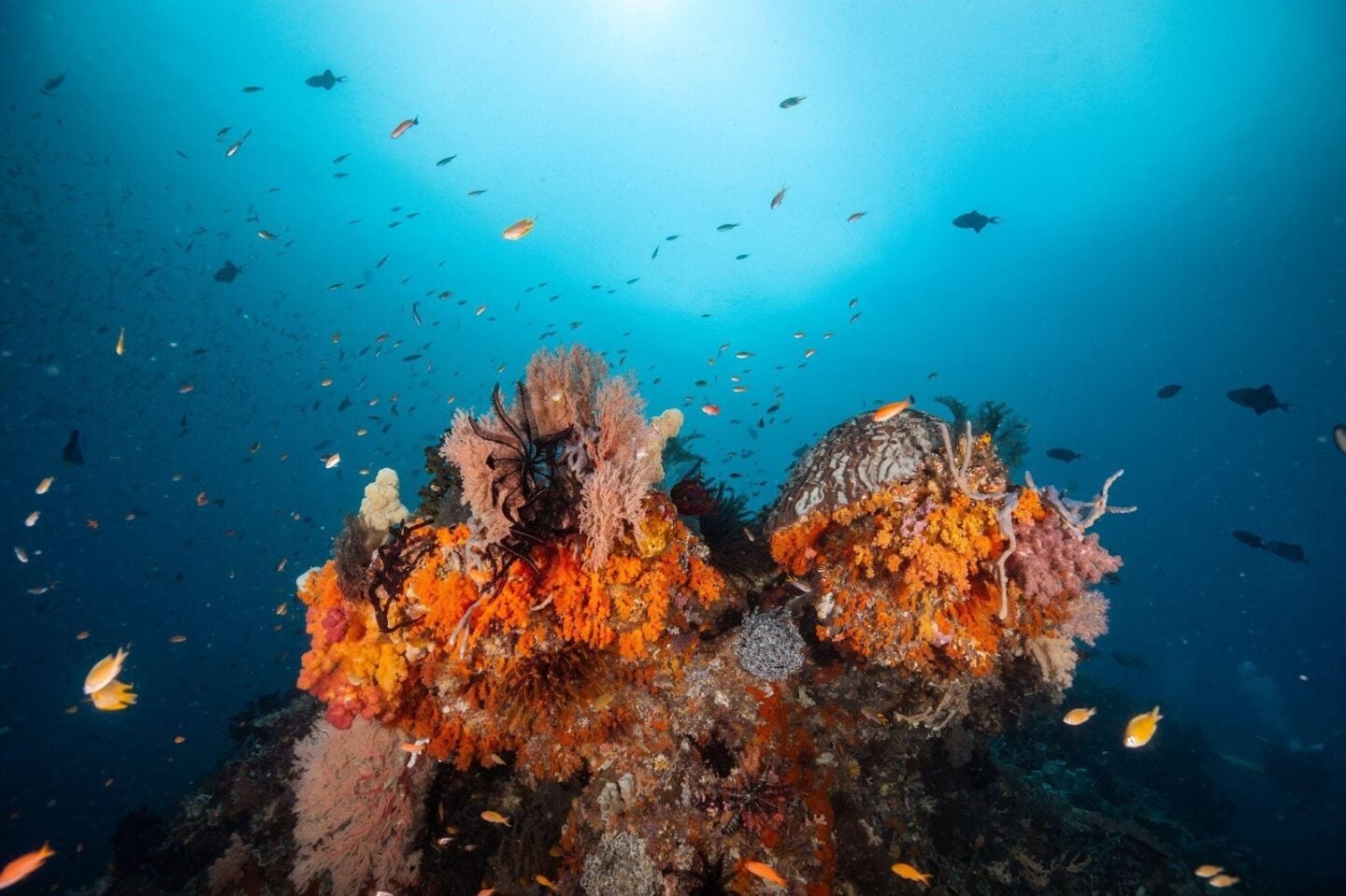
One of the most important facts about ocean sound is that it travels much faster and farther in water than in air. This difference underpins nearly all acoustic dynamics in marine ecosystems.
Water Density and Sound Speed
Water is far denser than air. This density allows sound waves to propagate more efficiently.
As a simple comparison:
- in air, sound travels at roughly 343 metres per second,
- in seawater, sound can travel at over 1,500 metres per second.
This means sound travels more than four times faster underwater.
For marine life, this allows sound signals to:
- reach very large areas,
- arrive more quickly,
- transmit important information in short timeframes.
This is why sound is often a more reliable means of communication than vision underwater.
Low-Frequency Sound and Long-Distance Travel
Not all sounds behave the same way. Low-frequency sounds are especially effective at travelling long distances in the ocean.
Under certain conditions, low-frequency sound can propagate:
- tens of kilometres,
- hundreds of kilometres,
- or even across entire ocean basins.
This is why many marine species, particularly large mammals, rely on low-frequency sound for long-distance communication. The ocean effectively functions as a vast transmission pathway for these sounds.
How Marine Life Uses Sound to Survive
For many marine animals, sound is not optional. It forms the foundation of behaviour.
This reliance exists because underwater environments impose significant visual limitations.
Communication, Navigation, and Finding Food
Marine animals use sound for many essential functions, including:
- communicating with others,
- maintaining social distancing,
- locating mates,
- sensing their surroundings,
- finding food sources.
Some fish produce sounds to mark territory or attract mates. Marine mammals use sound to communicate within groups and coordinate movement.
In many cases, sound enables marine animals to perceive their environment through reflected sound waves, particularly in dark or turbid waters.
Why Vision Alone Isn’t Enough Underwater
Unlike in air, light diminishes rapidly in water:
- red wavelengths disappear first,
- visibility decreases quickly with depth,
- Suspended particles reduce clarity.
Under these conditions, vision alone is insufficient.
Sound does not depend on light. It remains effective:
- at night,
- at depth,
- in murky water.
This is why many marine species evolved to prioritise hearing and acoustic perception over vision.
How Human Activity Changes the Ocean Soundscape
In recent decades, the ocean soundscape has changed significantly. These changes are not always visible, but they are experienced by marine life.
It is important to understand this neutrally and factually, without assigning blame.
Vessel Engines, Sonar, and Industrial Noise
Human activity introduces many sound sources into the ocean, including:
- vessel engines,
- propellers,
- sonar systems,
- industrial exploration,
- offshore construction.
These sounds often occupy frequencies that overlap with those used by marine animals for communication.
As a result, human-generated sound can:
- mask biological signals,
- reduce communication range,
- temporarily alter behaviour.
The impact varies widely depending on context, including location, duration, and sound intensity.
Why Noise Travels Beyond the Source
Because sound travels so efficiently underwater, its effects are not confined to the immediate source.
A vessel operating far from a dive site:
- can still be heard by marine animals,
- still contributes to the background sound environment.
For this reason, changes to the ocean soundscape are often widespread and cumulative rather than strictly local.
What Underwater Sound Means for Divers and Ocean Travellers
Why Some Dive Sites Feel More Active Than Others
Have you ever dived at two visually similar sites that felt very different?
One contributing factor is acoustic condition.
Healthy reefs often feature:
- active fish sounds,
- natural noises from invertebrates,
- a consistent, biologically sound background.
By contrast, areas exposed to prolonged noise may feel quieter, not only visually but also in animal behaviour.
Experienced divers often sense this difference, even if not consciously.
Read Also: How to Choose The Best Liveaboard for Diving in Indonesia
How Boat Behaviour Influences Marine Encounters
The way a vessel operates directly affects what occurs underwater. This is not only about guest comfort, but also about how marine life responds to our presence.
Vessel speed, engine use, and manoeuvring patterns can:
- influence whether animals remain in an area or move away,
- shape how natural marine encounters feel,
- affect dive stability and comfort.
Fast or aggressive approaches tend to increase animal alertness. Calm movement allows the environment time to adjust to a vessel’s presence.
On La Galigo Liveaboard, this principle is embedded in daily operations rather than treated as optional.
Approaches include:
- maintaining stable speeds, especially when approaching dive sites,
- avoiding sudden manoeuvres near active areas,
- positioning the vessel to avoid sitting directly above animal activity zones,
- Prioritising coordination between the captain, cruise director, and dive team before repositioning.
Read Also: Scuba Diving Equipment: Tips & Maintenance
The objective is practical and straightforward: to create a calmer acoustic environment so dives feel more natural and marine encounters occur more consistently.
This approach is not based on environmental claims, but on field experience. In many cases, the best interactions occur when the vessel is not the focal point underwater.
For guests, the benefits are tangible:
- more comfortable dives,
- marine life that is less likely to move away,
- a more complete experience without pursuit or pressure.
What Divers and Liveaboard Guests Can Do to Support a Healthier Ocean
As divers or liveaboard guests, the most meaningful contributions come not from dramatic actions, but from simple habits.
These include:
- following crew briefings and guidance, especially regarding distance and dive procedures,
- avoiding chasing or provoking marine animals through noise or sudden movement,
- maintaining buoyancy and controlled movement to reduce disturbance and stress,
- choosing experienced and responsible operators with stable operational practices,
- respecting natural conditions, even when encounters do not meet expectations.
These actions help keep diving experiences natural while supporting healthier marine ecosystems, without diminishing the enjoyment of the ocean.
Read Also: What is Allowed and Prohibited when Scuba Diving
Final Thought
Sound moves quickly and efficiently through the ocean, far more so than in the air. As a result, many marine species depend on sound to communicate, navigate, and locate food.
Human activity adds new layers of sound to the ocean, and these changes can influence animal behaviour even when the source is far away.
For divers and ocean travellers, understanding underwater sound helps explain why some locations feel more active and why vessel behaviour matters for the quality of a dive.
With calmer and more controlled approaches, underwater experiences can unfold more naturally, benefiting both people and marine life.
Frequently Asked Questions
What is ocean noise?
Ocean noise refers to all sounds beneath the ocean surface, whether natural, such as waves, rain, and marine animals, or generated by human activities, including vessels, sonar, and industrial operations.
Which animals are affected by underwater noise pollution?
Marine mammals such as whales and dolphins are most affected, along with fish and reef organisms that rely on sound for communication, navigation, and feeding.
Do all sounds affect marine life in the same way?
No. Low-frequency and long-duration sounds typically travel farther and affect wider areas than brief or high-frequency sounds.
References
Popper, A. N., & Hawkins, A. D. (2019). An overview of fish bioacoustics and the impacts of anthropogenic sounds on fish. Journal of Fish Biology, 94(5), 692–713.
National Oceanic and Atmospheric Administration. (n.d.). Understanding sound in the ocean. NOAA Fisheries.
National Research Council. (2003). Ocean noise and marine mammals. The National Academies Press.