
When you look at a coral reef from the surface of the sea, the first things that may catch your attention are the colourful corals, the fish swimming among them, and the incredibly complex structure of the reef. But behind this beautiful scenery, something much bigger is happening.
A coral reef is not simply a collection of corals, fish, and marine organisms living alongside one another. Every reef inhabitant is connected through various ecological relationships, including feeding relationships. Herbivores eat algae and, in turn, become prey for predators, while other organisms process dead organic matter. From these individual relationships, a vast network of interactions is formed.
This network is known as a coral reef food web.
A food web shows that life on a coral reef does not operate in a straight line. Changes in one group of organisms can affect other groups, even when they do not interact directly. Research published in Proceedings of the National Academy of Sciences examined coral reef food webs across six biogeographic regions: Madagascar, the Marshall Islands, New Caledonia, Okinawa, Hawaii, and the West Indies. Despite differences in species composition, the researchers found that these food webs shared many of the same major feeding pathways. However, many reef fish species had specialised diets, making certain trophic pathways vulnerable to biodiversity loss. The findings highlight how the loss of species with specialised diets could disrupt feeding pathways and affect energy flow through the food web (Pozas-Schacre et al., 2021).
So, when you dive with us and see a parrotfish grazing on the reef or a large predator moving in the distance, you are actually witnessing one part of a much larger system.
Let’s take a closer look at how this system works.
What Is a Coral Reef Food Web?
A food web is a network of feeding relationships that shows how organisms obtain energy and how that energy moves from one organism to another.
This concept differs from a food chain.
A food chain usually illustrates a single, simple pathway, such as:
Algae → Herbivorous fish → Predatory fish
A food web, by contrast, shows multiple interconnected pathways. One type of fish may feed on several food sources while also serving as prey for more than one predator.
That is why coral reef food webs can appear so complex. Research comparing six food webs from different coral reef regions found that these networks shared similar patterns of trophic interactions, even though their species compositions differed. The research also showed that many reef fish have relatively specific feeding patterns, meaning that the loss of certain species could affect important trophic pathways.
In other words, you cannot truly understand one organism without looking at its relationship with its environment.
At the simplest level, energy enters the system through producers and then moves through different consumer levels. But on a coral reef, there is more than one pathway. Energy and nutrients can move through multiple interconnected pathways, including those involving pelagic organisms and small fish.
The Main Players in a Coral Reef Food Web
To understand a food web without feeling like you have to memorise every species, it is easier to look at it based on ecological roles.
Producers
At the beginning of many food web pathways are producers, organisms that produce organic matter using energy, primarily through photosynthesis.
On coral reefs, this group includes algae and phytoplankton. Algae growing on the reef surface can provide food for various herbivores, while phytoplankton form part of food pathways in the marine environment.
Producers are important because they help introduce energy into the ecosystem. Without this energy source, consumers at the next levels would not have the foundation they need to survive.
Interestingly, coral itself is not a plant. Coral is an animal, but many corals have a symbiotic relationship with photosynthetic algae that help provide them with energy. So, when you see coral appearing motionless on the seabed, you are actually looking at part of a much more active biological relationship.
Primary Consumers
Next are primary consumers, including various herbivorous fish and sea urchins.
Herbivores obtain energy by eating producers such as algae. However, their role on coral reefs goes beyond simply being consumers.
By eating algae, herbivores can influence how much algae grows on the reef surface. Because algae can compete with coral for space, grazing activity can help determine the condition of the reef’s benthic community.
On the Caribbean reefs studied, increased parrotfish density led to increased grazing, followed by a significant decline in macroalgal cover. Because macroalgae are important competitors of coral, this change may support reef resilience.
So, when you see herbivorous fish continuously biting the surface of the reef, this activity is not simply feeding behaviour. It is part of a process that helps shape the reef community.
Predators and Higher-Level Consumers
At the next level are predators and higher-level consumers, including groupers, snappers, moray eels, and reef sharks.
Predators help shape the food web by preying on organisms at lower trophic levels. However, the role of predators is not always as simple as “eating prey and reducing prey numbers”.
Large predators can influence seaweed distribution not only through direct consumption but also through non-consumptive, or fear, effects. The presence of predators can cause herbivores to avoid certain areas, giving algae a kind of refuge from grazing.
This shows that predators can influence the food web even when they are not actively hunting.
Decomposers and Detritivores
Not all material in a food web ends up when one organism is eaten.
Organic material from the remains of organisms and other biological activities can enter the detrital pathway. Here, detritivores and microorganisms help process this material.
Bacteria and microorganisms decompose and transform organic material, helping return nutrients to the system.
Therefore, a coral reef food web is not only about who eats whom, but also about how energy and nutrients move through the ecosystem.
These feeding positions are known as trophic levels. Producers form the foundation of many food pathways, primary consumers obtain energy by feeding on producers, and higher-level consumers obtain energy by feeding on other consumers. However, a food web does not consist of a single sequence of trophic levels. Because organisms can feed on different food sources, the same species may be connected to several pathways within the wider network.
How Energy Moves Through a Coral Reef Food Web
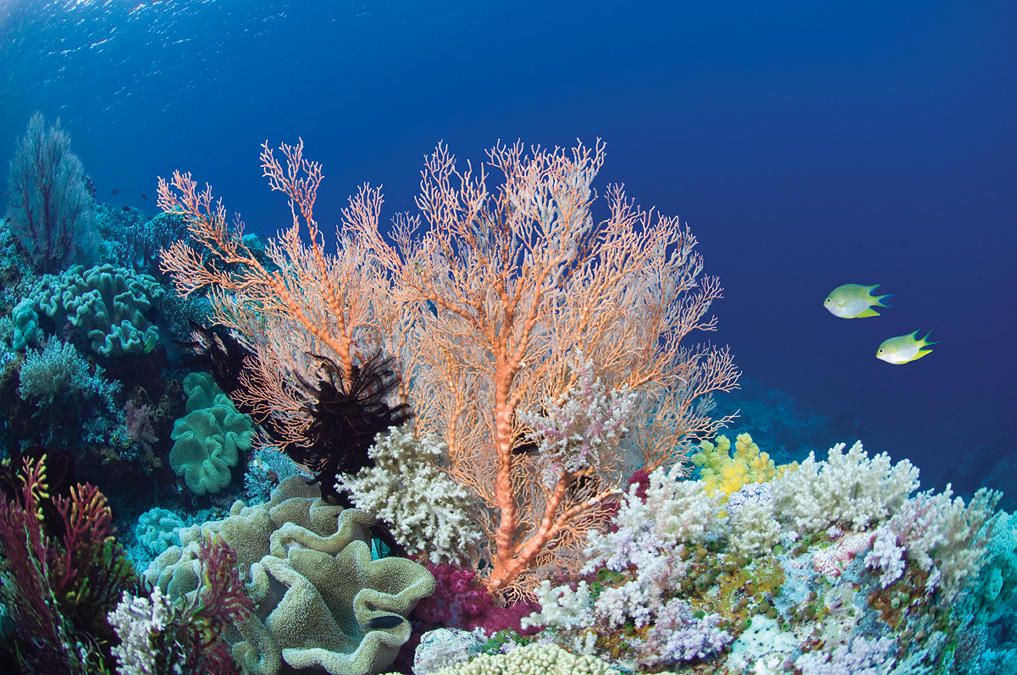
One of the easiest ways to understand a food web is to follow energy flow.
In simple terms, you can picture it like this:
Sunlight → Producers → Herbivores → Predators
Photosynthetic organisms use sunlight to produce organic matter. Herbivores then obtain energy by eating producers, and that energy moves again when predators eat herbivores.
However, on a coral reef, the movement of energy does not stop at a single food chain.
Pathways involve plankton, detritus, and interactions between the reef and the surrounding pelagic environment. As a result, energy on a reef moves through a network that is far more complex than a single food chain.
What is also interesting is that energy and nutrients do not come only from what happens directly above the reef. Small organisms and connections with the pelagic environment can contribute to energy flow and reef productivity.
Coral reefs present a famous ecological puzzle known as Darwin’s paradox. They thrive in tropical waters that are close to a nutrient desert, yet they are among the most productive ecosystems on Earth. Part of the answer is exactly what this section describes: reefs are extraordinarily efficient at capturing and recycling what little comes past, through the algae inside the coral, through the detrital pathway, and through very small fish that convert plankton into food for everything larger.
The reef is not rich because the water is rich. It is rich because almost nothing escapes it.
So, when you look at a coral reef as an ecosystem, imagine not only the reef surface, but an energy network that is constantly moving.
How Food Webs Help Keep Coral Reefs in Balance
Food webs matter because every relationship within them can shape community structure.
Herbivores Keep Algae in Check
One of the clearest examples is the relationship between herbivores, algae, and coral.
When herbivorous fish eat algae, they help control algal growth on the reef surface. If grazing increases, macroalgal cover can decrease. Increased grazing by parrotfish in marine reserves was associated with an approximately fourfold reduction in macroalgal cover. Because macroalgae compete with coral, this relationship shows how changes in consumers can affect organisms further along the network.
However, it is important not to assume that all grazers have the same function.
Different types of grazers can produce different effects on the reef substrate. Sea urchins, for example, can exert much stronger grazing pressure on crustose coralline algae than herbivorous fish under the conditions examined in the study.
This means that herbivore diversity and composition matter, not just their total abundance.
Predators Help Regulate Populations
Predators help shape community structure by influencing prey populations and behaviour.
However, this influence can occur through multiple mechanisms. Sharks and other large predators can alter herbivore behaviour, causing grazing to vary across different areas. Areas considered risky may become places where herbivores reduce feeding, allowing seaweed to receive temporary protection.
This is known as a trophic cascade: a change at one trophic level can affect another, more distant trophic level.
Food webs are interesting precisely because their effects do not always move in a straight line. The presence or absence of one group can alter the behaviour, abundance, or distribution of other groups.
Decomposers Recycle Nutrients
Food webs also need pathways that return material to the system.
When microorganisms and other organisms process organic material, nutrients can become available again for use in subsequent biological processes. In this way, an ecosystem not only transfers energy from one organism to another but also continuously processes and recycles material.
In the context of coral reefs, understanding energy and nutrient flow shows that ecosystem function depends on many processes happening at the same time.
In other words, a healthy reef is not simply a reef with plenty of fish or beautiful-looking corals. What matters more is whether the ecological relationships within it are still functioning.
What Happens When a Coral Reef Food Web Is Disrupted?
Food webs become highly vulnerable when a key component changes significantly.
One example is overfishing.
When fishing activities reduce certain groups, these changes can ripple through the food web. However, the effects are not always the same on every reef. Coral reef food webs contain multiple pathways shaped by species with relatively specific feeding patterns. As a result, losing certain consumer species can make particular trophic pathways more vulnerable.
On Caribbean reefs, for example, fishing-driven changes can affect relationships among predators, parrotfish, algae, and coral. Mumby and colleagues found that when fishing mortality decreased, large parrotfish abundance increased, grazing increased, and macroalgae declined.
Parrotfish also provide a direct connection to reef conservation in Indonesia. In parts of Indonesia, they are heavily fished, including through night spearfishing while they sleep in their mucus cocoons. This is both a striking example of how fishing practices affect reef species and a real management issue for coral reef conservation.
Meanwhile, removing sea urchin predators through fishing can change grazer communities, which can then affect crustose coralline algae. These effects can also be linked to reef stability, growth, and resilience.
This gives us an important lesson:
Coral reef food webs are highly interconnected, but their responses are also highly context-dependent.
So, we cannot assume that removing one species will always produce the same effect on every reef.
Why Healthy Food Webs Matter for Coral Reef Conservation
When we talk about coral reef conservation, it is easy to focus our attention solely on coral.
Of course, coral is extremely important. But coral does not live alone.
A healthy reef needs herbivores that graze, predators that shape interactions with prey, and various consumers and microorganisms that move energy and nutrients through the system.
Although thousands of fish species and highly complex trophic relationships exist, energy pathways show relatively consistent patterns across regions. At the same time, reliance on species with specialised feeding patterns makes some pathways vulnerable when biodiversity declines.
That is why conservation is not enough if we only ask:
“How do we keep coral alive?”
We also need to ask:
“How do we maintain the relationships that keep the entire reef functioning?”
Protecting different trophic levels, reducing excessive fishing pressure, and maintaining consumer diversity can help preserve the ecological processes that support reef resilience. Changes in grazing can be associated with changes in macroalgae and conditions that are more favourable for coral. In contrast, changes in predators and grazers can produce further consequences for the reef.
For us at La Galigo, this is one of the things that makes coral reefs so special.
When you dive among coral and fish, you are not simply enjoying an underwater landscape. You are entering an ecosystem built by thousands of relationships, some of which you can see while others take place far beyond your view.
And protecting the reef means keeping those relationships functioning.
READ ALSO: Why the Coral Triangle Should Be on Every Ocean Lover’s Bucket List
Final Thoughts
A coral reef food web teaches us that life beneath the surface is never truly separate.
Producers introduce energy into the ecosystem. Consumers move energy through various pathways. Herbivores help shape communities of algae and benthic organisms. Predators can influence both prey populations and behaviour. Meanwhile, microorganisms and detrital pathways help process material and support the movement of nutrients through the ecosystem.
When one relationship changes, the effects can spread to other parts of the food web. This is what makes coral reefs so dynamic and, at the same time, so vulnerable.
For us, understanding a food web is not simply about knowing who eats whom. It is about understanding how every organism is part of a larger system.
And when you see a coral reef this way, every fish, alga, predator, and tiny organism among the rocks begins to appear not as separate forms of life, but as part of one interconnected network.
That connection is what helps keep the reef alive, productive, and resilient.
Frequently Asked Questions
What is a coral reef food web?
A coral reef food web is a network of feeding relationships between various organisms living in a coral reef ecosystem. Unlike a food chain, which shows a single pathway, a food web shows multiple interconnected relationships. Patterns remain consistent even when species composition differs.
What are the producers in a coral reef food web?
Producers are organisms that produce organic matter through processes such as photosynthesis. On coral reefs, examples include algae and phytoplankton. They form the foundation of energy pathways that support consumers at higher trophic levels.
What do herbivores do in coral reef ecosystems?
Herbivores eat algae and can help control algal growth on the reef surface. Increased grazing by parrotfish is associated with reduced macroalgal cover, an important competitor of coral.
What is the role of predators in a coral reef food web?
Predators influence the food web by preying on prey and can affect both their populations and behaviour. Large predators such as sharks can produce non-consumptive effects: herbivores avoid high-risk areas, giving seaweed a refuge from grazing.
How does energy flow through a coral reef food web?
Energy can flow from producers to herbivores and then to predators, but coral reefs have many interconnected energy pathways. Planktonic pathways, detrital pathways, and connections with the pelagic environment also contribute to energy and nutrient flow.
What happens when one species is removed from a coral reef food web?
The effects depend on the species that is lost and its ecological context. Because some coral reef food webs contain pathways that depend on consumers with specialised diets, losing certain species can make particular trophic pathways more vulnerable and affect other organisms in the network.
How does overfishing affect coral reef food webs?
Overfishing can alter the abundance and composition of consumers, which can then affect predator-prey relationships and grazing. On Caribbean reefs, for example, reduced fishing mortality was associated with increased large parrotfish, increased grazing, and a decline in macroalgae. In other locations, changes in predator populations can also alter grazer communities and produce a trophic cascade.
Why are coral reef food webs important for ocean health?
Food webs help maintain the various processes that allow coral reefs to function as ecosystems. Relationships among producers, consumers, predators, and other organisms influence energy flow, species interactions, and ecological processes that support reef resilience. Therefore, maintaining coral reef health also means maintaining its network of relationships.
References
Mumby, P. J., Dahlgren, C. P., Harborne, A. R., Kappel, C. V., Micheli, F., Brumbaugh, D. R., Holmes, K. E., Mendes, J. M., Broad, K., Sanchirico, J. N., Buch, K., Box, S., Stoffle, R. W., & Gill, A. B. (2006). Fishing, trophic cascades, and the process of grazing on coral reefs. Science, 311(5757), 98–101.
O’Leary, J. K., & McClanahan, T. R. (2010). Trophic cascades result in large-scale coralline algae loss through differential grazer effects. Ecology, 91(12), 3584–3597.
Pozas-Schacre, C., Casey, J. M., Brandl, S. J., Kulbicki, M., Harmelin-Vivien, M., Strona, G., & Parravicini, V. (2021). Congruent trophic pathways underpin global coral reef food webs. Proceedings of the National Academy of Sciences of the United States of America, 118(39), Article e2100966118.
Rasher, D. B., Hoey, A. S., & Hay, M. E. (2017). Cascading predator effects in a Fijian coral reef ecosystem. Scientific Reports, 7, Article 15679.