
In tropical oceans rich with life, many marine creatures display extraordinary shapes, colours, and behaviours. Among all these wonders, there is a small group of animals that often amazes divers and underwater photographers. They are known as pygmy seahorses.
Their extremely small size makes them almost impossible to see with the naked eye. Many divers may pass them without realising that one of the world’s most distinctive marine animals is right in front of them. When they are finally discovered, pygmy seahorses often appear as if they are simply part of the coral itself.
This remarkable trait has made pygmy seahorses one of the hidden treasures of coral reef ecosystems. Although they range in size from only a few millimetres to about two centimetres, they display extraordinary adaptations that enable them to survive in complex marine environments.
Understanding pygmy seahorses does more than introduce us to extremely small marine creatures. Their story also shows how life on coral reefs develops through highly specific relationships between organisms, habitats, and survival strategies.
What Are Pygmy Seahorses?
Pygmy seahorses are a group of extremely small seahorses belonging to the genus Hippocampus within the family Syngnathidae, which also includes pipefish and seadragons.
Unlike many other seahorse species that can be found in seagrass beds or shallow coastal waters, pygmy seahorses usually live in tropical coral reef environments. They are well known for two main characteristics. These are their extremely small size and remarkable camouflage ability.
The term “pygmy seahorse” is used to describe several miniature seahorse species that are found primarily in the Indo-Pacific region, including Indonesia, the Philippines, Papua New Guinea, and Australia.
Research on pygmy seahorses has developed relatively slowly compared with research on other marine animals. This is largely because their extremely small size and their ability to blend perfectly with their habitat make them difficult to observe, even for scientists and experienced divers.
However, over the past few decades, researchers have begun to understand more about how these tiny creatures live, reproduce, and interact with their coral reef environments.
How Small Are Pygmy Seahorses?
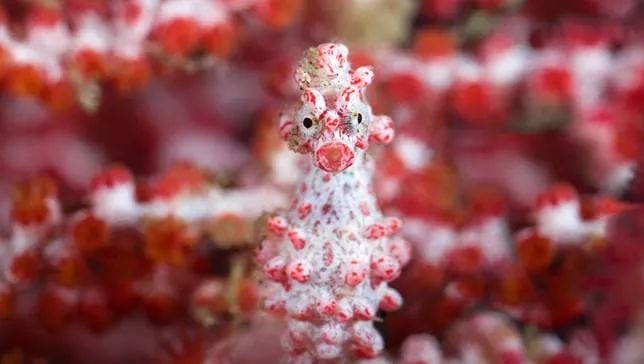
One of the most fascinating aspects of pygmy seahorses is their truly miniature size.
Most pygmy seahorse species measure around 1 – 2 centimetres in length. Some species are even smaller than this. At such a size, their bodies are often no larger than a human fingernail.
For comparison, many common seahorse species can grow between 10 – 20 centimetres in length. This means pygmy seahorses represent only a small fraction of the size of their larger relatives.
Their extremely small size has several important consequences for their lives. Pygmy seahorses rely almost entirely on camouflage to avoid predators. They also live very closely associated with particular habitats, especially sea fans or gorgonian corals.
Because of their small bodies, pygmy seahorses rarely swim far from their home. They usually remain within the same coral colony throughout their lives.
Read Also: 11 Interesting Things to Know About Seahorses
Where Pygmy Seahorses Live
Most pygmy seahorses are found in the Indo-Pacific region, one of the world’s richest centres of marine biodiversity. This region includes many countries across Southeast Asia and the western Pacific, including Indonesia.
Tropical waters such as Raja Ampat, Sulawesi, Bali, the Philippines, and Papua New Guinea are well-known locations where several pygmy seahorse species have been recorded. These areas are part of the Coral Triangle, a region with the highest coral reef diversity in the world.
These environments provide ideal conditions for pygmy seahorses because they offer:
- Complex coral reef structures
- Many types of sea fan corals (gorgonians)
- Availability of small plankton as food
- Protection from currents and predators
Many pygmy seahorse species live at depths of approximately 10 – 40 metres, although some can be found in shallower or deeper waters.
Their geographic distribution is often closely connected to the distribution of specific coral species that provide their habitat.
The Coral Habitats They Depend On
One of the most fascinating aspects of pygmy seahorses is their close relationship with gorgonian corals, commonly known as sea fans.
Many pygmy seahorses live specifically on particular types of gorgonian coral. These corals provide both protection and a structure that supports their camouflage.
The bodies of pygmy seahorses often have small bumps that closely resemble the coral polyps on which they live. This adaptation makes them almost indistinguishable from their surroundings.
The relationship between pygmy seahorses and gorgonian corals can be considered a form of habitat specialisation. This means they cannot easily move to different types of habitats.
If the coral they depend on is damaged or disappears, pygmy seahorses will most likely lose their home as well.
For this reason, the health of coral reef ecosystems is extremely important for their survival.
Masters of Camouflage: How Pygmy Seahorses Stay Hidden
The camouflage ability of pygmy seahorses is often considered one of the most remarkable in the marine world.
Their bodies not only share the same colour as the coral they inhabit, but also feature textures that closely resemble their surroundings. Many species are highly specialised to particular host environments, with each species typically associated with specific corals or gorgonians.
One well-known example is Hippocampus bargibanti, one of the most famous pygmy seahorse species. This species usually lives on sea fans of the genus Muricella and has colours and body shapes that are almost identical to the coral.
This adaptation provides a major survival advantage. Predators searching for prey among coral reefs often cannot distinguish pygmy seahorses from the surrounding coral structures.
Camouflage also helps them when hunting. Pygmy seahorses feed on small organisms such as zooplankton and microscopic crustaceans that drift with ocean currents.
By remaining still and hidden, they can capture passing prey without attracting predators’ attention.
Types of Pygmy Seahorses Divers May Encounter
As scientific research has progressed, more pygmy seahorse species have been discovered. Some of the most well-known species include the following.
Hippocampus bargibanti
This species was first discovered in 1969 and remains one of the most famous pygmy seahorses. Hippocampus bargibanti lives on sea fans of the genus Muricella and has body patterns that closely resemble the coral polyps.
Hippocampus denise
This species was scientifically described in 2003 by Lourie and Randall. Hippocampus denise has a smoother body compared with H. bargibanti and can be found on several types of gorgonian coral.
Hippocampus pontohi
This species is known as one of the pygmy seahorses that macro photographers can find more easily because of its different habitat. Unlike some other species, Hippocampus pontohi is often found on small corals or algae on the seabed.
Hippocampus satomiae
This species is among the smallest known pygmy seahorses. Its extremely tiny size makes it very difficult to detect without the assistance of macro photographers or highly experienced divers.
Behaviour and Daily Life of Pygmy Seahorses
Like other seahorses, pygmy seahorses display several behaviours that distinguish them from many other fish.
They use a prehensile tail, a tail capable of gripping, to hold onto corals or nearby structures. This allows them to remain stable even when ocean currents are present.
Pygmy seahorses feed on tiny organisms. They use their long snouts to suck in small prey drifting through the water.
One distinctive characteristic of seahorses that pygmy seahorses also share is their reproductive behaviour, in which the male carries the eggs. The female transfers eggs into a special pouch on the male’s body, and the male carries them until they hatch.
This process is considered one of the most unusual reproductive strategies among fish.
Why Pygmy Seahorses Are So Difficult to Find
Many divers say that finding a pygmy seahorse is one of the most challenging experiences in macro diving.
There are several main reasons why they are so difficult to locate.
First, their bodies are extremely small. Without careful observation, divers can easily swim past them.
Second, their camouflage is extremely effective. Their bodies often look like a natural part of the coral they live in.
Third, they usually live on specific coral species, so divers must know which corals to examine closely.
For this reason, many divers rely on experienced local guides to locate pygmy seahorses during dives.
Can Divers See Pygmy Seahorses?
Although they are difficult to find, pygmy seahorses can still be observed by divers.
Dive locations within the Coral Triangle, including Indonesia and the Philippines, are widely known as some of the best places to encounter several pygmy seahorse species.
Divers usually have a greater chance of seeing them when they:
- Dive with experienced guides
- Use macro lights or macro cameras
- Carefully examine sea fan corals
Macro photographers often spend long periods at a single location searching for pygmy seahorses. When they are finally discovered, their tiny size and unusual body shape make them fascinating subjects for underwater photography.
Read Also: Top 5 Macro Dive Sites in Komodo
Why Pygmy Seahorses Are Famous in Macro Diving
In the world of diving, particularly macro diving, pygmy seahorses are often considered one of the most fascinating marine creatures to find and photograph. Macro diving is a type of diving that focuses on very small marine life, which is often overlooked by ordinary divers. Because of their extremely small size and remarkable camouflage abilities, pygmy seahorses present both a challenge and a reward for underwater photographers.
For many macro photographers, discovering a pygmy seahorse is often regarded as a special moment during a dive. These tiny animals are usually only visible after careful observation among the branches of sea fans or other coral structures. When finally seen through a macro camera lens, the unique details of their bodies, from their horse-shaped heads to the small bumps that imitate coral polyps, create a truly captivating photographic subject.
In addition to their unusual appearance, pygmy seahorses are fascinating for their relatively calm behaviour. They often grip coral using their prehensile tails and rarely move far from their home. This behaviour allows photographers to observe and capture images carefully without disturbing the animal.
For this reason, pygmy seahorses are often described as one of the “holy grails” of macro diving. Many divers and underwater photographers travel to regions with high biodiversity, such as Indonesia and the Coral Triangle, in the hope of seeing these extraordinary tiny creatures in their natural habitat.
Why Protecting Coral Reef Habitats Matters
The survival of pygmy seahorses depends heavily on the health of coral reef ecosystems.
Because they live on specific coral species, damage to these habitats can directly affect their populations. Threats to coral reefs, such as climate change, ocean warming, and human activities, can affect many marine species, including pygmy seahorses.
Protecting coral reefs, therefore, also means protecting thousands of species that depend on them. Pygmy seahorses are only one example of how marine life can evolve in highly specialised and complex ways.
Marine conservation efforts that maintain the quality of coral habitats help ensure that these unique animals can continue to exist in tropical oceans.
Final Thought
Pygmy seahorses are a remarkable example of the ocean’s diversity. With their extremely small size and extraordinary camouflage abilities, they demonstrate how evolution can produce highly specialised adaptations.
Pygmy seahorses represent highly specialised components of reef biodiversity, demonstrating the extraordinary adaptations that exist within coral reef ecosystems.
For divers and ocean enthusiasts, discovering a pygmy seahorse often becomes an unforgettable experience. Beyond that, their story also reminds us of the importance of maintaining healthy coral reefs.
Behind what may appear to be an ordinary sea fan coral, one of the smallest and most extraordinary marine creatures in the world may be hidden. For divers who wish to witness this small wonder firsthand, regions such as Raja Ampat and the Coral Triangle offer exceptional opportunities. Exploring these biodiverse waters with experienced liveaboard operators such as La Galigo Liveaboard can provide the chance to dive in many of the best locations, accompanied by guides who understand where small creatures like pygmy seahorses are often found.
FAQ
1. How big is a pygmy seahorse?
Pygmy seahorses are among the smallest seahorses in the world. Most species measure about 1 to 2 centimetres in length, although some may be slightly smaller. This size makes them much smaller than many other seahorses that can reach lengths of 10 to 20 centimetres. Because of their miniature size, pygmy seahorses are often difficult to see without careful observation or the assistance of a macro camera lens.
2. Where do pygmy seahorses live?
Pygmy seahorses usually live in tropical Indo-Pacific waters, particularly in regions with high coral reef diversity such as Indonesia, the Philippines, Papua New Guinea, and Australia. Many species live on gorgonian corals or sea fans, which provide shelter and support their camouflage. They are typically found at depths of about 10 – 40 metres, although some species may live at slightly different depths depending on their habitat.
3. Are pygmy seahorses endangered?
The conservation status of pygmy seahorses varies by species. Some species, such as Hippocampus bargibanti, are listed by the IUCN as Data Deficient, meaning that scientific information about their populations remains limited. However, many scientists agree that pygmy seahorses rely heavily on healthy coral reefs. Habitat damage, such as coral bleaching, climate change, and human activity, may therefore affect their populations.
4. Are pygmy seahorses poisonous?
No. Pygmy seahorses are not poisonous and are not dangerous to humans. They are small fish that do not possess venom-based defence mechanisms like some other marine animals. Their primary defence against predators is their extremely effective camouflage, which makes them almost invisible among the corals where they live.
5. How do pygmy seahorses reproduce?
Like all seahorses, pygmy seahorses have a unique reproductive system in which the male carries the eggs. The female deposits her eggs into a specialised pouch on the male’s body. Inside this pouch, the eggs are fertilised and develop until they are ready to hatch. After the incubation period, the male releases fully formed baby seahorses, although they are still extremely small.
6. How does a pygmy seahorse eat?
Pygmy seahorses feed on tiny marine organisms, especially zooplankton and microscopic crustaceans carried by ocean currents. They use their long, tube-shaped snouts to suck in prey very quickly. This process happens extremely fast, often in a fraction of a second. Because they usually grip coral with their tails, pygmy seahorses can wait for prey to drift past in the water and capture it without swimming far.
7. How many species of pygmy seahorses are known?
Scientists have currently identified around 9 to 10 pygmy seahorse species, although this number may change as new research continues. Some of the most well-known species include Hippocampus bargibanti, Hippocampus denise, Hippocampus pontohi, and Hippocampus satomiae. New species may still be discovered because many marine habitats remain insufficiently studied.
8. What do pygmy seahorse babies look like?
Baby pygmy seahorses already resemble miniature versions of adult seahorses. After hatching from the male’s pouch, they immediately live independently without parental care. Because of their extremely small size, juvenile pygmy seahorses are very vulnerable to predators and rely heavily on camouflage for survival.
9. Can pygmy seahorses swim like other fish?
Pygmy seahorses can swim, but their swimming ability is quite limited. They usually move slowly, using a small dorsal fin on their back. Most of their time is spent gripping coral with their prehensile tail, which prevents them from being carried away by ocean currents.
10. Where are the best places to see pygmy seahorses while diving?
Some of the best dive locations to see pygmy seahorses are within the Coral Triangle, a region known for its exceptional marine biodiversity. Locations such as Raja Ampat, Sulawesi, Bali, and the Philippines are widely recognised as places where divers and underwater photographers can encounter various pygmy seahorse species.
References
Reijnen, B. T., van der Meij, S. E. T., & van Ofwegen, L. P. (2011). Fish, fans and hydroids: Host species of pygmy seahorses. ZooKeys, 103, 1–26.
Lourie, S. A., & Kuiter, R. H. (2008). Three new pygmy seahorse species from Indonesia (Teleostei: Syngnathidae: Hippocampus). Zootaxa, 1963(1), 54–68.
Lourie, S. A., & Randall, J. E. (2003). A new pygmy seahorse, Hippocampus denise (Teleostei: Syngnathidae), from the Indo Pacific. Zoological Studies, 42(2), 284–291.
Froese, R., & Pauly, D. (Eds.). (2024). Hippocampus bargibanti Whitley, 1970. FishBase.
International Union for Conservation of Nature (IUCN). (2023). Hippocampus bargibanti. The IUCN Red List of Threatened Species.
Lourie, S. A., Foster, S. J., Cooper, E. W. T., & Vincent, A. C. J. (2004). A guide to the identification of seahorses. Project Seahorse & TRAFFIC North America.