
Imagine being born on a sandy beach, then spending decades exploring the vast ocean. Without a map, compass, or GPS, you swim thousands of kilometres before eventually returning to the very same beach where you first hatched. It sounds like fiction, yet this is the remarkable life of a sea turtle.
This extraordinary ability has earned sea turtles the title of the ocean’s greatest navigators. For more than 100 million years, they have survived climate change, continental drift, and even the extinction of the dinosaurs.
As we explore Indonesia’s waters with La Galigo, we often witness unforgettable moments as a sea turtle glides peacefully through coral reefs or grazes across a seagrass meadow. Encounters like these are not only memorable diving experiences, but also a reminder that every sea turtle has an extraordinary journey behind it.
How Do Sea Turtles Navigate Across Entire Oceans?
One of the greatest mysteries of the marine world is how sea turtles always manage to find their way home.
A female sea turtle may migrate thousands of kilometres to reach feeding grounds before returning to the very beach where she hatched decades earlier to lay her eggs. This phenomenon is known as natal homing, and it remains one of the most remarkable navigation abilities in the animal kingdom.
Sea turtles use the Earth’s magnetic field as a natural map. While still inside their eggs, they begin recognising the unique magnetic signature of the beach where they hatch. This information becomes an internal compass that helps guide them back to the same location once they reach adulthood.
The Earth’s magnetic field is not their only guide. Sea turtles also rely on ocean currents, the position of the sun, and environmental cues as they approach the coastline. Together, these natural signals enable them to complete transoceanic journeys with remarkable accuracy.
This extraordinary navigational ability is one reason sea turtles have maintained their life cycle for millions of years. Today, however, these long migrations are becoming increasingly challenging because habitat loss, human activities, and climate change affect the beaches where they breed.
What Makes Sea Turtles Different from Other Turtles?
Although they all have shells, sea turtles differ greatly from tortoises and freshwater turtles.
Sea turtles are reptiles that spend almost their entire lives in the ocean. Females come ashore only to lay their eggs. This adaptation has made their bodies far more efficient for swimming than those of their terrestrial relatives.
Their long front flippers function like wings underwater, allowing them to swim with both grace and power. Their streamlined shells also help reduce drag as they move through the ocean.
Unlike land tortoises, sea turtles cannot retract their heads and flippers into their shells. Instead, they rely on their swimming speed and body size to avoid predators.
Although they live in the sea, sea turtles breathe air using lungs. This means they must regularly surface to breathe before diving beneath the water again.
These remarkable adaptations enable sea turtles to thrive in a variety of habitats, from seagrass meadows and coral reefs to the open ocean.
Meet the Seven Species of Sea Turtles
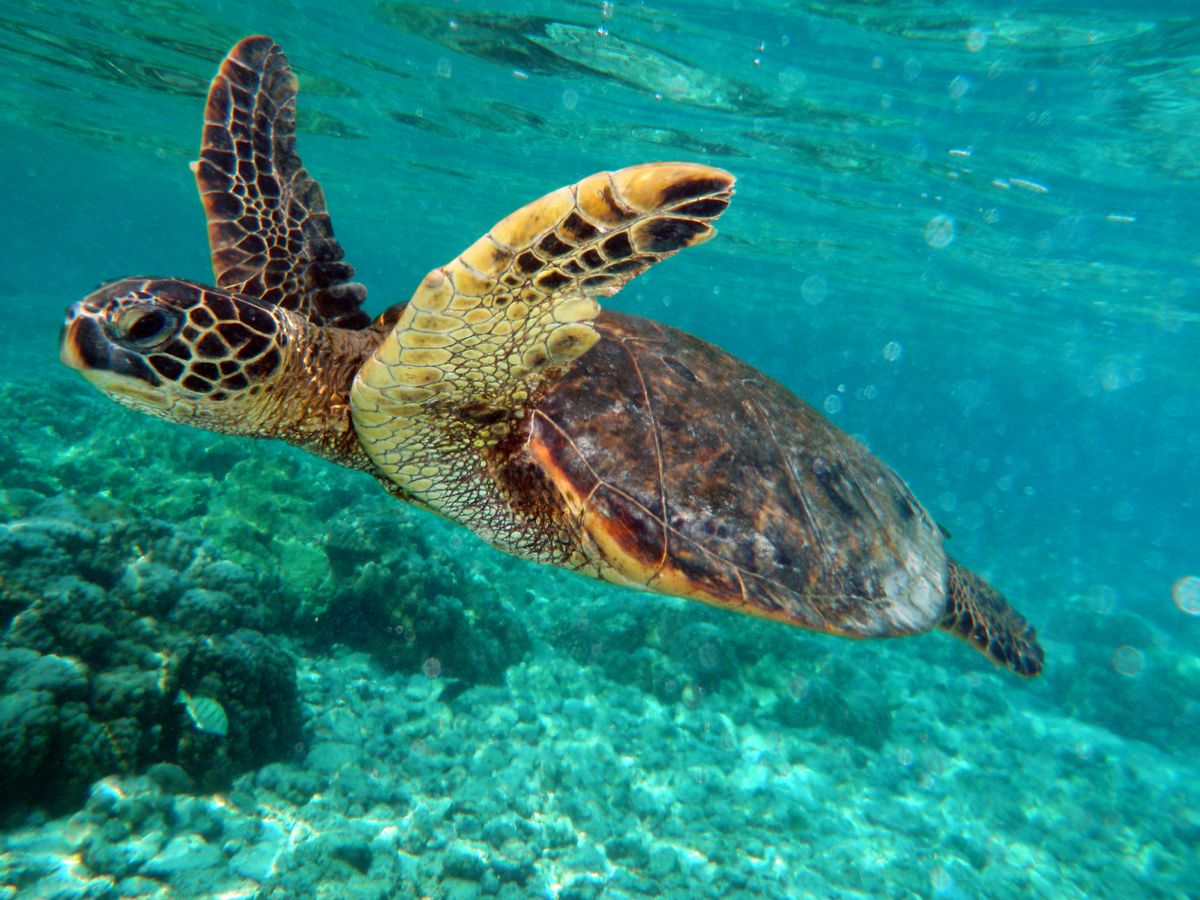
There are currently seven living species of sea turtle in the world. The good news is that six of them can be found in Indonesia, making the country one of the world’s most important regions for sea turtle conservation.
Each species has its own distinctive characteristics.
Green Turtle (Chelonia mydas) is the species most commonly encountered by divers in Indonesia. As adults, they feed mainly on seagrass, playing an important role in maintaining healthy seagrass meadows.
Hawksbill Turtle (Eretmochelys imbricata) is easily recognised by its pointed beak. This specialised shape allows it to reach marine sponges growing deep within coral reefs.
When it comes to size, the Leatherback Turtle (Dermochelys coriacea) is the undisputed giant. As the world’s largest sea turtle, it can grow to more than two metres in length and is one of the ocean’s most remarkable long-distance travellers.
Meanwhile, the Loggerhead Turtle (Caretta caretta) has exceptionally powerful jaws for crushing crabs and molluscs. Olive Ridley Turtle (Lepidochelys olivacea) is famous for the phenomenon known as arribada, during which thousands of females nest on the same beach within a short period.
The remaining two species are the Kemp’s Ridley Turtle, the rarest sea turtle in the world, and the Flatback Turtle, whose distribution is almost entirely restricted to Australian waters.
Where Do Sea Turtles Live?
Although sea turtles are often seen swimming peacefully around coral reefs, they do not spend their entire lives in one place. They are migratory animals that move between different habitats as they grow, feed, and reproduce.
Their journey typically begins on sandy beaches, where adult females lay their eggs. After hatching, the young turtles, known as hatchlings, make a rapid dash to the sea and enter a stage known as the lost years, a period during which their whereabouts in the open ocean remain difficult for scientists to observe.
As they mature, each species occupies different habitats according to its ecological needs.
Green turtles spend much of their time in seagrass meadows, where seagrass forms the main part of their diet. In contrast, hawksbill turtles are more commonly found on coral reefs, where they feed on marine sponges.
Meanwhile, species such as leatherback turtles and loggerhead turtles spend much of their lives in the open ocean, following ocean currents in search of jellyfish and other prey.
Indonesia is one of the world’s most important countries for sea turtles because it provides all of these habitats. From nesting beaches in Papua to the coral reefs of Raja Ampat and the seagrass meadows of Komodo, Indonesia’s waters offer places for sea turtles to nest, feed, and migrate. This is one reason Indonesia is home to six of the world’s seven sea turtle species.
Read Also: Frogfish: Secretive Hunters of the Deep
Why Do Sea Turtles Return to the Same Beach?
One of the most fascinating facts about sea turtles is that female turtles return to the very beach where they were born.
After reaching adulthood, a process that can take several decades, a female sea turtle undertakes a remarkable journey back to her natal beach to lay her eggs. She returns because that beach has already proved to be a successful nesting site for previous generations.
Nesting usually takes place at night, when temperatures are cooler, and the risk of disturbance from predators and humans is lower. The turtle crawls ashore, selects a suitable area of sand, and uses her rear flippers to dig a nest before laying dozens, or sometimes more than a hundred, eggs. She then carefully covers the nest with sand and returns to the sea, never seeing her hatchlings emerge.
Around 45 to 60 days later, the eggs hatch. Interestingly, sand temperature not only affects hatching success but also helps determine the sex of the hatchlings. As a result, climate change and rising beach temperatures have become new challenges for the long-term survival of sea turtles.
When night falls, hundreds of hatchlings emerge from the nest almost simultaneously and instinctively head towards the sea by following the natural light along the horizon. Unfortunately, artificial lighting from hotels, vehicles, or torches can disorient them, causing them to move away from the ocean and significantly increasing their risk of death.
The Incredible Life Cycle of a Sea Turtle
Compared with many other marine animals, sea turtles have an exceptionally long life cycle.
Their journey begins as an egg before they hatch into tiny hatchlings that immediately attempt to reach the sea. They then enter the lost years, a stage during which they spend much of their lives in the open ocean and remain one of the marine world’s greatest mysteries.
Several years later, juvenile turtles begin moving into shallower habitats such as seagrass meadows and coral reefs, where they feed and continue to grow. They do not reach sexual maturity until they are approximately 20 to 40 years old, depending on the species.
Only after reaching adulthood do they begin their long reproductive migrations, returning to the beach where they first hatched. This cycle continues throughout a lifespan that can exceed 50 years.
Their slow growth and late maturity are among the main reasons sea turtle populations take so long to recover when adult numbers decline.
Why Are Sea Turtles So Important for Healthy Oceans?
Encountering a sea turtle while diving is undoubtedly a memorable experience. However, their role extends far beyond being one of the ocean’s most iconic attractions.
Green turtles help maintain healthy seagrass meadows by grazing on older seagrass leaves. Naturally cropped seagrass grows more vigorously, creating vital habitat for numerous species, including fish, seahorses, and dugongs.
Meanwhile, hawksbill turtles help maintain the balance of coral reef ecosystems by feeding on marine sponges. Without them, sponges could become overly abundant and compete with corals for space.
Sea turtles also play an important role in the marine food web. Their eggs and hatchlings provide food for a wide range of wildlife, while nests that do not hatch return valuable nutrients to the beach, helping to support the growth of coastal vegetation.
What Threatens Sea Turtles Today?
After surviving for more than 100 million years, sea turtles now face their greatest threats from human activities.
Plastic waste floating in the ocean is often mistaken for jellyfish and swallowed by sea turtles. At the same time, many turtles are accidentally caught in fishing gear as bycatch or lose their habitats due to coastal development.
On nesting beaches, disturbances can also come from seemingly insignificant sources. Artificial lighting, large numbers of visitors, and even foot traffic across the sand can disrupt nesting or disorient hatchlings as they make their way to the sea. Artificial lighting and tourism-related activities are among the primary threats to successful sea turtle nesting.
How Can Travellers Help Protect Sea Turtles?
The good news is that every traveller can help protect sea turtles without being a conservation expert.
If you encounter a sea turtle while snorkelling or diving, give it plenty of space to swim naturally. Avoid touching, chasing, or blocking its path. If you visit a nesting beach, use as little light as possible and follow local guides’ guidance.
Simple actions such as reducing your use of single-use plastics, choosing responsible tour operators, and respecting the rules of protected areas can also make a meaningful difference to the long-term survival of sea turtles.
At La Galigo, we believe that the best diving experiences always go hand in hand with protecting the ocean for the wildlife that calls it home.
Where Can You See Sea Turtles in Indonesia?
Indonesia offers countless opportunities to encounter sea turtles in their natural habitat.
In Raja Ampat, green turtles and hawksbill turtles are often seen swimming around its exceptionally healthy coral reefs.
In Komodo National Park, sea turtles are frequently encountered while diving or snorkelling at several of the region’s most popular sites.
You may also have the opportunity to see sea turtles in Alor, Wakatobi, the Derawan Islands, and along several beaches in Papua that serve as important nesting sites.
Wherever your journey takes you, the most memorable experience isn’t how close you get to a sea turtle, but the privilege of watching this ancient marine traveller live naturally in a healthy ocean.
If you dream of encountering sea turtles in their natural habitat, we invite you to explore some of Indonesia’s finest diving destinations with La Galigo through a liveaboard experience designed for ocean lovers. Join us as we dive in Raja Ampat, Komodo, Alor, and other iconic destinations while experiencing the underwater world responsibly and with respect for marine wildlife.
Book your next La Galigo Liveaboard adventure today and experience what it feels like to share the ocean with one of the world’s most extraordinary navigators.
Frequently Asked Questions
How long do sea turtles live?
Most sea turtles can live for more than 50 years, and some species are believed to live much longer.
Why do sea turtles always return to the same beach?
They have a remarkable natural navigation system that lets them recognise the unique characteristics of the beach where they hatched and return there when they are ready to breed.
Do all sea turtles live on coral reefs?
No. Sea turtles occupy a range of habitats, including sandy beaches, seagrass meadows, coral reefs, and the open ocean.
Why are sea turtles important for marine ecosystems?
Sea turtles help maintain healthy seagrass meadows, control sponge populations on coral reefs, and support the balance of marine food webs.
What should I do if I encounter a sea turtle while diving?
Keep a respectful distance, avoid touching or chasing the turtle, refrain from using flash photography, and allow it to behave naturally.
References
As-singkily, M., Nijland, R., & Becking, L. E. (2025). Sea turtle protection in Indonesia: A review of constitutional and customary regulations. Environmental Challenges, 20, 101304.
Hamann, M., Godfrey, M. H., Seminoff, J. A., Arthur, K., Barata, P. C. R., Bjorndal, K. A., Bolten, A. B., Broderick, A. C., Campbell, L. M., Carreras, C., Casale, P., Chaloupka, M., Chan, S.-K. F., Coyne, M. S., Crowder, L. B., Diez, C. E., Dutton, P. H., Epperly, S. P., FitzSimmons, N. N., … Godley, B. J. (2010). Global research priorities for sea turtles: Informing management and conservation in the 21st century. Endangered Species Research, 11(3), 245–269.
Sandova, Z., Widuri, F., Rizky, A., Yanti, F. Y. I., Nurdin, J., Novarino, W., & Aprizal. (2026). Turtle nesting and conservation management in Amping Parak, West Sumatra. Jurnal Biologi
Tapilatu, R. F., Dutton, P. H., Tiwari, M., Wibbels, T., Ferdinandus, H. V., Iwanggin, W. G., & Nugroho, B. H. (2013). Long-term decline of the western Pacific leatherback, Dermochelys coriacea: A globally important sea turtle population. Ecosphere, 4(2), Article 25.
Wallace, B. P., DiMatteo, A. D., Bolten, A. B., Chaloupka, M. Y., Hutchinson, B. J., Abreu-Grobois, F. A., Mortimer, J. A., Seminoff, J. A., Amorocho, D., Bjorndal, K. A., Bourjea, J., Bowen, B. W., Dueñas, R. B., Casale, P., Choudhury, B. C., Costa, A., Dutton, P. H., Fallabrino, A., Finkbeiner, E. M., … Mast, R. B. (2011). Global conservation priorities for marine turtles. PLoS ONE, 6(9), e24510.