
The Komodo dragon life cycle is one of the most fascinating survival stories in Indonesia. These powerful reptiles begin life as fragile eggs buried underground, grow into tree climbing juveniles, and eventually become the dominant predators of Komodo National Park.
If you are joining a Komodo liveaboard, understanding this life cycle adds more meaning to your ranger guided dragon walk. You are not just seeing a famous reptile. You are seeing one part of a protected ecosystem that connects Komodo’s islands, wildlife, and reefs.
What Is the Life Cycle of a Komodo Dragon?
The life cycle of a Komodo dragon is easiest to understand through five main growth stages:
- Egg
- Hatchling
- Juvenile
- Subadult
- Adult
Before these stages begin, adult Komodo dragons reproduce during the mating season and females prepare nesting sites for their eggs.
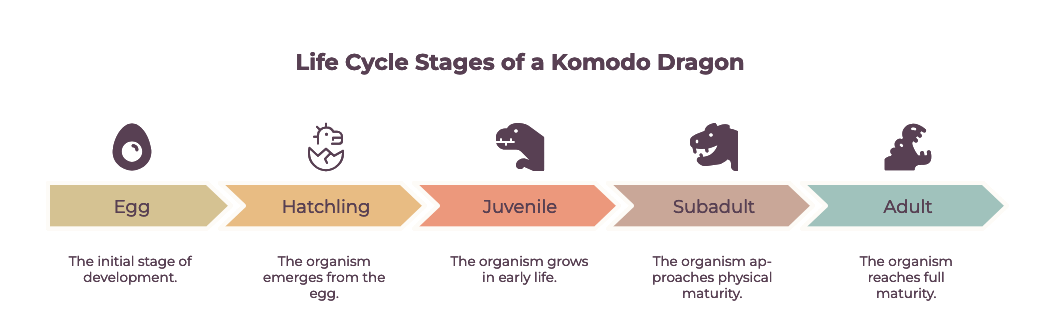
Each stage comes with different challenges. Young Komodo dragons must avoid predators, including adult Komodos, while adults compete for food, territory, and mates.
1. Mating Season and Nesting
The Komodo dragon life cycle begins with mating. Komodo dragons are usually solitary animals, but during the breeding season, males search for females and may compete aggressively with other males.
Male Komodo dragons are known to wrestle by standing on their hind legs and pushing against each other. The stronger male usually wins access to the female. This behaviour is one of the reasons Komodo dragons are often seen as ancient, powerful looking animals.
After mating, the female prepares to lay eggs.
For you as a visitor, this explains why Komodo dragons are usually seen alone during ranger guided walks, except during certain breeding behaviours or feeding related encounters.
2. Egg Laying and Incubation
Female Komodo dragons lay eggs rather than giving birth to live young. A female may use a burrow, dig her own nest, or use an old mound nest made by megapode birds.
The eggs are buried underground, where they are protected from direct sunlight, weather changes, and some predators. According to the Smithsonian’s National Zoo, Komodo dragon eggs usually incubate for around seven to nine months, depending on nest conditions, and the female may guard the nest for part of the incubation period, but hatchlings are independent once they emerge.
This stage is extremely important because the eggs are vulnerable. If the nest is disturbed or conditions are poor, the young dragons may not survive.
3. Hatchlings: Why Baby Komodos Are Rarely Seen
When Komodo dragons hatch, they are small, lightweight, and highly vulnerable. They may grow into apex predators later, but at this stage, they are potential prey.
One of the most surprising facts about the life cycle of a Komodo dragon is that adult Komodos may prey on young Komodos. Because of this, hatchlings often escape into trees soon after hatching.
This tree dwelling behaviour gives them a better chance of survival. It keeps them away from larger dragons and other ground predators.
This is why you are much more likely to see adult Komodo dragons than babies during a ranger guided walk.
4. Juvenile Stage: Life in the Trees
The juvenile stage is one of the most important parts of the Komodo dragon life cycle, as young dragons spend much of their early life in trees. A study on immature Komodo dragons found that hatchlings were predominantly arboreal, meaning they spent most of their time above the ground.
During this stage, young Komodos eat smaller prey such as insects, geckos, small birds, eggs, and other small animals. Their diet is very different from adult Komodos, which can hunt much larger prey.
This stage is about survival, growth, and avoiding danger. Juvenile Komodos are fast, alert, and much more secretive than adults.
So, if you do not see young Komodo dragons during your visit, it does not mean they are absent. They are simply harder to spot because they spend much of their early life away from the ground.
5. Subadult Stage: Moving from Trees to the Ground
As Komodo dragons grow larger, they gradually spend more time on the ground. This is a major turning point in the Komodo dragon life cycle.
At this stage, they are too large to live mostly in trees but not yet as dominant as full grown adults. They begin hunting bigger prey and scavenging more often. They also have to compete with larger dragons for food and space.
Subadult Komodos are still at risk, but they are stronger, faster, and better equipped to survive than hatchlings or juveniles.
6. Adult Stage: The Apex Predator of Komodo National Park
Adult Komodo dragons are the top predators in their environment. The Komodo Survival Program describes the species as the largest lizard in the world and notes that it is naturally found on Komodo, Rinca, Nusa Kode, Gili Motang, and parts of Flores.
Adult Komodos can hunt deer, wild pigs, water buffalo, smaller reptiles, birds, and even other Komodo dragons. They also feed on carrion, which means they help clean up the ecosystem by consuming dead animals.
Their strong bodies, sharp claws, serrated teeth, powerful bite, and excellent sense of smell make them highly effective predators.
Because Komodo dragons are powerful wild animals, every dragon walk should be done with a licensed ranger. When you follow ranger instructions, keep a safe distance, and avoid disturbing wildlife, the experience becomes safe, educational, and memorable.
The adult stage completes the Komodo dragon life cycle, when the animal becomes capable of reproducing and maintaining the next generation.
How Long Does a Komodo Dragon Take to Grow?
Komodo dragons grow slowly. They begin as eggs, spend months developing underground, live as vulnerable hatchlings, and then pass through years of juvenile and subadult growth before reaching full adult size.
This slow growth makes conservation especially important. If young Komodo dragons do not survive, the adult population cannot remain healthy in the long term.
Komodo dragons often reach sexual maturity at around 8–9 years old, although growth rates can vary depending on food availability, sex, and environmental conditions.
Because the Komodo dragon life cycle unfolds over many years, survival during the juvenile and subadult stages is particularly important.
Why This Matters for Your Komodo Liveaboard Trip
Understanding the Komodo dragon life cycle helps you get more from your Komodo liveaboard trip. A dragon walk is not just a quick land stop between dives. It is a chance to understand the national park as a complete ecosystem, from the reefs below the surface to the wildlife on land.
With La Galigo, your Komodo trip is not only about logging dives. It is about experiencing the national park properly: world-class dive sites, island viewpoints, and a ranger-guided dragon walk that helps you understand the wildlife above the surface. This gives you a more complete Komodo journey without rushing the experience into a single day.
READ ALSO: Komodo Dragon: Facts, Habitat, Conservation & More
Why the Komodo Dragon Life Cycle Matters for Conservation
The Komodo dragon is listed as Endangered on the IUCN Red List. This means the species faces real conservation pressure.
Protecting the life cycle of a Komodo dragon means protecting more than the adults you may see during your walk. It also means protecting nesting areas, juvenile habitats, prey animals, and the wider island ecosystem.
This is why responsible tourism matters. Your behaviour on the trail helps reduce stress on wildlife and keeps the experience respectful for the next visitors too.
For you, this is why ranger rules matter. When you visit Komodo National Park, you should always stay with your ranger, keep a safe distance, avoid loud behaviour, never feed wildlife, and respect the natural habitat.
READ ALSO: Top Five Things to do in Komodo National Park
Can You See Komodo Dragons on a Komodo Liveaboard Trip?
Yes, you can see Komodo dragons during a Komodo liveaboard trip when your itinerary includes a ranger-guided walk on Komodo or Rinca. Wildlife sightings are never guaranteed, but these guided walks give you the safest and most responsible chance to observe Komodo dragons in their natural habitat.
With La Galigo, this land experience becomes part of a wider Komodo journey that combines diving, island scenery, and time inside one of Indonesia’s most iconic national parks.
What You May Actually See During a Dragon Walk
During a ranger guided dragon walk, you are more likely to see adult or subadult Komodo dragons than hatchlings or juveniles. Young Komodos spend much of their early life in trees, which makes them harder to spot from the trail.
Your ranger may also point out nesting areas, tracks, resting spots, or signs of feeding behaviour depending on the route and conditions. This makes the walk more meaningful because you are not just looking for a photo. You are learning how Komodo dragons survive in their natural habitat.
Responsible Dragon Walk Tips for Your Komodo Trip
During your Komodo dragon walk, always stay with your ranger and follow their instructions. Keep a safe distance, avoid sudden movements, speak calmly, and never feed wildlife. Komodo dragons are wild animals, so the safest way to observe them is respectfully and from the distance recommended by your guide.
You should also avoid wandering away from the group, standing too close for photos, or trying to attract a dragon’s attention. A good dragon walk is not about getting the closest photo. It is about seeing the animal safely in its natural habitat.
Final Thoughts: A Life Cycle Built on Survival
The komodo dragon life cycle is a story of survival at every stage. Eggs must remain hidden underground. Hatchlings must escape into trees. Juveniles must avoid larger predators. Subadults must learn to compete. Adults must hunt, defend territory, and reproduce.
The Komodo dragon life cycle is a story of survival at every stage. Eggs must remain hidden underground. Hatchlings move into trees. Juveniles avoid larger predators. Subadults learn to compete. Adults hunt, defend territory, and reproduce.
Understanding this life cycle helps you see Komodo dragons as more than famous reptiles. They are part of a delicate island ecosystem found only in one region of Indonesia.
If you are joining a Komodo liveaboard, this knowledge gives more meaning to your time in the national park. You are not only coming for the dives. You are also experiencing Komodo above and below the surface, from world-class reefs to the only region on Earth where Komodo dragons still live in the wild.
Frequently Asked Questions
What is the Komodo dragon life cycle?
Komodo dragons hatch from eggs, grow into hatchlings, spend much of their early life as tree-dwelling juveniles, transition into subadults, and eventually become adults capable of reproducing.
What predators threaten young Komodo dragons?
Adult Komodo dragons have few natural predators, but young Komodos are vulnerable to birds of prey, snakes, wild pigs, and larger Komodo dragons.
Do Komodo dragons hatch from eggs or are they born alive?
Komodo dragons hatch from eggs. Females typically lay around 15–30 eggs, and the eggs usually incubate for around eight to nine months before hatching.
How long do Komodo dragons usually live?
Komodo dragons are often reported to live around 30 years in the wild, although lifespan estimates can vary. Some individuals may live longer under managed care.