
What Is a Peacock Mantis Shrimp?
In tropical oceans, many small creatures appear beautiful, yet they possess extraordinary abilities. One of the most well-known examples is the peacock mantis shrimp, a brightly coloured marine animal recognised as one of the most powerful small predators in coral reef ecosystems.
The peacock mantis shrimp has the scientific name Odontodactylus scyllarus. Although it is often called a “shrimp”, it is not a true shrimp. It belongs to a group of crustaceans known as stomatopods, an order of marine animals with body structures and hunting behaviours that differ significantly from those of typical shrimp or crabs.
In total, scientists have identified more than 400 species of mantis shrimp worldwide.
One reason the peacock mantis shrimp is so famous is the combination of three remarkable abilities that rarely occur together in a single animal. First, its body displays extremely bright and complex colours, which is why it is often described as one of the most colourful marine creatures in the world. Second, it possesses an incredibly fast and powerful strike used to break the shells of its prey. Third, its visual system is among the most complex in the animal kingdom and can detect wavelengths of light that humans cannot see.
Interestingly, mantis shrimp attract the attention not only of divers but also of scientists. Research on this small animal has helped explain how it can produce such an extremely fast and powerful strike. At the same time, researchers have discovered that mantis shrimp possess an extraordinary visual system. They can detect a wide range of colours, ultraviolet light, and even polarised light, abilities that make the underwater world appear very different from what humans can perceive.
This combination of visual beauty, mechanical power, and advanced sensory systems makes the peacock mantis shrimp one of the most fascinating marine animals for scientists, underwater photographers, and divers worldwide.
Quick Facts: Peacock Mantis Shrimp
Scientific name: Odontodactylus scyllarus
Animal group: Stomatopoda (mantis shrimp)
Average size: approximately 10–18 cm
Diet: Carnivorous
Habitat: Tropical coral reefs and nearby sandy areas
Distribution: Indo-Pacific region, including Indonesia, the Philippines, Australia, and tropical Asia
This species typically lives on seabeds that contain a mixture of coral and sand, where it can build burrows for shelter and hunting.
Peacock Mantis Shrimp Is One of the Ocean’s Most Colourful Creatures
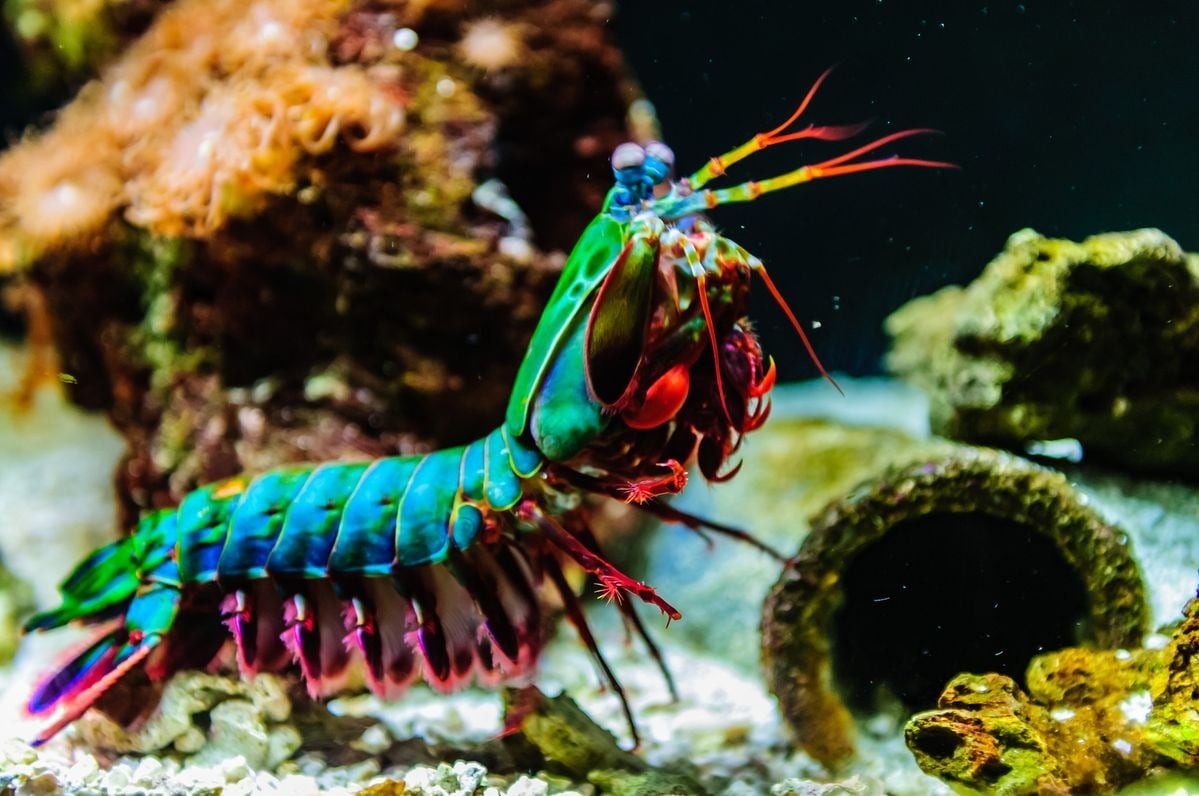
Body Colours and Patterns
The peacock mantis shrimp is often regarded as one of the most colourful creatures in the ocean. Its body displays striking colour combinations, including green, blue, red, and bright orange.
The main body section, or carapace, is usually green with complex spotted patterns. Meanwhile, the antennal scales often display bright orange or red colours, making the animal even more visually striking.
These colour combinations give the mantis shrimp an almost fantastical appearance. In the colourful environment of coral reefs, this appearance may help them both camouflage and communicate with other individuals.
Some studies of mantis shrimp visual systems also suggest that their body colours may play a role in visual communication between individuals, particularly in territorial behaviour and reproduction.
Size and Physical Characteristics
The peacock mantis shrimp usually measures between 10 and 18 centimetres in length, making it one of the relatively large mantis shrimp species.
Its body has several distinctive characteristics:
- A pair of large eyes that can move independently
- Front limbs modified into raptorial appendages, often described as striking “clubs”
- An elongated body with hardened segments typical of crustaceans
This body structure is designed for highly efficient predatory life in coral reef environments.
The Incredible Punch of the Peacock Mantis Shrimp
One of the main reasons the peacock mantis shrimp is so famous is the strength of its strike. In the animal world, this ability is considered one of the most extreme.
How the Smashing Claw Works
Peacock mantis shrimp belong to a group of mantis shrimp known as “smashers.” They possess a pair of front limbs that have evolved into extremely powerful hammer-like structures.
These limbs operate using an energy storage mechanism similar to a spring. The mantis shrimp’s muscles first compress elastic structures within the appendage. When the stored energy is released, the appendage accelerates at an extremely high rate.
This mechanism allows the mantis shrimp to generate far greater force than would be possible using muscle contraction alone.
One of the Fastest Punches in the Animal Kingdom
The acceleration of a mantis shrimp strike can reach approximately 580,000 metres per second squared, making it one of the fastest movements in the animal kingdom. The attack occurs in an extremely short moment and involves extraordinary acceleration.
This speed is powerful enough to break hard shells such as those of clams or crabs. In some cases, the strike can even crack thin glass if the mantis shrimp is kept in an aquarium that is not strong enough.
This ability makes the mantis shrimp an extremely effective predator despite its relatively small size.
Cavitation Bubbles and Impact
One of the most fascinating phenomena produced by the mantis shrimp’s strike is the formation of cavitation bubbles.
When the striking club moves extremely quickly through the water, the surrounding pressure can drop dramatically, forming cavitation bubbles. When these bubbles collapse, they generate an additional shockwave.
This means that the mantis shrimp’s prey often experiences two impacts at the same time:
- The physical strike from the club
- A shockwave produced by the collapsing cavitation bubble
This phenomenon demonstrates how complex and efficient the hunting mechanism of this small animal truly is.
Read Also: Ocean Sunfish: Characteristics, Habitat and Predators of the Mola – Mola
The Most Complex Eyes in the Animal Kingdom
In addition to its powerful strike, the mantis shrimp is also famous for its extremely complex visual system.
How Peacock Mantis Shrimp See Colour
Mantis shrimp possess far more colour receptors than humans.
Humans have three primary types of colour receptors, while mantis shrimp have more than ten different types of photoreceptors. This means they can detect a wide range of light wavelengths in a unique way.
Interestingly, despite having many receptors, mantis shrimp may process colour differently from humans. Instead of comparing colour spectra in the complex way the human brain does, they may identify colours through a rapid recognition system.
Detecting Polarised and Ultraviolet Light
Mantis shrimp can rotate their eyes to help detect polarised light and ultraviolet light in the marine environment.
This ability is extremely useful underwater, where light is often scattered and redirected by water and particles.
Detecting polarised light allows mantis shrimp to:
- Recognise prey
- Detect predators
- Communicate with other mantis shrimp
How Their Eyes Move Independently
The eyes of mantis shrimp are also unique because they can move independently from each other.
This trinocular vision within each eye allows them to independently estimate depth while scanning the environment separately. As a result, mantis shrimp gain an extremely wide field of observation without needing to move their bodies.
Habitat and Distribution
Indo-Pacific Coral Reefs
Peacock mantis shrimp are primarily found in the Indo-Pacific region, one of the marine areas with the highest biodiversity in the world.
This region includes:
- Indonesia
- The Philippines
- Australia
- Papua New Guinea
- Various other tropical islands
Living in Burrows Near the Reef
Peacock mantis shrimp spend most of their lives inside burrows that they create on the seabed.
These burrows are usually located in sandy areas or rubble close to coral reefs. From this shelter, they are able to:
- Hide from predators
- Wait for passing prey
- Protect themselves from ocean currents
Typical Depth Range
Peacock mantis shrimp are commonly found at depths of around 3 – 40 metres, a depth range that is also popular among recreational divers.
How Peacock Mantis Shrimp Hunt
Favourite Prey
Peacock mantis shrimp are carnivorous predators that feed on various hard-shelled marine animals.
Their main prey includes:
- Small crabs
- Sea snails
- Clams
- Other molluscs
Using Their Powerful Clubs to Break Shells
When hunting, mantis shrimp use their powerful striking clubs to break the shells of their prey. Once the shell cracks, they can easily reach the soft tissue inside.
This strategy allows them to take advantage of food sources that many other predators cannot consume.
Ambush Hunting from a Burrow
Many mantis shrimp hunt using an ambush strategy.
They wait near the entrance of their burrow until prey passes by, then strike rapidly before the prey has a chance to escape.
Territorial Behaviour and Life in a Burrow
How They Build and Maintain Burrows
Peacock mantis shrimp rely heavily on their burrows. These shelters are usually created by digging into sand or by using natural gaps between rocks and coral.
They actively clean and maintain the burrow to ensure it remains safe and suitable as a living space.
Defending Their Territory
Mantis shrimp are also known to be highly territorial animals. They defend their area from other mantis shrimp or animals that approach too closely.
This behaviour is often observed when a mantis shrimp displays an aggressive posture near the entrance of its burrow.
Divers Love Seeing Peacock Mantis Shrimp
A Favourite Subject for Macro Photography
For divers and underwater photographers, the peacock mantis shrimp is one of the most fascinating subjects in macro photography.
Several factors make it particularly appealing:
- Extremely bright body colours
- Large and expressive eyes
- Active behaviour around its burrow
Where Divers Often Spot Them
Divers can encounter mantis shrimp in various Indo-Pacific locations known for their marine biodiversity, including:
- Raja Ampat in Indonesia
- Komodo
- Other tropical coral reefs
In these locations, mantis shrimp are often seen peeking from their burrows on the seabed. For divers, observing a peacock mantis shrimp in the wild is often one of the most exciting macro diving experiences. The animal is typically seen looking out from a small hole in the sand or among broken coral fragments, while its constantly moving eyes observe the surrounding environment.
Waters such as Raja Ampat and Komodo are widely recognised as two of the best places in the world to encounter unique marine critters. During liveaboard diving trips, divers often have the opportunity to explore several dive sites home to a wide variety of remarkable small creatures, including mantis shrimp.
For those who wish to explore the coral reefs of this region more extensively, liveaboard journeys such as those offered by La Galigo Liveaboard allow divers to visit remote dive sites in both Raja Ampat and Komodo. In locations like these, the chances of encountering extraordinary marine life, from nudibranchs to peacock mantis shrimp, become much greater.
Read Also: What is Ocean Sound and Underwater Noise Pollution?
Verdict
The peacock mantis shrimp may be small, but its abilities are truly extraordinary. Its body displays striking bright colours, making it resemble a living jewel within tropical coral reefs.
Behind this beauty, however, lies a highly efficient predator. Its rapid and powerful strike allows it to break the shells of its prey with ease. Combined with its extremely complex visual system, the mantis shrimp can detect its surroundings in ways that most animals cannot.
The combination of spectacular colours, a unique striking mechanism, and remarkable visual abilities makes the peacock mantis shrimp one of the most fascinating creatures in coral reef ecosystems.
For divers, encountering a mantis shrimp in the wild often becomes a memorable experience. A small rainbow-coloured predator peering out of a burrow on the seabed serves as a reminder that even the smallest creatures in the ocean can possess extraordinary abilities.
Frequently Asked Questions
What is a peacock mantis shrimp?
The peacock mantis shrimp is a species of mantis shrimp with the scientific name Odontodactylus scyllarus. It belongs to the group of crustaceans known as stomatopods, which are different from ordinary shrimp. This species is famous for its bright colours, powerful strike, and extremely complex visual system.
Is the peacock mantis shrimp real?
Yes. The peacock mantis shrimp is a real marine animal. It lives in tropical coral reef ecosystems across the Indo-Pacific region. Its striking colours and powerful strike often make it appear almost fictional, but it is a genuine part of marine life.
How big is a peacock mantis shrimp?
Peacock mantis shrimp usually measure around 10-18 centimetres in length. This size makes them relatively large compared with many other stomatopod species.
Why is the peacock mantis shrimp famous?
The peacock mantis shrimp is famous for three main reasons: its extremely bright colours, its incredibly fast and powerful strike, and its highly complex visual system. This combination makes it one of the most fascinating marine animals for scientists, underwater photographers, and divers.
How powerful is a peacock mantis shrimp?
The peacock mantis shrimp possesses a remarkably powerful strike relative to its body size. Its hammer-like front appendages can move at extremely high speeds and exert enough force to break hard shells, such as those of crabs or clams.
How strong is the punch of a mantis shrimp?
The mantis shrimp strike is one of the fastest movements in the animal kingdom. The attack occurs extremely quickly and generates enough force to break the hard shells of its prey.
How hot is the punch of a peacock mantis shrimp?
When a mantis shrimp strikes its prey at extremely high speed, the movement can create cavitation bubbles in the water. When these bubbles collapse, they generate a small shock wave and a small amount of heat. This phenomenon demonstrates the extreme speed and force of the mantis shrimp’s strike.
Where do peacock mantis shrimp live?
Peacock mantis shrimp live in the Indo-Pacific region, particularly in tropical coral reef ecosystems. They can be found in waters around Indonesia, the Philippines, and Australia. Well-known diving destinations such as Raja Ampat and Komodo are also habitats for this species.
What do peacock mantis shrimp eat?
Peacock mantis shrimp are carnivorous predators that typically feed on small crabs, sea snails, clams, and other molluscs. They use their striking club to break the shells of their prey before consuming the soft tissue inside.
What kills peacock mantis shrimp?
In the wild, peacock mantis shrimp may be preyed upon by larger marine predators, including predatory fish, octopuses, and small sharks. They may also die due to competition with other mantis shrimp or environmental changes affecting their habitat.
Is the peacock mantis shrimp rare?
Peacock mantis shrimp are not extremely rare, but they are not always easy to find. They usually remain inside burrows on the seabed and only occasionally appear at the entrance. Because of this behaviour, divers often need to observe carefully in order to spot them in the wild.
Why do divers like seeing peacock mantis shrimp?
For divers and underwater photographers, the peacock mantis shrimp is a fascinating macro diving subject. Its bright colours, expressive eyes, and distinctive behaviour around its burrow make it a popular subject for photography in tropical dive locations.
Can mantis shrimp really see more colours than humans?
Mantis shrimp possess a highly complex visual system with many types of light receptors. They can detect a wide range of wavelengths, including ultraviolet light and polarised light, which humans cannot see.
References
Caldwell, R. L., & Dingle, H. (1976). Stomatopods. Scientific American, 234(1), 80–89.
Chiou, T. H., Kleinlogel, S., Cronin, T. W., Caldwell, R. L., Loeffler, B., Siddiqi, A., & Marshall, N. J. (2008). Circular polarisation vision in a stomatopod crustacean. Current Biology, 18(6), 429–434.
Gagnon, Y. L., Tobalske, B. W., & Patek, S. N. (2018). Power amplification in mantis shrimp strikes: Energy storage and release mechanisms. Integrative and Comparative Biology, 59(6), 1573–1584.
Marshall, N. J., Land, M. F., King, C. A., & Cronin, T. W. (2014). The colourful world of the mantis shrimp. Philosophical Transactions of the Royal Society B: Biological Sciences, 369(1636), 20130065.
Thoen, H. H., How, M. J., Chiou, T. H., & Marshall, N. J. (2014). A different form of colour vision in mantis shrimp. Science, 343(6169), 411–413.