
What Is a Lionfish?
In tropical coral reef ecosystems, many fish appear beautiful and colourful. However, some of them are not only visually striking but also possess remarkable survival abilities. One of the most well-known fish in this category is the lionfish, a marine predator recognised for its dramatic fins and powerful venomous spines.
Lionfish are marine fish from the genus Pterois, a group that belongs to the family Scorpaenidae. Lionfish naturally originate from the Indo-Pacific region, a vast marine area that includes Indonesia, the Philippines, Australia, and various tropical waters across Asia. In this region, lionfish have long been part of coral reef ecosystems and coexist with a wide range of predators and other marine species.
Lionfish are easily recognised by several distinctive features:
- Red, brown, and white striped patterns on the body
- Long, fan-like pectoral fins
- Sharp venomous spines
- Slow yet elegant swimming movements
The combination of dramatic appearance and strong defensive capability makes lionfish one of the most iconic fish in tropical coral reefs.
However, behind their beauty, lionfish are also highly efficient predators. They possess effective hunting strategies, high reproductive capacity, and defence mechanisms that make them difficult targets for other predators.
Quick Facts: Lionfish
Scientific name: Pterois volitans / Pterois miles
Animal group: Scorpaenidae (scorpionfish)
Average size: approximately 30–38 cm
Diet: Carnivorous (small fish and crustaceans)
Habitat: Tropical coral reefs, mangroves, and seagrass beds
Distribution: Indo-Pacific, also found in the Western Atlantic and the Caribbean
Lionfish are commonly found in shallow marine habitats with complex structures such as coral, rocks, or marine vegetation. These environments provide both shelter and ideal hunting grounds.
The Elegant Appearance of the Lionfish
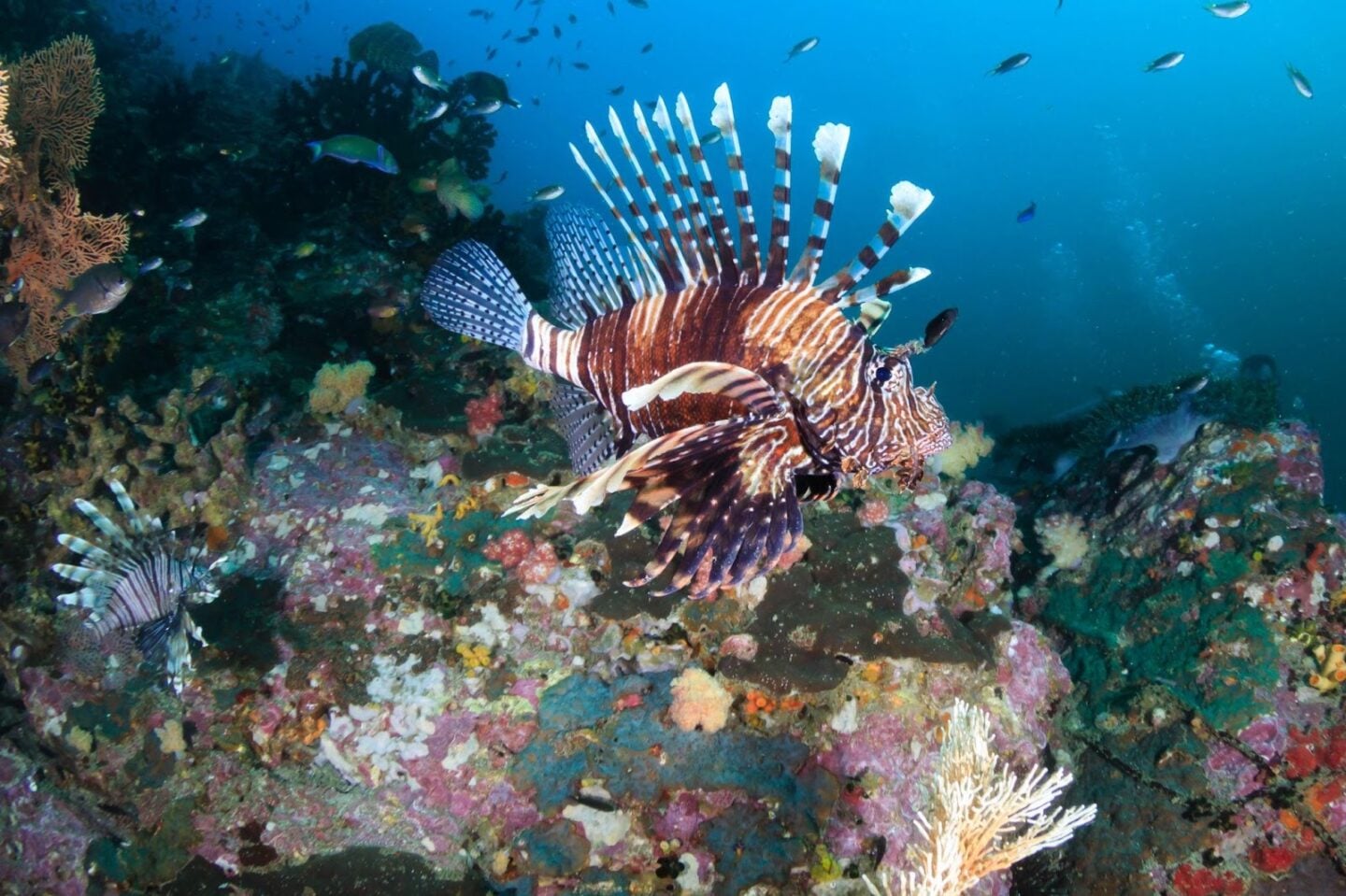
One of the main reasons lionfish are so easily recognised is their striking visual appearance.
The body of a lionfish is decorated with contrasting stripes in reddish-brown, white, and sometimes golden tones. These patterns help them blend with shadows and reef structures, which can be advantageous for both hunting and avoiding predators.
The pectoral fins are also highly distinctive. They extend outward like large fans on both sides of the body. When moving slowly around coral formations, these fins create a dramatic effect, making the lionfish appear almost decorative within the marine environment.
In addition, lionfish possess dorsal fins filled with long spines. These spines form the most important part of their defence system.
This appearance makes lionfish a popular subject for underwater photographers and divers. In underwater photography, they are frequently considered highly appealing subjects due to the combination of body colour and unique fin structure.
Venomous Spines: The Powerful Defence of Lionfish
The beauty of lionfish is not only for visual appeal. Behind their elegant fins lies a highly effective defence mechanism.
Lionfish have venomous spines located on several parts of their body, particularly:
- Dorsal fins
- Anal fins
- Pelvic fins
These spines are connected to venom glands. When a spine penetrates the skin of a predator or another organism, venom can enter through the wound.
Lionfish use their venom primarily for defence rather than hunting.
If a human is stung by a lionfish, the most common effects include:
- Intense pain
- Swelling
- Redness in the affected area
Although lionfish stings are rarely fatal, they can be extremely painful and may require medical attention.
This defence system provides a significant advantage. Many marine predators avoid lionfish due to the risk of envenomation. This helps lionfish survive in a wide range of coral reef habitats.
Read Also: Frogfish: Secretive Hunters of the Deep
How Lionfish Hunt
Although lionfish move relatively slowly, they are highly effective predators.
They feed on a variety of prey, mainly:
- Small reef fish
- Shrimp
- Small crustaceans
Most of their diet consists of small fish, although crustaceans can also form an important component depending on location and life stage.
Their hunting strategy is quite unique.
When approaching prey, lionfish often spread their wide pectoral fins. These fins act as barriers that help corner the prey.
Once the prey is within close range, the lionfish launches a rapid attack by opening its mouth suddenly and drawing the prey in.
This hunting method allows lionfish to capture prey very efficiently, even when the prey attempts to escape.
Lionfish primarily hunt alone, however may occasionally hunt in loose associations, depending on environmental conditions and prey availability.
Habitat and Natural Distribution
Lionfish naturally originate from the Indo-Pacific region, one of the most biodiverse marine areas in the world.
This region includes:
- Indonesia
- The Philippines
- Papua New Guinea
- Australia
- Southern Japan
- Various tropical islands in the Pacific and Indian Oceans
In their natural habitat, lionfish are commonly found in:
- Coral reefs
- Rocky areas
- Shallow lagoons
- Seagrass beds
- Mangroves
Their depth range varies considerably, from very shallow waters to depths exceeding 300 metres.
Coral reef structures provide both shelter and feeding grounds. Many small prey species live around reefs, making it easier for predators such as lionfish to find food.
Lionfish as an Invasive Species
Although lionfish are a natural part of Indo-Pacific ecosystems, the situation is different in other regions.
In recent decades, lionfish have spread to the Western Atlantic and the Caribbean, where they are considered invasive.
Many scientists believe this spread likely resulted from the release of aquarium fish into the sea.
After entering new ecosystems, lionfish populations have grown rapidly. Several factors contribute to their expansion, including:
- High reproductive capacity
- Highly flexible diet
- Few effective predators in invaded regions
They can have a significant impact on reef fish communities.
Because lionfish consume large numbers of small fish, increases in lionfish population size has been associated with substantial declines in some reef fish populations
This is why lionfish are often the focus of research in marine ecology and invasive species management.
Rapid Reproduction
One of the main reasons lionfish can expand so quickly in new habitats is their high reproductive capacity.
Females can produce very large numbers of eggs.
Some studies show that a single female can produce millions of eggs in one year. These eggs are released into the water column and develop into larvae that can disperse widely through ocean currents.
Lionfish larvae can remain in the water column for an extended period before settling in reef habitats.
This process allows lionfish to spread across very large geographic areas in a relatively short time.
Divers Often Notice Lionfish
For many divers, lionfish are among the easiest fish to recognise on coral reefs.
There are several reasons why lionfish frequently attract attention.
First, their movements are calm and elegant. Lionfish are often seen hovering slowly near coral with their fins spread wide, creating a very distinctive silhouette underwater.
Second, their colour patterns and fin shapes are highly unique. The combination of contrasting stripes and long, fan-like fins makes them easy to identify even from a distance.
Third, lionfish can be active both during the day and at night, giving divers a high chance of encountering them.
In many diving destinations across the Indo-Pacific, including biodiverse waters such as Raja Ampat and Komodo National Park, lionfish are often seen around coral structures, rock walls, or reef crevices. These complex ecosystems provide both shelter and ideal hunting grounds for predators such as lionfish.
For underwater photographers, lionfish are also a very popular subject due to their dramatic and expressive body shape. Their wide fins and contrasting colours make them highly photogenic, particularly in wide-angle and close-focus photography.
For divers who want to explore these reef ecosystems in greater depth, liveaboard trips often offer the best way to visit remote, life-rich dive sites. With La Galigo Liveaboard, divers are invited to explore spectacular locations in both Raja Ampat and Komodo. In places like these, lionfish are just one of many fascinating marine creatures that can be found among vibrant tropical reefs.
Read Also: Ocean Sunfish: Characteristics, Habitat and Predators of the Mola – Mola
Verdict
A beautiful predator with a powerful defence.
Lionfish are a perfect example of how beauty and survival capability can coexist within a single marine species.
Their bodies, marked with contrasting stripes and long fins, make them appear among the most elegant fish on coral reefs. However, behind this appearance lies a highly effective defence system through venomous spines.
As predators, lionfish have efficient hunting strategies and a flexible diet. These abilities help them survive in a wide range of tropical marine habitats.
In some regions, particularly outside their native range, this adaptability has made lionfish an invasive species of interest to scientists.
For divers and marine life observers, seeing a lionfish in the wild is often a memorable experience. A fish moving slowly with its fins fully extended is a reminder that the underwater world is filled with creatures that are both beautiful and remarkable in how they survive.
Lionfish may appear like living decorations on coral reefs, but in reality, they are highly efficient, adaptable and also resilient predators.
Frequently Asked Questions
What is a lionfish?
A lionfish is a marine fish from the genus Pterois, known for its long fins and venomous spines. It lives in tropical coral reef ecosystems and is a predator that feeds on small fish and crustaceans.
Are lionfish venomous?
Yes, lionfish have venomous spines on several of their fins. This venom is used as a defence mechanism against predators.
Where do lionfish live?
Lionfish naturally live in the Indo-Pacific region, including Indonesia, the Philippines, and Australia. They are now also found in the Western Atlantic and the Caribbean.
What do lionfish eat?
Lionfish are carnivorous predators that feed on small animals, including reef fish, shrimp, and other crustaceans.
Are lionfish dangerous to humans?
Lionfish are not aggressive towards humans, but their sting can cause intense pain if touched accidentally.
Why are lionfish considered invasive?
In the Western Atlantic and the Caribbean, lionfish have spread rapidly and are consuming many local fish species. This can disrupt the balance of coral reef ecosystems.
How big do lionfish grow?
Most lionfish can grow to a length of approximately 30 to 38 centimetres.
Why do divers like seeing lionfish?
Lionfish have a unique body shape and dramatic fins, making them one of the most interesting fish for divers to observe and photograph.
References
Albins, M. A., & Hixon, M. A. (2008). Feeding ecology of invasive lionfish (Pterois volitans) in the Bahamian archipelago. Environmental Biology of Fishes, 86(3), 389–398.
Côté, I. M., Green, S. J., & Hixon, M. A. (2013). Ecological drivers of invasive lionfish (Pterois volitans and Pterois miles) distribution and abundance. Frontiers in Marine Science, 6, 258.
Morris, J. A., Jr., & Whitfield, P. E. (2008). Biology, ecology, control and management of the invasive Indo-Pacific lionfish: An updated integrated assessment. NOAA Technical Memorandum NOS NCCOS 99. National Oceanic and Atmospheric Administration.
Morris, J. A., Jr., Akins, J. L., Barse, A., Cerino, D., Freshwater, D. W., Green, S. J., Muñoz, R. C., Paris, C., & Whitfield, P. E. (2008). Biology and ecology of the invasive lionfishes Pterois miles and Pterois volitans. Proceedings of the 61st Gulf and Caribbean Fisheries Institute, 409–414.
National Oceanic and Atmospheric Administration. (n.d.). Impacts of invasive lionfish. NOAA Fisheries.
National Oceanic and Atmospheric Administration. (n.d.). Lionfish facts. NOAA Ocean Service.
Rojas-Vélez, S., Tavera, J. J., & Acero, A. (2023). Biology and ecology of the lionfish Pterois volitans. Animals, 13(14), 2272.